
Introduction
Welcome to the third article of Unit 6! In this article, we’ll be covering everything about how genetic information stored in DNA is used to create proteins through the processes of transcription and RNA processing. RNA is essential in this lesson as it serves as the crucial link between DNA and proteins, carrying genetic instructions and helping assemble amino acids into functional proteins. Understanding how RNA is produced and modified is essential for understanding gene expression and how cells function!
RNA Types Determine DNA Functions
RNA (ribonucleic acid) plays several important roles in gene expression. The sequence of RNA bases and the structure of the molecule determine its specific function within the cell.
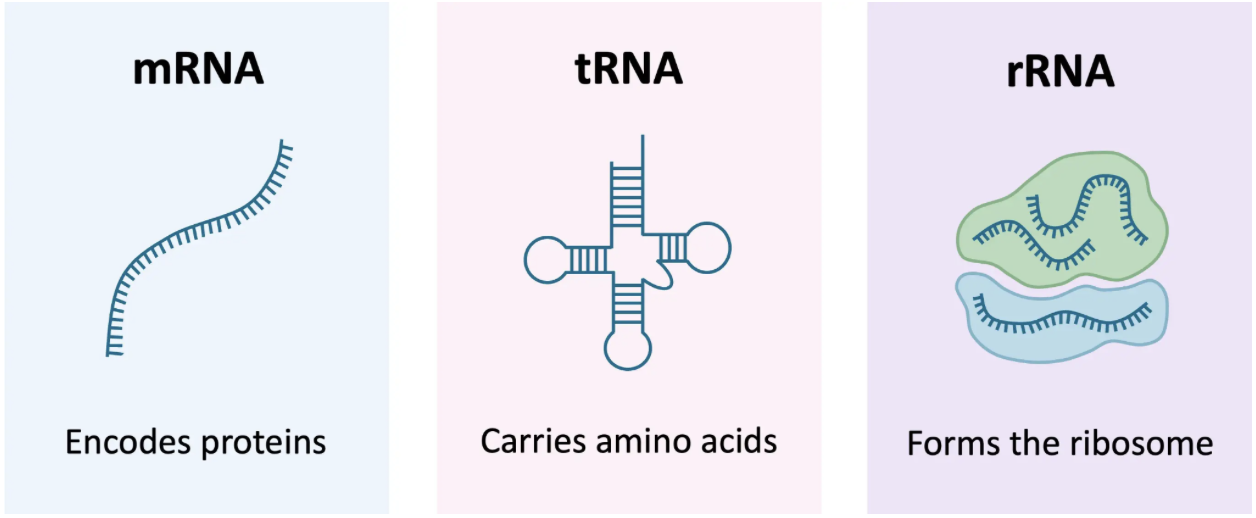
There are three major types of RNA that work together during protein synthesis:
- Messenger RNA (mRNA) carries genetic information from DNA in the nucleus to the ribosome in the cytoplasm. The sequence of bases in mRNA serves as a set of instructions that determines the order of amino acids in a protein.
- Transfer RNA (tRNA) transports specific amino acids to the ribosomes during translation. Each tRNA molecule contains an anticodon, a sequence of three nucleotides that pairs with a complementary codon on the mRNA strand. This ensures that the correct amino acids are added to the growing protein.
- Ribosomal RA (rRNA) forms the structural and functional core of the ribosomes. Ribosomes are the cellular structures where proteins are assembled. In addition to providing structure, rRNA helps catalyze the formation of peptide bonds between amino acids.
What is Transcription?
Transcription is the process by which genetic information stored in DNA is copied into an RNA molecule. During transcription, an enzyme called RNA polymerase binds to DNA and uses one strand, called the template strand, to synthesize a complementary RNA strand.
RNA polymerase then reads the DNA template strand in the 3’ → 5’ direction while building the RNA molecule in the 5’ → 3’ direction. The resulting RNA strand contains the sequence that corresponds to the genetic information encoded in the gene.
Unlike DNA replication, transcription only copies a specific gene rather than the entire DNA molecule.
The Protein Pathway
The flow of genetic information within a cell follows this pathway:
DNA → mRNA → Protein
- DNA stores the genetic information.
- Transcription creates an mRNA copy of a gene.
- Translation uses the RNA sequence to assemble a protein.
Proteins then perform a wide variety of cellular functions, including enzyme activity, structural support, transport, signaling, and regulation.
Prokaryotic Cell Transcription vs. Eukaryotic Cell Transcription
Although both prokaryotic and eukaryotic cells perform transcription, several important differences exist between the two processes.
In prokaryotes, transcription occurs in the cytoplasm because these cells lack a nucleus. As soon as an mRNA molecule begins to form, ribosomes can attach and start translation. This means that transcription and translation can occur simultaneously.
In eukaryotes, transcription takes place inside the nucleus while translation occurs in the cytoplasm. Because the two processes occur in different locations, transcription and translation cannot occur simultaneously. Before leaving the nucleus, the newly synthesized RNA must undergo several processing steps to become a mature mRNA molecule.
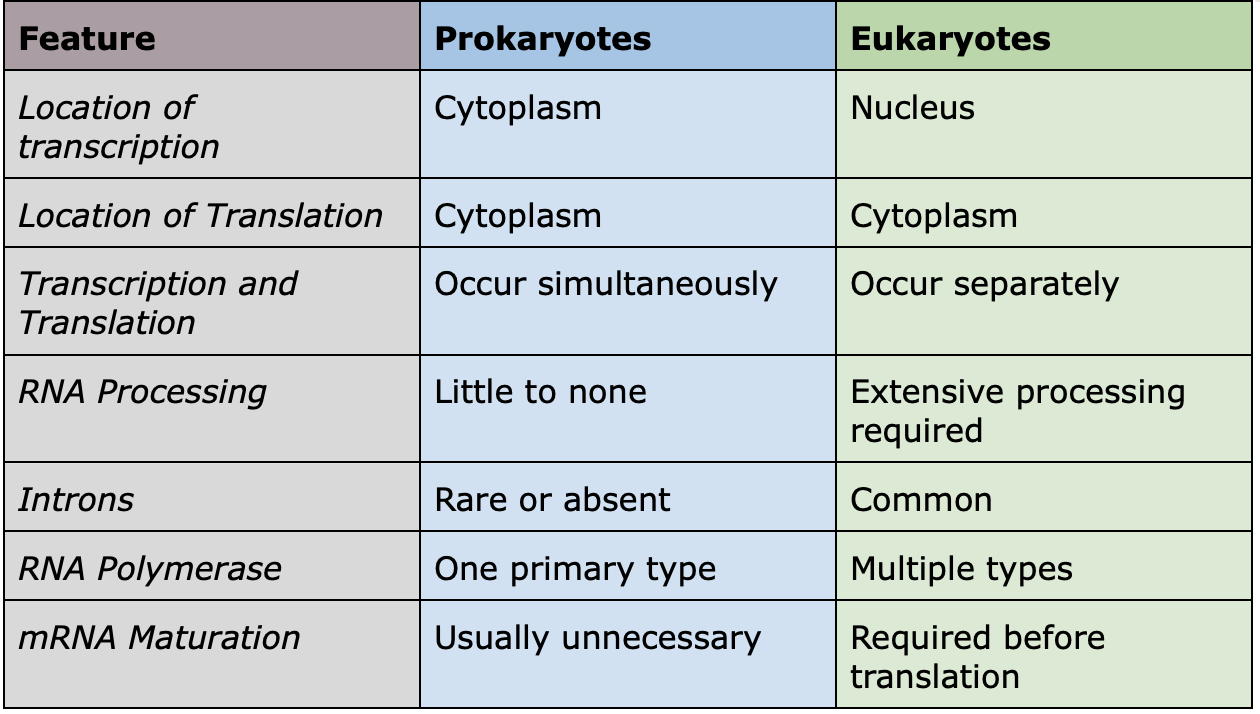
Despite these differences, both prokaryotes and eukaryotes use RNA polymerase to synthesize RNA from a DNA template strand, and both produce RNA molecules that carry genetic information used in protein synthesis.
RNA Processing in Eukaryotes
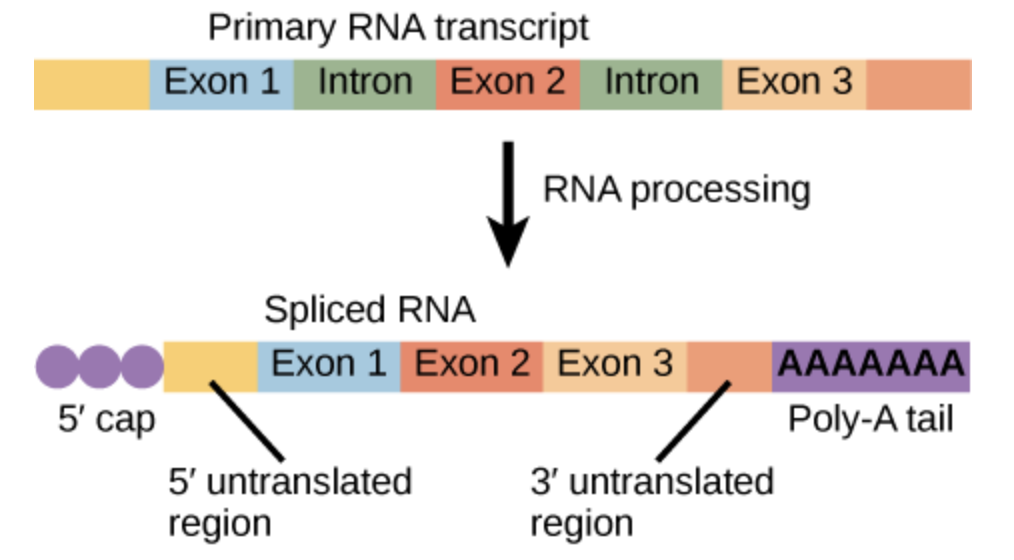
The initial RNA transcript produced during transcription is known as pre-mRNA. This molecule is not yet ready to be translated and must first undergo several modifications.
5’GTP Cap
The first modification is the addition of a modified guanine nucleotide called the 5’ cap (or GTP cap) to the beginning of the RNA molecule.
The 5’ cap serves several important functions:
- Protects mRNA from degradation by enzymes
- Helps ribosomes recognize and bind to the mRNA during translation
- Assists in transporting mRNA out of the nucleus
Poly-A Tail
At the opposite end of the molecule, a long sequence of adenine nucleotides is added to form the poly-A tail.
The poly-A tail:
- Increases mRNA stability
- Protects the molecule from enzymatic breakdown
- Helps transport the mRNA from the nucleus to the cytoplasm
Introns and Exons
Most eukaryotic genes contain both introns and exons. Exons are the portions of a gene that remain in the mature mRNA and contain information used to produce a protein. Introns are non-coding sequences that interrupt the gene’s coding information and must be removed before translation can occur.
During RNA processing, a complex called the spliceosome removes introns and joins exons together in a process known as RNA splicing. The spliceosome consists of small nuclear RNAs (snRNAs) and proteins organized into structures called small nuclear ribonucleoproteins (snRNPs) that recognize and excise introns. The resulting mature mRNA contains only the coding information necessary for protein synthesis.
Alternative Splicing
One of the most important advantages of RNA processing is the ability to perform alternative splicing.
Alternative splicing occurs when exons are joined together in different combinations. Rather than producing only one final mRNA molecule, a single pre-mRNA transcript can be processed into multiple different mature mRNAs.
As a result:
- One gene can produce multiple proteins.
- Protein diversity increases without increasing the number of genes.
- Different cell types can produce proteins specialized for their unique functions.
For instance, a nerve cell and a muscle cell may use the same gene but splice the RNA differently, resulting in different proteins being produced in each cell type.
Alternative splicing helps explain how humans can create hundreds of thousands of different proteins despite having only about 20,000 protein-coding genes.
Key Takeaways
- RNA serves as the intermediary between DNA and proteins.
- The three major types of RNA are mRNA, tRNA, and rRNA.
- During transcription, RNA polymerase synthesizes RNA using a DNA template strand.
- RNA is synthesized in the 5’ → 3’ direction while the DNA template is read in the 3’ → 5’ direction.
- Prokaryotes perform transcription in the cytoplasm with little RNA processing.
- Eukaryotic pre-mRNA undergoes extensive processing before translation.
- The 5’ cap and poly-A tail protect mRNA and aid in its transport and translation.
- Introns are removed, and exons are joined together during RNA splicing.
- Alternative splicing allows a single gene to produce multiple proteins.