Introduction
Welcome to Unit 7 of AP Biology! While Units 5 and 6 focus on how individuals reproduce and pass on their DNA, Unit 7 dives into reproduction and evolution on a larger scale. This article will cover the first 3 sections of the unit as they’re all relatively short.
- Topic 7.1 is an introduction to the concepts of natural selection and allows you to describe the relationship between natural selection and evolution.
- Topic 7.2 adds to the theory of natural selection and focuses on how phenotypic variation affects evolution.
- Topic 7.3 introduces artificial selection and how it differs from natural selection.
By the end of this article, you should be able to identify natural selection, evolution, and artificial selection as well as their differences and examples of each. So, without further ado, let’s get into it!
Charles Darwin's Theory of Evolution
In the mid-1800s, English naturalist Charles Darwin proposed the idea of descent with modification, which is now our modern definition of evolution.
Evolution is the change in the genetic material over time. Darwin originally referred to this as descent with modification, which posits that heritable traits change from one generation to the next. Darwin explained his observations using the idea of natural selection.
Natural Selection: Overview
Natural selection is a process in which individuals with certain traits tend to survive and reproduce at higher rates than other individuals due to these traits. Natural selection is a major mechanism of evolution.
Think of natural selection as bears living in Antarctica. The polar bear can survive in the cold weather because of its thick fur, but a bear without fur would die due to the cold. Pretty chilly of an idea! But because the bear with thick fur survived, it reproduces more, resulting in a larger portion of the bear population having thick fur. In the meantime, the bears that don’t inherit the trait of having thick fur end up dying out due to the intense cold. This is how natural selection affects evolution.
Another way natural selection occurs is when competition for limited resources arises. This results in differential survival, meaning that the traits that lead to survival will appear more often in the population.
An example of this is how giraffe necks became so long! Giraffes didn’t always have long necks. Over time, those with shorter necks died out due to not being able to get enough food while giraffes with longer necks survived—passing the long neck gene to the next population.
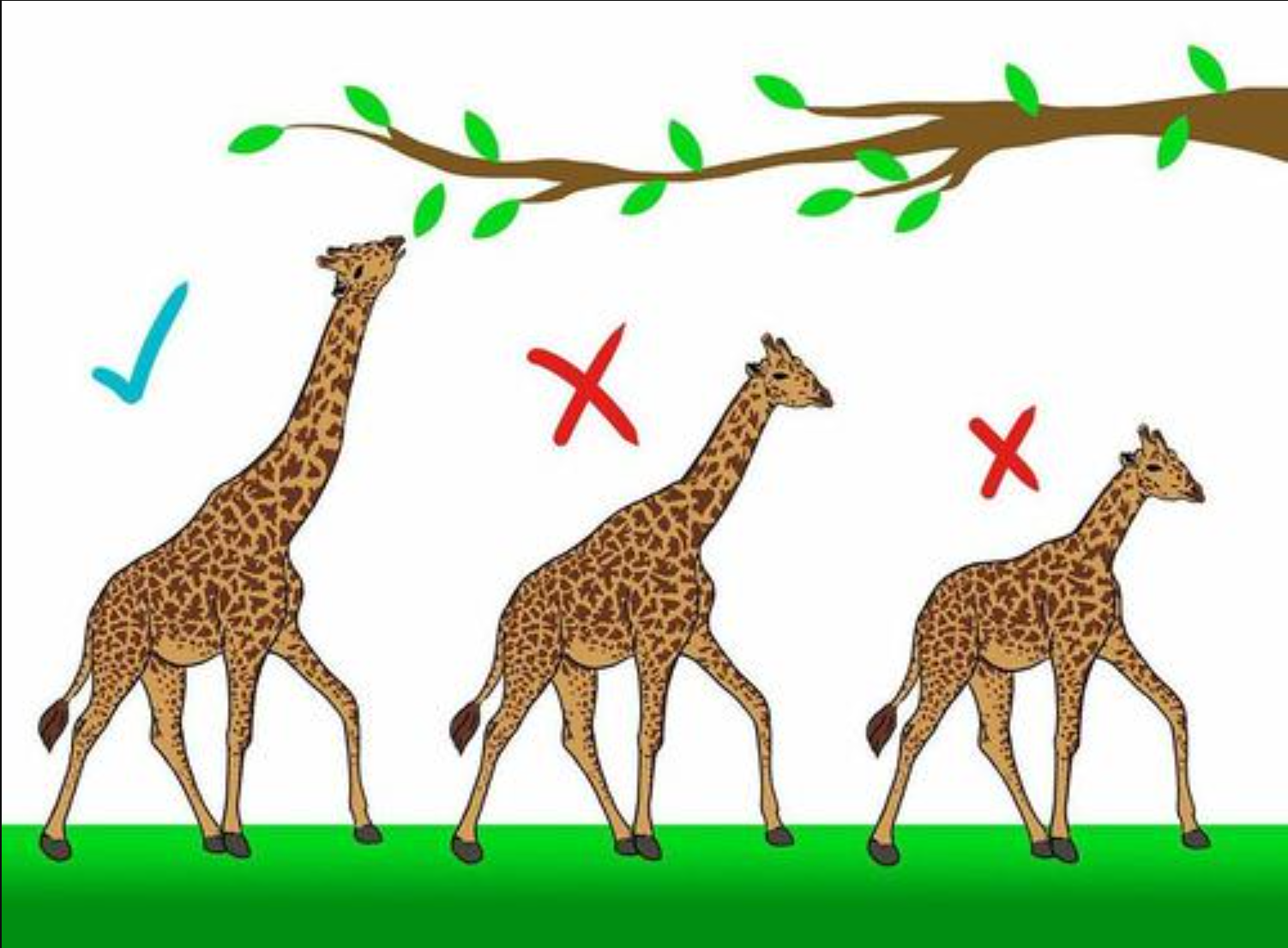
Source: Flexbooks | 10.36 Natural Selection and Populations - Advanced
As shown above, this proves Darwin’s theory of natural selections, which states that individuals (giraffes) with more favorable phenotypes (long necks) are more likely to survive and produce more offspring, passing on those favorable traits to future generations.
Natural Selection's Effects on Populations
Evolutionary fitness (an organism's ability to survive and reproduce) is measured by its reproductive success. Higher reproductive success indicates better fitness and vice versa.
As we’ve noticed in recent years, environments and their biotic and abiotic factors fluctuate, affecting evolution and creating selective pressures on populations. The evolution of an organism may slow down if it no longer requires evolution or adaptation. A great example of this is the horseshoe crab, as it has undergone barely any physical evolution in the past 480 million years. Evolution rates and directions are further explored later on in Unit 7 in Topic 7.10.
Natural Selection: Overview
To recap what we learned so far, natural selection is a process in which individuals that have certain traits tend to survive and reproduce at higher rates than other individuals because of these traits.
Natural Selection: Phenotypic Variation
Natural selection acts on phenotypic variations in populations. Some phenotypes will increase or decrease an organism's fitness, or its ability to survive and reproduce.
Bears are a great example of this. Polar bears (which have white fur) live in the Arctic, which is covered in snow, and can blend in with their environment. On the other hand, grizzly bears with brown fur live in woodlands, surrounded by trees, allowing them to blend in and survive. Both of these phenotypes enable the bear to survive in its environment. But imagine if they swapped–they’d be unable to blend in and survive, making themselves a target for predators, ultimately decreasing their fitness.
Environments can change too, causing selective pressures on populations. If a grizzly bear's forest were burnt down, it wouldn’t have trees to hide in, and it would ultimately stand out since they’re so large, making them a target for predators.
Natural Selection: Genetic Variation
Meiosis and sexual reproduction result in unique offspring that are both different and similar to their parents. The more genetic diversity in a population, the better it can respond to environmental changes, and there’s a higher chance that there are individuals that can withstand these changes. Species with low genetic diversity are at higher risk of decline and/or extinction due to not having traits that are adaptable.
For example, bacteria may have molecular differences in proteins that help with resistance to antibiotics. When the proteins make enzymes and cells that are resistant to antibiotics, the bacteria survives and passes it on to its offspring, ultimately increasing its ability to withstand environmental pressures.
Now that we’ve fully covered natural selection, it’s time that we move on and discuss the next topic—artificial selection.
Artificial Selection
Artificial selection is the selective breeding of domesticated plants and animals to encourage the concurrence of desirable traits. This type of selection is only seen in organisms affected by humans. This is basically how plants and animals are domesticated.
Dogs are entirely the result of artificial selection as every single dog breed is unnatural and entirely influenced by humans.
A tip that may help you memorize the difference between natural selection and artificial selection is that natural implies that selection happens on its own while artificial means that the selection was created through other means or with assistance. Sort of like how some foods are colored through natural dyes such as fruits while others are given their color through artificial dyes such as Red 40 in Doritos.
Conclusion
To summarize everything discussed thus far, natural selection is the process where individuals tend to survive at higher rates than others due to variation in traits. These variations can either be phenotypic or genotypic. Artificial selection is where organisms are chosen to reproduce in order to encourage the presence of a selected trait, and this can only happen through human intervention.
Practice Questions
Free Response Question
A species of rabbit lives in a snowy environment. Some rabbits have white fur while others have brown fur. Explain how natural selection would act on this population over time, and identify what would happen to the population’s genetic diversity if brown-furred rabbits were completely eliminated. Use the concepts of fitness, phenotypic variation, and selective pressure in your response.
Free Response Answer
White-furred rabbits have a phenotypic variation that increases their fitness in a snowy environment because they can blend in and avoid predators more easily. The snowy environment acts as a selective pressure, meaning brown-furred rabbits are more visible to predators, reducing their ability to survive and reproduce. Over time, white fur would become more common in the population as brown-furred rabbits die off.
If brown-furred rabbits were completely eliminated, the population's genetic diversity would decrease. This is dangerous because lower genetic diversity means the population is less equipped to respond to future environmental changes. For example, if the snow melted permanently, the all-white population would now stand out and have no brown-furred individuals to survive the new conditions, putting the species at risk of decline or extinction.
This is just an example! Here are the key points that your free response answer must hit to get full credit though:
- White hair = higher fitness; White-furred rabbits are better suited to survive in a snowy environment + Explain that white fur allows them to blend in and avoid predators.
- Defines or applies selective pressure; the snowy environment is the selective pressure acting on the population
- Brown fur = lower fitness; brown-furred rabbits are more visible and thus less likely to survive
- Connects to reproduction; surviving rabbits reproduce more, passing white fur to the next generation