
Introduction
Welcome to Topic 7.6: Evidence of Evolution, and 7.7: Common Ancestry of AP Biology. We will first cover Topic 7.6, and then cover Topic 7.7.
- Topic 7.6 dives deep into the research from several branches that support the theory of evolution
- Topic 7.7 discusses the primary evidence supporting our common ancestry with all eukaryotes.
Evidence of Evolution: Overview
Like all theories, we need evidence to support these theories. Darwin’s theory of evolution has plenty of evidence in several fields. Evolution is considered the “unifying theme of biology” because it ties together evidence and research from many branches, including (but not limited to) paleontology, morphology, biogeography, biochemistry, and direct observation.
Evidence in Paleontology
Ever wondered how we know so much about dinosaurs, even though they’re extinct? Paleontology, the study of prehistoric life through fossil records, allows us to study extinct species like dinosaurs.
Fossils are preserved remains of organisms, such as bones, footprints, and feces. While fossils may seem insignificant, they actually reveal so much more. They reveal a history of the types of organisms that have lived on Earth, including now extinct species, and the ages of those fossils.
We can estimate the age of a fossil in several ways.
Over time, things decay. In chemistry, the rate of decay of isotopes describes how fast atoms decay and can be used to calculate how old something is. Geographic data and the rate of decay allow us to find the age of a fossil and the surrounding rocks through common isotopes such as carbon-14. But how do fossils tie into evolution? Transitional fossils are used to link ancestral species to their descendants. This is critical for piecing together evolutionary history and played a crucial role in understanding our ancestors.
Evidence in Morphology
While paleontology studies dead fossils, morphology is the study of the form of living things. Ever wonder why birds and humans both have arms or wings? Our similar structures are called homologous structures and suggest evidence of common ancestry. While these structures are similar, they serve different functions due to their use in different environments. This is the result of divergent evolution. For example, birds use their wings to fly,
Most people have heard of appendicitis or have known someone who had to have their appendix removed. If the appendix is considered an organ, then why can we function just fine if it’s removed? This is because the appendix is an example of a vestigial structure, or in other words, a structure with little or no function to an organism. Vestigial structures may be remnants of an ancestor that once utilized the structure, providing evidence of divergent evolution. The appendix is believed to aid in digesting tough, fibrous foods.
After reading this, you may look at a bat and a butterfly and assume they’re closely related since they both have wings. However, this is an example of analogous structures, which are similar structures that evolved independently in different organisms due to serving similar purposes. Analogous structures differ structurally but are functionally similar due to their shared environments. The bat and the bird both evolved to have wings to fly. These structures are the result of convergent evolution and, therefore, are not related.
An image to illustrate divergent and convergent evolution is attached below.
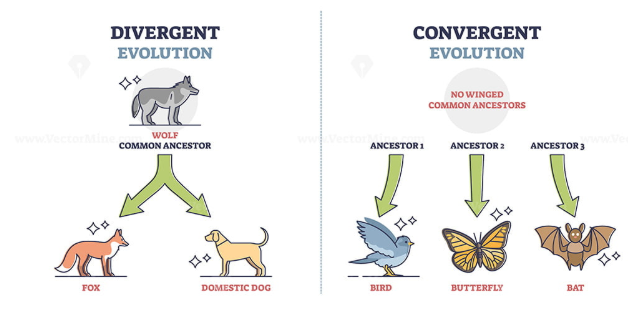
Image Source: Divergent vs convergent evolution with ancestors development outline diagram | VectorMine
Evidence in Biogeography
Biogeography is the study of the geographic distribution of plants and animals, examining where living things are located. The distribution of organisms lines up with what has been discovered about continental drift and Pangea. Species in nearby geographic areas often resemble each other, with variations tailored to their specific environments. An example of biogeographical evidence for evolution is the Galápagos Finches, otherwise known as Dariwn’s finches.
Evidence in Biochemistry
Biochemistry is the study of the chemical processes that occur in living organisms. Through biochemistry, we can analyze DNA and proteins from different species, allowing us to compare similarities and predict common ancestry. Closely related species would have similar DNA sequences. Pseudogenes also provide evidence of divergent evolution and are basically nonfunctional genes; think of them as the vestigial structures of your DNA.
Common Ancestry In Eukaryotes: Overview
All eukaryotic cells and organisms share a common ancestor. Yes, that means you and a stink bug are related in some way. The similarities in all eukaryotic cells, DNA, and genes support this claim.
Evidence of Common Ancestry
In Unit 2, we discussed the structure of eukaryotic cells. All eukaryotic cells have membrane-bound organelles (nuclear envelope, endoplasmic reticulum, Golgi complex, lysosomes, vesicles/vacuoles, plasma membrane, etc.)
Another significant piece of evidence supporting common ancestry is in our own DNA. To revisit units 5 and 6, DNA carries our genetic information, and all living systems share the genetic code. In eukaryotic cells, DNA is primarily found in the nucleus and exists in the form of linear chromosomes.
While on the topic of DNA, only eukaryotic cells contain introns that are spliced from RNA sequences during transcription and RNA processing.
So, what’s the point of pointing out all these similarities? All of these consistencies among eukaryotic cells suggest that eukaryotic cells inherited these traits from a common ancestor rather than through independent lineages, ultimately serving as strong evidence of common ancestry.
Conclusion
Throughout unit 7, we’ve discussed evolution in depth. Evolution is supported through evidence from several fields, including but not limited to paleontology, morphology, biogeography, biochemistry, eukaryotes, and common ancestry. To reiterate, 7.6 & 7.7 serves as supporting evidence for evolution and is not intended to conflict with personal beliefs or persuade one to agree or disagree with evolution.