
Welcome to 1.14, and today we will be looking into the behavior of functions more. We will be working with a lot of vertical asymptotes in this chapter, so let’s get a quick review so we aren’t confused.
A vertical asymptote occurs when a function goes to infinity or negative infinity.
What this means is that if you look at a graph and it shoots straight up to infinity or down to negative infinity, that would be considered a vertical asymptote. For example, where is the vertical asymptote in this graph?
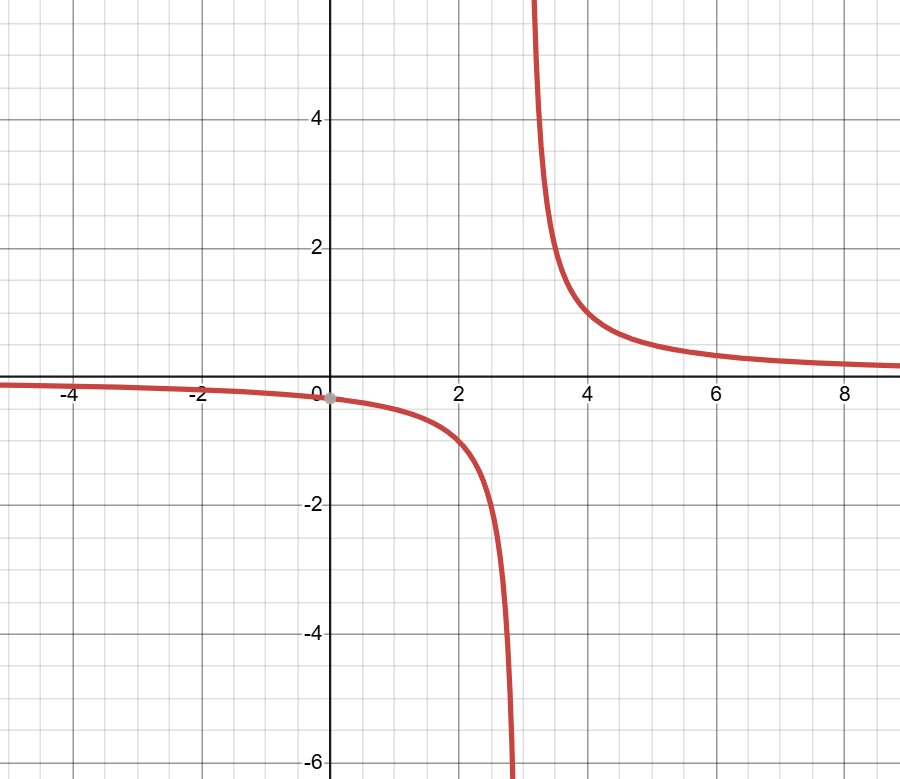
Notice that the graph shoots to infinity and negative infinity at , which means that at , there is a vertical asymptote. Let’s play the game again! Where is the function’s vertical asymptote?
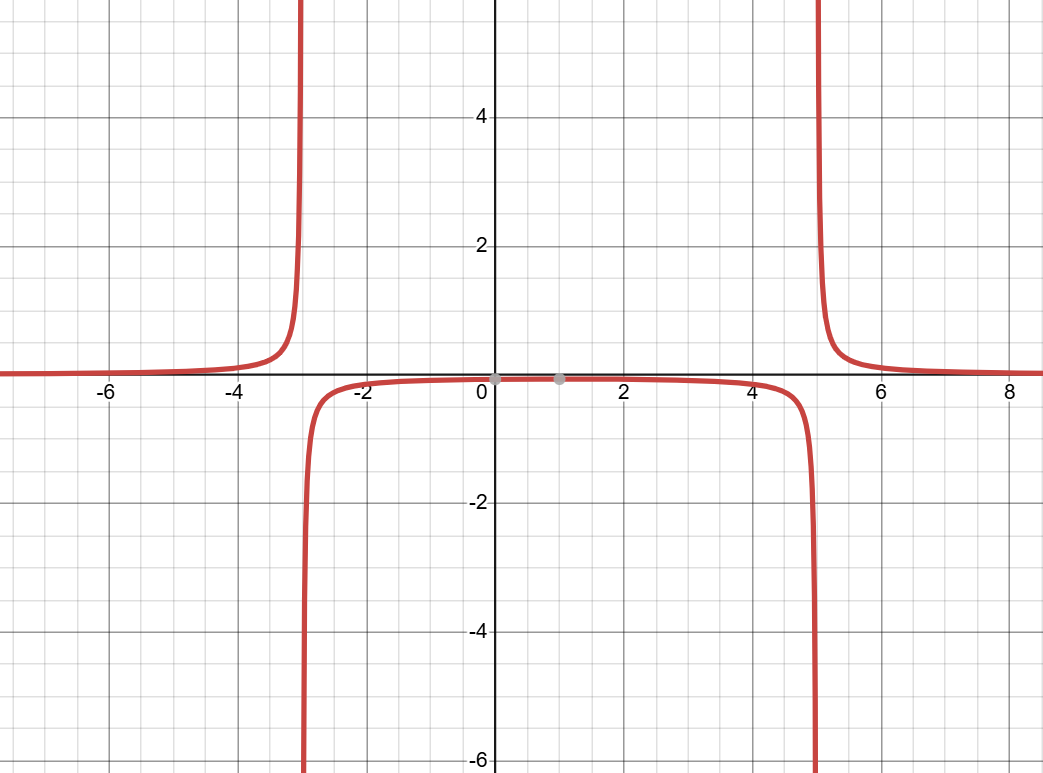
Notice how there are two places where the function goes to infinity and negative infinity. One is at , and the other at . Let’s try another function.
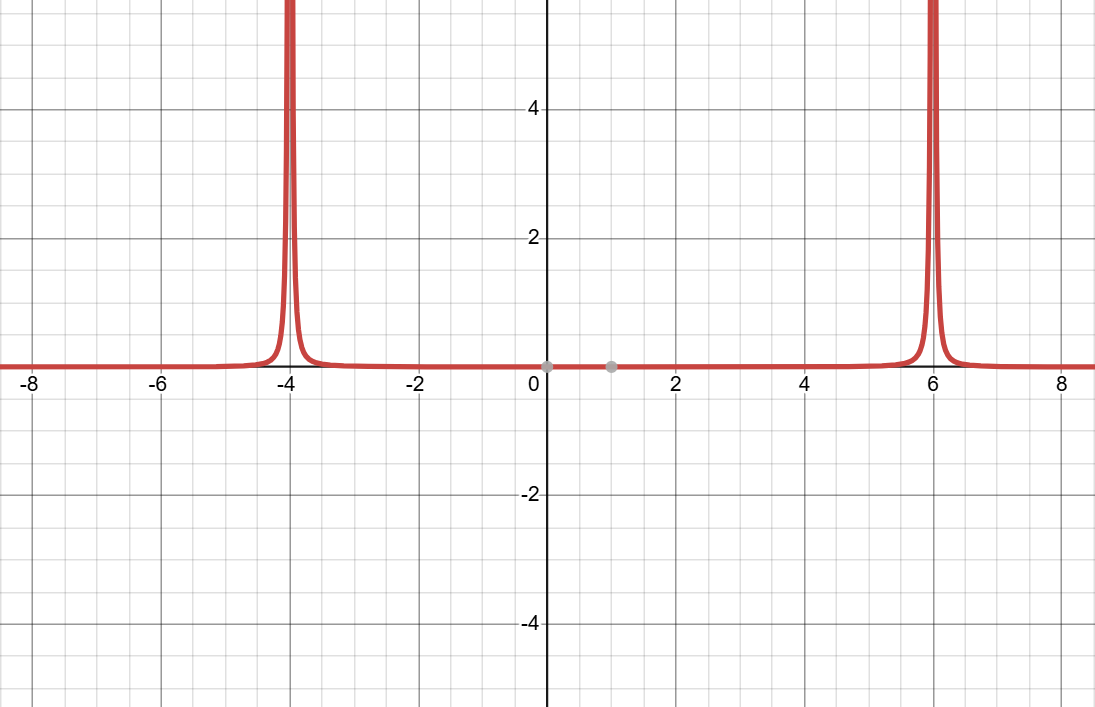
The function here seems to have two points where it shoots straight up to infinity, but there’s no part of the asymptote that goes down to negative infinity. Does this mean that at and , there’s no vertical asymptote? Nope! If both sides of the vertical asymptote shoot to infinity, or negative infinity, that is still considered a vertical asymptote!
Every vertical asymptote will result in the function being discontinuous, so a fully continuous function like or naturally wouldn’t have any asymptotes because they don’t have any discontinuities. Even if both sides go towards positive infinity or negative infinity, the function is still not continuous.
To find the vertical asymptote provided with the mathematical expression, all you need to do is find when the denominator is . If at any point the denominator of a function is equal to , then you can say there is a vertical asymptote. The only exception to this is if the numerator is also equal to at the same time.
For example, , plugging in results in . Both the denominator and numerator are equal to , so there is no certainty that there is a vertical asymptote. Take note that I said certainty, not possibility. If this occurs, then you will have to go through some extra steps to verify if a vertical asymptote is present or not.
Now that we have an understanding of vertical asymptotes, let’s start applying them to limits!
Example 1: Calculate
First, let’s confirm if we are even working with a vertical asymptote. If we plug in , we get . The denominator is and the numerator isn’t , so that means that there is a vertical asymptote present.
To solve this limit, we can figure out how the function is going to change by plugging in values of . The limit can go to infinity or negative infinity, so we will need to figure out which one. Because we are going from the right side, the values of should be greater than and close to
Plugging in into the expression, we will get . Notice that our expression is a large negative number, so it is safe to say that
Example 2: Calculate
First step, let’s even verify that there is a vertical asymptote at . For this function there seems to be no denominator, but if we use trigonometric identities we actually will find that there is a denominator.
We can use the form of to determine if the function will have a vertical asymptote at . Plugging in , we get . This means that there is a vertical asymptote at this point. Because this limit isn’t one sided, we will have to figure out if both sides of the asymptote go in the same direction. If both sides of the asymptote don’t go in the same direction, the limit would be undefined because both sides of the limit don’t match. Going from the left side, we can plug in a familiar value that is close to , like . We know that , so . Although it isn’t necessarily a large number, it is a positive number which suggests that the function goes towards positive infinity.
We can also analyze the behavior of the function just to make sure. Remember that at , , and the value slowly goes down until it is at . This means that as the value of gets smaller and smaller and closer to , is going to be infinitely large in the positive direction. Going from the right side, we can analyze the behavior of the function. Remember that past , starts to become negative. This means that close to , the value of will approach but will be negative. This means that is a large negative number, or negative infinity. Notice that from the left side, we conclude that the function goes to positive infinity, but the function from the right goes to negative infinity. This means that the limit does not exist because both sides approach different infinities.
Example 3: The graph below is the function . Find and
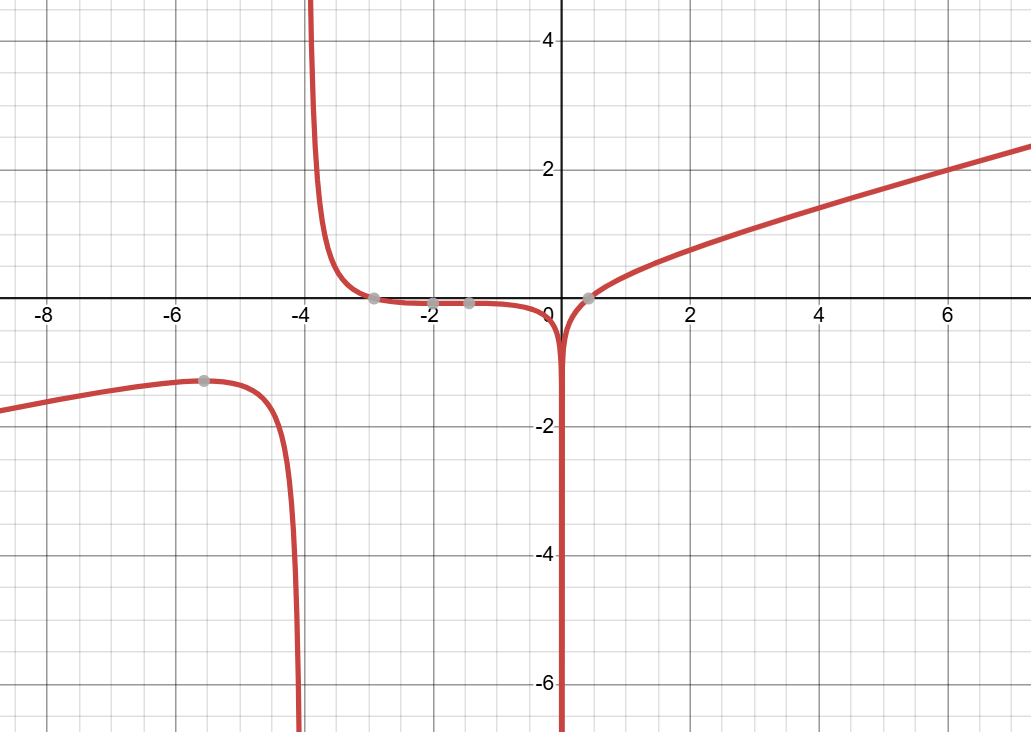
Let’s solve for . If we look from the left and right sides of the function, notice how they approach different sides. From the left side, the function goes towards negative infinity. From the right side, the function goes towards positive infinity.Now for . If we look from the left and right side of the function, both seem to approach negative infinity. From the left, it goes straight down. From the right, it goes straight down. This means that
Practice
Now it is time for some practice: