
Introduction
In the last article, we began talking about rules for taking the derivative of basic power functions. However, if you know anything about math, there are many different types of other functions and we will be taking a look at another set of function types.
Let’s take a look at the first rule, which is a simple one.
Constant Rule
The Constant Rule:
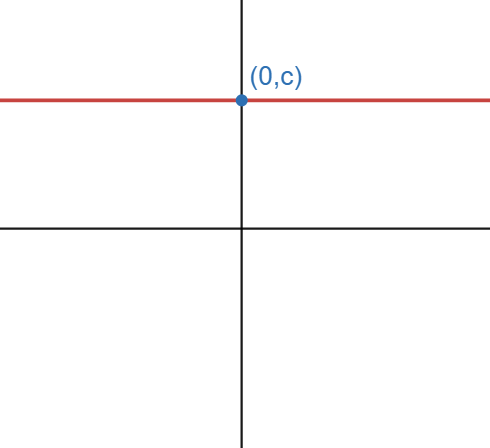
represents a constant, such as or . If you think about the graph of , then you may realize that it is simply a straight line. Because this straight line doesn’t go up or down, it doesn’t change and will have a derivative of throughout.
Sum/Difference Rule
The Sum/Difference Rule:
This rule allows you to split functions if their terms are separated by a plus or minus sign. Do take note that you cannot split multiplication and division the same way, as different methods are used for them instead.
If you wonder why this works, think about the functions. If were to increase by a certain amount, would increase by that amount. The same thing goes with . If they were to decrease by a certain amount, the whole function would decrease by their amounts added up. You can think about this as adding up the slopes of the function.
Constant Multiple
The Constant Multiple Rule:
We can apply a similar intuition where if a function is multiplied by a certain number, its slope will also be multiplied by that number. This is mathematically reinforcing this concept.
Knowing all these rules can help us differentiate functions such as polynomials, and that’s really it at the moment.
Differentiating a Polynomial
Example 1:
Calculate the derivative of with respect to
Notice that the function can be split into different components, as each term is separated with a plus or minus sign. This makes calculations significantly simpler to perform.
Do take note that is simply . The power rule is applicable here.
Derivative of a Polynomial at a Point
Consider . Calculate .
We have found just now, so it will allow us to easily plug in different points and make calculations much easier and quicker.
.
Compared to the limit definition, it is a lot easier to do so.
Derivative of Other Functions
Example 2:
Calculate the derivative of with respect to .
Did you get ? Unfortunately, you are wrong. Notice that all of the terms are secretly just constants, and so we have a case which means that the derivative is going to be .
Differentiating a Taylor Polynomial
Example 3:
The fourth order Taylor polynomial centered around for is . Calculate .
You are very likely not familiar with a Taylor polynomial, but you do have the details of the function. As long as you know what function you are differentiating, you can differentiate it if it applies. In this case, a polynomial is perfectly differentiable!
These rules can be used to solve trickier problems which don’t give the full function(s) too.
Conceptual Differentiation Problem
Example 4:
.
Calculate .
Notice how although we do not have the full functions and exactly what they are, we know their derivatives at the desired point, and so we can solve it.
.
Please make sure to not plug in the desired point only. Only plug in the desired point into the function once you have found the derivative. If you do make this mistake, you are very likely to get a different answer.
Practice
To conclude, this rule along with the power rule will allow you to differentiate a lot of things with a lot more speed.