
Introduction
This topic explores extrema (maximum and minimum values) of functions and introduces critical points. The essential knowledge tells us that if a function is continuous over the interval , then the Extreme Value Theorem guarantees that has at least one minimum value and at least one maximum value on , a point on a function where the first derivative equals zero or fails to exist is a critical point of the function, and all local (relative) extrema occur at critical points of a function, though not all critical points are local extrema. Understanding these concepts is fundamental to analyzing function behavior.
The Extreme Value Theorem
Statement of the Theorem
Extreme Value Theorem (EVT): If is continuous on the closed interval , then has both:
- An absolute (global) maximum value
- An absolute (global) minimum value
on that interval.
Key Point: The EVT guarantees existence but does not tell us where these extrema occur or what their values are.
Real-World Example: Imagine the graph is like a hill. no matter if you're going up or down there's always a time where you're higher than any other time, same for the bottom.
Why Continuity and Closed Intervals Matter
The EVT requires BOTH conditions:
- The function must be continuous
- The interval must be closed (includes both endpoints)
Example 1:
Consider on .
is continuous on (polynomial) ✓
By the EVT, has a maximum and minimum on .
Minimum: at
Maximum: at
When the EVT Does Not Apply
Example 2:
For on :
is not continuous at (undefined there).
The EVT does not apply. Indeed, has no maximum value on this interval (it approaches as ).
Example 3:
For on (open interval):
is continuous, but the interval is not closed.
The EVT does not apply. The function has no maximum or minimum on the open interval (it approaches but never reaches and ).
Critical Points
Definition of Critical Points
A critical point of is a value in the domain where:
- , OR
- does not exist (undefined)
Important: Critical points are -values, not points .
Finding Critical Points
Example 4:
Find all critical points of
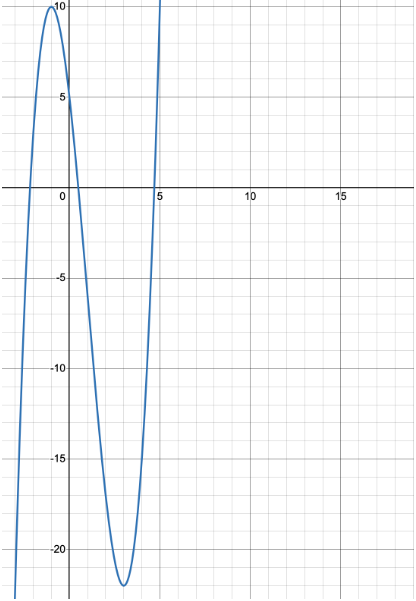
Find :
Set :
or
The derivative exists everywhere, so the critical points are and .
You can see patterns using the graph. Look where the visible changes in the graph are, and then look at the critical points.
I highly recommend you to graph the following examples to see the visuals for yourself.
Example 5:
Find all critical points of .
Find :
Set : has no solution
Check where is undefined: is undefined at
The critical point is .
Global (Absolute) Extrema
Definition
Global Maximum: is a global maximum if for all in the domain.
Global Minimum: is a global minimum if for all in the domain.
Finding Global Extrema on Closed Intervals
For a continuous function on , global extrema occur at:
- Critical points in
- Endpoints or
The Candidates Test:
- Find all critical points in
- Evaluate at critical points and endpoints
- The largest value is the global maximum
- The smallest value is the global minimum
Example 6:
![[IMAGE: Desmos graph of g(x) = x³ - 6x² + 9x + 2 on [0, 5]]](https://firebasestorage.googleapis.com/v0/b/ap-students-32bbe.appspot.com/o/images%2F1759804816097_image.png?alt=media&token=de09a81c-0bc4-45a6-8e20-d693446c7ad9)
This graph shows how to find global (absolute) extrema on a closed interval.
The function has critical points at and (mark these with points in Desmos). To find global extrema, we must check: (1) the critical points and , and (2) the endpoints and .
Evaluating:
The global maximum is at (an endpoint!), and the global minimum is , occurring at both and . This demonstrates that global extrema can occur at either critical points or endpoints.
Local (Relative) Extrema
Definition
Local Maximum: is a local maximum if for all near .
Local Minimum: is a local minimum if for all near .
Local extrema are "peaks and valleys" - they don't have to be the highest or lowest points overall.
Key Theorem About Local Extrema
If has a local extremum at , then is a critical point.
This means: All local extrema occur at critical points.
However: Not all critical points are local extrema!
Example 7:
For :
Find critical points:
At , the function has a critical point, but it's neither a local maximum nor minimum (it's an inflection point).
Distinguishing Local from Global
A global extremum is also a local extremum, but a local extremum may not be global.
Example 8:
For on :
Critical points:
Evaluate:
(local maximum)
(local minimum)
At : local maximum of (tied for global maximum)
At : local minimum of (tied for global minimum)
Analyzing Critical Points
Types of Critical Points
A critical point can be:
- A local maximum
- A local minimum
- Neither (like an inflection point or saddle point)
Editor's Note: A saddle point in this context occurs when there is an inflection point with a horizontal tangent, eg on .
Example 9:
Find critical points:
or
Analyze each:
- At : Looking at values near 0, this is neither a max nor min (inflection point)
- At : is a local (and global) minimum
Using Test Points
To determine if a critical point is a local extremum, check the sign of around it:
Local Maximum: changes from positive to negative
Local Minimum: changes from negative to positive
Neither: doesn't change sign
Example 10:
For with critical points and :
Test intervals:
- : (increasing)
- : (decreasing)
- : (increasing)
At : changes from to , so local maximum
At : changes from - to +, so local minimum
Justifying Extrema Claims
Complete Justification Process
To justify that a value is an extremum:
- Find all critical points
- Evaluate the function at critical points and endpoints (if applicable)
- Compare values to identify the extremum
- State the conclusion with proper reasoning
Example 11:
Justify that has a local maximum at on the interval .
Find critical points:
or
Test signs around :
- For : (increasing)
- For : (decreasing)
Since changes from positive to negative at , the function has a local maximum at .