
Introduction
This topic explores how to determine the concavity of functions using derivatives. The essential knowledge tells us that the graph of a function is concave up (down) on an open interval if the function's derivative is increasing (decreasing) on that interval, the second derivative of a function provides information about the function and its graph, including intervals of upward or downward concavity, and the second derivative of a function may be used to locate points of inflection for the graph of the original function. Understanding concavity helps us analyze the shape and behavior of function graphs.
Understanding Concavity
Visual and Mathematical Definitions
Concave Up: A function is concave up on an interval if the graph curves upward like a cup (∪). The tangent lines lie below the graph.
Concave Down: A function is concave down on an interval if the graph curves downward like a cap (∩). The tangent lines lie above the graph.
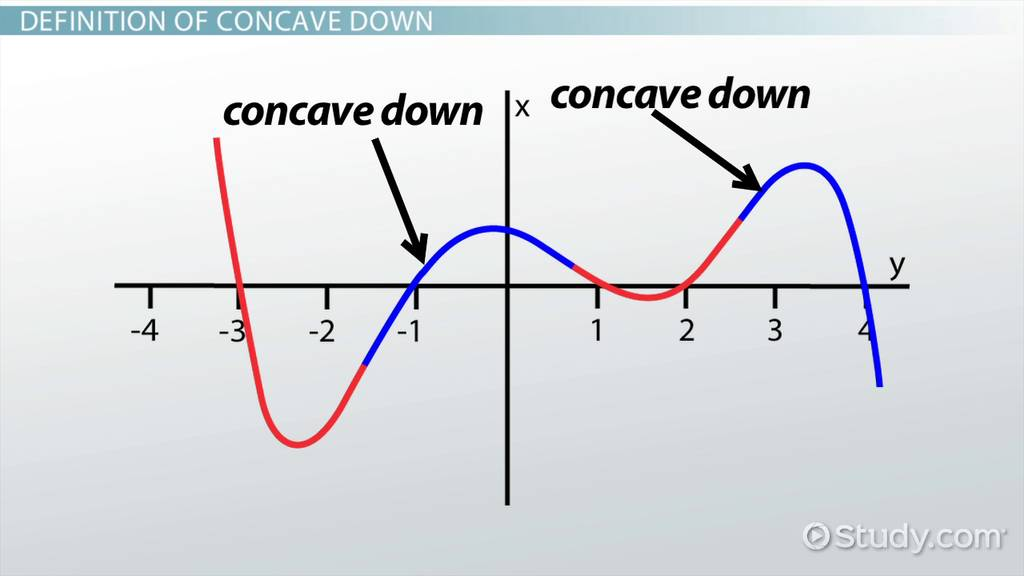
Taken from Study.com
Mathematical Definition (using ):
- Concave up when is increasing
- Concave down when is decreasing
Example 1:
For :
is increasing for all (since the slope of is positive).
Therefore, is concave up on .
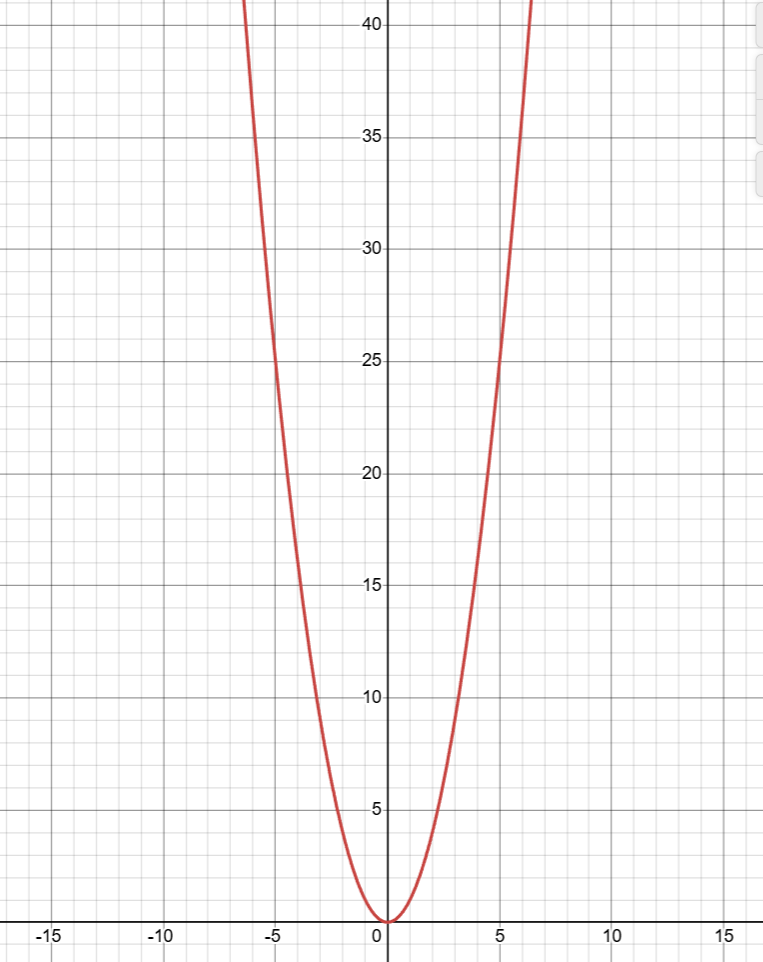
Taken from Desmos
Using the Second Derivative to Determine Concavity
The Second Derivative Test for Concavity
Since concavity depends on whether is increasing or decreasing, we use the derivative of (which is ) to test:
If on an interval, then is concave up on that interval.
If on an interval, then is concave down on that interval.
This works because:
- means is increasing
- means is decreasing
Finding Intervals of Concavity
Procedure:
- Find
- Find where or is undefined
- Create a sign chart for
- Determine the sign of on each interval
- Conclude about concavity
Example 2:
Determine where is concave up and concave down.
Find :
Find :
Find where : , therefore
Test intervals:
- For (test ):
- For (test ):
Conclusion:
- Concave down on
- Concave up on
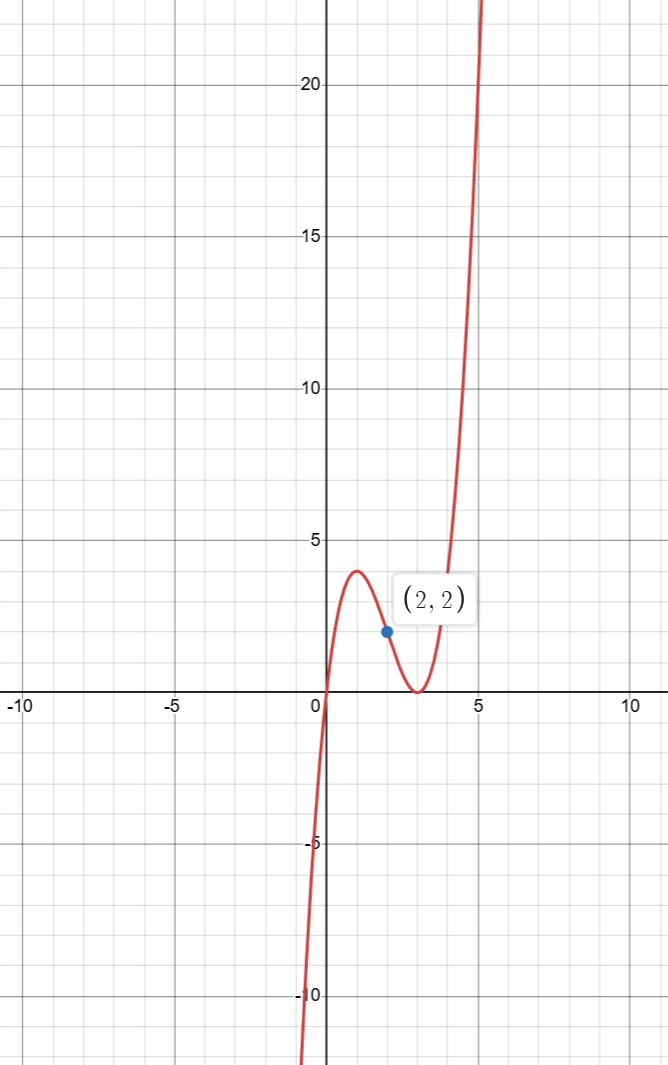
Taken from Desmos
Points of Inflection
Definition and Identification
A point of inflection is a point where the concavity changes (from concave up to concave down, or vice versa).
Requirements for a point of inflection at :
- or is undefined
- The concavity changes at
Important: Just because does NOT guarantee a point of inflection. The concavity must actually change.
Example 3:
Find all points of inflection of .
Find :
Potential inflection points where : and
Test concavity:
- For : (concave up)
- For : (concave down)
- For : (concave up)
At : concavity changes from up to down → inflection point
At : concavity changes from down to up → inflection point
Points of inflection: and
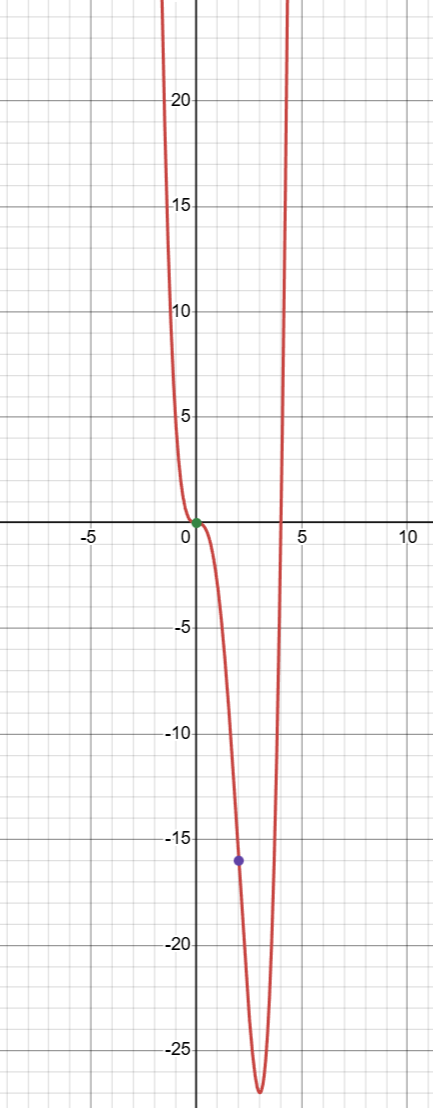
Taken from Desmos
When Points Are Not Inflection Points
Example 4:
Determine if has an inflection point at .
Find :
Set :
Test concavity:
- For : (concave up)
- For : (concave up)
At : concavity does not change (remains concave up).
Therefore, is not a point of inflection, even though .
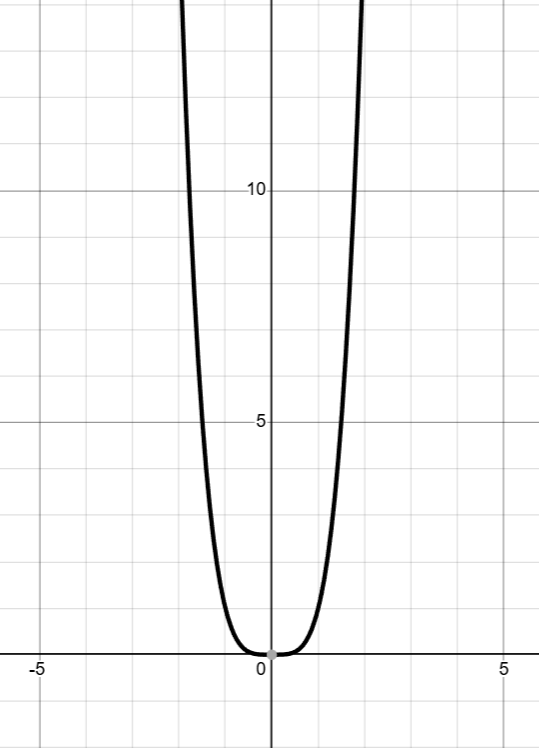
Taken from Desmos
Analyzing More Complex Functions
Functions with Multiple Inflection Points
Example 5:
Find intervals of concavity and inflection points for .
Find :
Potential inflection points: and
Test concavity:
- For : (concave up)
- For : (concave down)
- For : (concave up)
Concavity:
- Concave up on and
- Concave down on
Inflection points: and
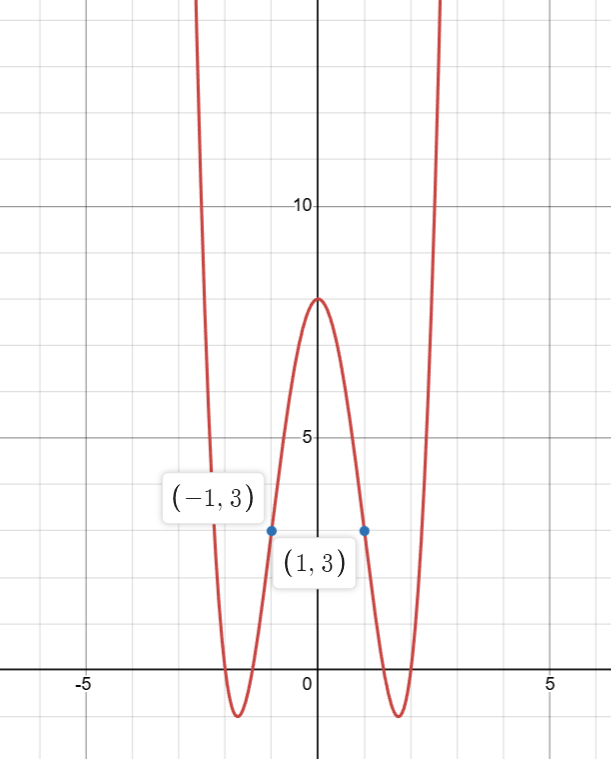
Taken from Desmos
Trigonometric Functions
Example 6:
Determine the concavity of on .
Find :
Find where :
Test concavity:
- For : (concave down)
- For : (concave up)
Concavity:
- Concave down on
- Concave up on
Inflection point:
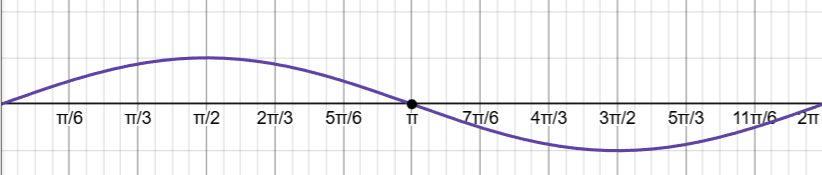
Taken from Desmos
Relationship Between f, f', and f''
Complete Analysis
Understanding the relationships:
- → increasing
- → decreasing
- → concave up (and increasing)
- → concave down (and decreasing)
Example 7:
For , describe the behavior at .
Find derivatives:
At :
Interpretation:
- means horizontal tangent (critical point)
- means concave up
- Since the function is concave up with a horizontal tangent, this is a local minimum