
Introduction
Welcome to this guide on the Fundamental Theorem of Calculus, this article will guide you through the Fundamental Theorem of Calculus and its applications:
Fundamental Theorem of Calculus
Consider a continuous function on the interval of , then
Where , function is known as the antiderivative of . This word will appear multiple times in this lesson and lessons after it.
The theorem above is called the Fundamental Theorem of Calculus (FTC for short). This is a very powerful theorem, as it links differentiation and integration, the two fundamental operations in calculus.
Note this theorem can also be written as
Here is equivalent to
Example 1:
Evaluate
To evaluate this definite integral, we first need to find a function that has a derivative of , recall from Unit 2 that has a derivative of , thus by the Fundamental Theorem of Calculus:
Applications of FTC
Application of Fundamental Theorem comes in various different questions, first we will take a look at finding a function defined with an variable integration bound.
Example 2:
Find the polynomial function defined by
At first glance it seems weird that the variable is on the upper bound, which sounds absurd. But let's pretend that is a number and use FTC to solve integral
Therefore .
This question inspires us to recognize that when a variable is on the integration bound, it means the integral will be a function of the variable, or:
Where again and is a number.
On the exam, you might also encounter questions that ask you to find the value of a function at a point.
Example 3:
is an antiderivative of , if , find an expression that equals to
In order to solve this problem, let's first use FTC:
Notice here appears, so we can easily find an expression for :
This type of question can also come in tabular form
Example 4:
Consider a function and its derivative :
Find the value of
We know that by FTC:
From the table, and , thus
This type of question can also come in the form of graphs.
Example 5:
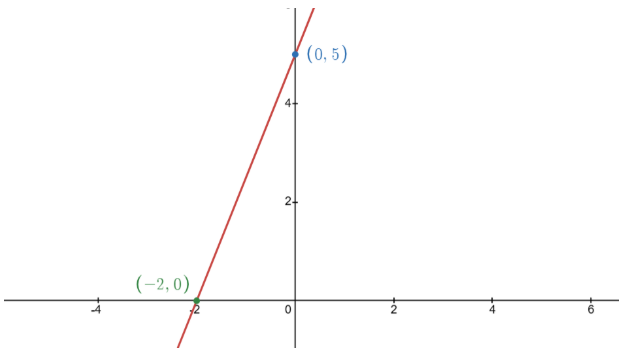
Consider a function with a derivative of . If this is the graph of and , find .
First, by FTC we have
Thus
By the geometric meaning of integrals, is the area under the curve of , which is the triangle formed by the graph of and the coordinate axis.
This offers a way to calculate the integral, the area of the triangle is simply , thus the integral also equals to , meaning