
Introduction
Welcome back! Today, we’ll be going over how integrals are used to find position, velocity, and acceleration from each other. The main purpose of integrals in this scenario is to help with solving problems that involve accumulating change over an interval. The main examples of this would be describing the motion of particles, like a ball thrown into the air.
As mentioned by the essential knowledge, the definite integral of velocity over an interval gives us displacement on that interval, and the definite integral of speed over an interval gives us the total distance on that interval. When mentioning speed and velocity, we are referring to the functions that give us the speed and velocity of a particle. Therefore, integrating these functions over a specific interval gives us the total distance traveled by the particle and the displacement of the particle respectively on that interval.
Position, Velocity, and Acceleration
As you may or may not already know, position, velocity, and acceleration can be described as the functions , , and . Furthermore, velocity can be found by taking the derivative of position, and acceleration can be found by taking the second derivative of position (derivative of velocity). Since we know that integrals are antiderivatives, it makes sense that integrating acceleration gives us velocity, and integrating velocity gives us position. For this topic however, we will be integrating speed, which is actually the absolute value of velocity.
Total Distance
Total distance simply means the total distance traveled by an object over a specific period of time. As mentioned earlier, the total distance traveled by a particle can be found by taking the definite integral of the speed function over a specific interval.
Formula:
For the interval , the total distance traveled by a particle is given by
Example
- Find the total distance traveled by the particle whose velocity is given by on the interval .
Explanation:
To find total distance, we have to integrate speed, which is the absolute value of velocity The resulting expression is
Normally, integrating an absolute value function would require us to split the integral into two separate integrals, one for the positive values and one for the negative values. However, on the interval , is always positive, meaning we can ignore the absolute value sign and proceed as normal.
Integrating the expression gives
Plugging in:
Simplifying:
Answer:
Therefore, the total distance traveled by the particle on the interval is
Normally, you would integrate with respect to time when dealing with motion and use the correct units, but since this is an example, it’s integrated with respect to for simplicity.
Displacement
The main difference between total distance and displacement is that while total distance removes all negative distances using the absolute value function, displacement includes the negative values. A way to think of this is imagine you are driving on a highway from City A to City B. Total distance would be how much your car traveled while displacement would be the length of a straight line from City A to City B.
The main way this is applied to functions is when integrating. Since integrals measure the area between the graph and the -axis, if the graph goes into the negative values, the resulting area will be negative as well. Total distance takes these negative areas and puts them into the absolute value function, making them positive. This is why our formula for total distance includes the velocity function inside an absolute value sign. On the other hand, displacement leaves these negative areas as is, which is why there is no absolute value sign in our formula for displacement.
Picture Example:
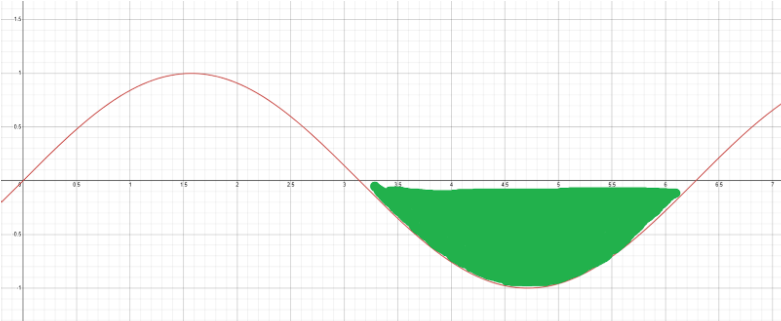
The above picture is the graph of the sine function on the interval [0, 7], and the green portion represents the negative area that displacement takes into account and total distance negates.
Example
- Find the displacement of the particle whose velocity is given by the function on the interval .
Explanation:
To find displacement, we simply integrate the velocity function over the specified interval, which is in this case.
This gives us the integral , which integrates to
Plugging in:
Answer:
The displacement of the particle whose velocity is given by the function on the interval is .
Practice
Now that we’ve gone over how to find both total distance and displacement, as well as done an example for each, let’s do some practice problems.
1. Find the total distance traveled by the particle whose velocity is given by the function from = 1 second to = 4 seconds.
2. Find the displacement of the particle whose velocity is given by the function from = 2 seconds to = 6 seconds.
3. If the position of a particle at a given time is given by the function , what is the displacement of the particle from = 0 seconds to = 4 seconds?
Practice Answers
1. Total distance is the integral of absolute value of velocity on the interval, so we integrate on the interval and get .
Plugging in our values gets us .
Simplifying gives , which becomes , then , which is our final answer.
2. Displacement is integral of velocity, so we integrate on the interval and get .
Plugging in values gives us .
Simplifying gives us , which gives us our final answer of .
3. In this case, we have to take the derivative of the position function, and then integrate the derivative. These two pretty much cancel out, with the only difference being that the from the position function is removed. This is because it gets turned into 0 when we take the derivative, and isn’t brought back when we integrate because we’re using a definite integral. Essentially, we basically get
Plugging in gives us
Simplifying gives us , which simplifies to our final answer of .