
Introduction
Welcome back! Today, we’re going to cover one of the most important topics in calculus, namely finding the area between two functions. Although you can calculate area for both functions of and functions of , we’re going to be sticking to functions of for now. Now although this seems like it would be difficult, it’s actually pretty simple. All you do is take the definite integral of the top function (the one with higher values on the interval) minus the bottom function (the one with lower values on the interval). The main use of this concept is basically an extension of finding the area under a curve, which is mostly used for calculating net change in systems.
The method for finding the area between curves for functions of is as follows: Given two functions and on the interval , and is higher on the interval, the area between the curves can be calculated using the formula . In most cases, the bounds of the integral will have to be found by setting both functions equal to each other and seeing where they intersect.
Finding Area
Now why does this work? As you may remember, if we have an integral like , we can split it into . This is the same principle we use in our formula. By calculating the area under and the area under and subtracting ’s area from ’s area, we are able to find the area between the two curves.
Picture Example
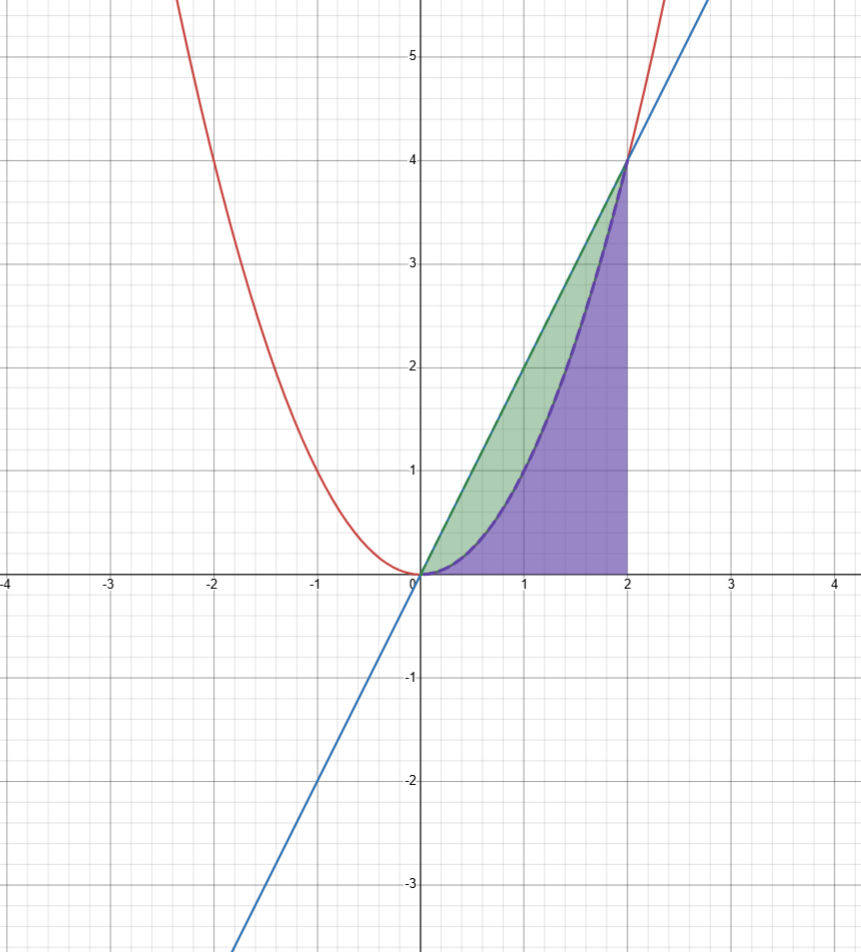
This is a graph of and . is the parabola, while is the straight line. By setting them equal to each other, we see they intersect at , which we can also see by looking at the graph. The purple area represents where the area under and the area under overlap, while the green area represents where there is only the area under , which is also the area between the two functions. Since is the higher function here (meaning its values are above those of on the interval), our formula for finding the area between the two functions would be .
Now that you have a decent understanding of how we find the area between curves, let’s move on to some practice problems.
Practice
- Find the area of the region enclosed by the parabola and the line .
- Find the area of the region bounded by the curves and on the interval .
- Find the area of the region bounded by the curves and on the interval .
Practice Answers
1)
The first thing we have to do is find the bounds of the area we are calculating. To do this, we’ll set the functions equal to each other.
Finding Bounds:
Now that we have our bounds, we need to see which function is higher on the interval. To do this, we’ll plug in a random point on the interval into each function. In this case, let’s test .
Plugging in:
Therefore, is higher on the interval.
Solving:
Therefore, the area of the region enclosed by and is .
2)
In this problem, we already have the bounds, so our first step becomes finding which function is higher on the interval. Let’s test
Plugging in:
Since is greater than , is higher on the interval.
Solving:
Therefore, the area of the region bounded by the curves of and on the interval is .
3)
For this last problem, we’ve been given the bounds, so the only thing left to do is see which function is higher. Let’s test .
Plugging in:
Therefore, is higher on the interval.
Solving:
Therefore, the area of the region bounded by the curves and on the interval is