
Welcome to the FiveHive article for Unit 8.9 of AP Calculus!
In this article, we will be exploring a major section of the applications of integral calculus. Namely, we will be looking at how we can find the volume of a solid shape created when revolving a graph around an axis.
As usual, we will only cover the topics included in the CED for unit 8.9.
The Disc Method
The disc method is a primary method of finding the volume of a solid created by revolving a function around an axis.
We call it the disc method because when we imagine the cross section of the resulting solid, it is a complete circle that is “attached” to the - or -axis.
Integration with respect to x
Let’s consider the graph of on the interval .
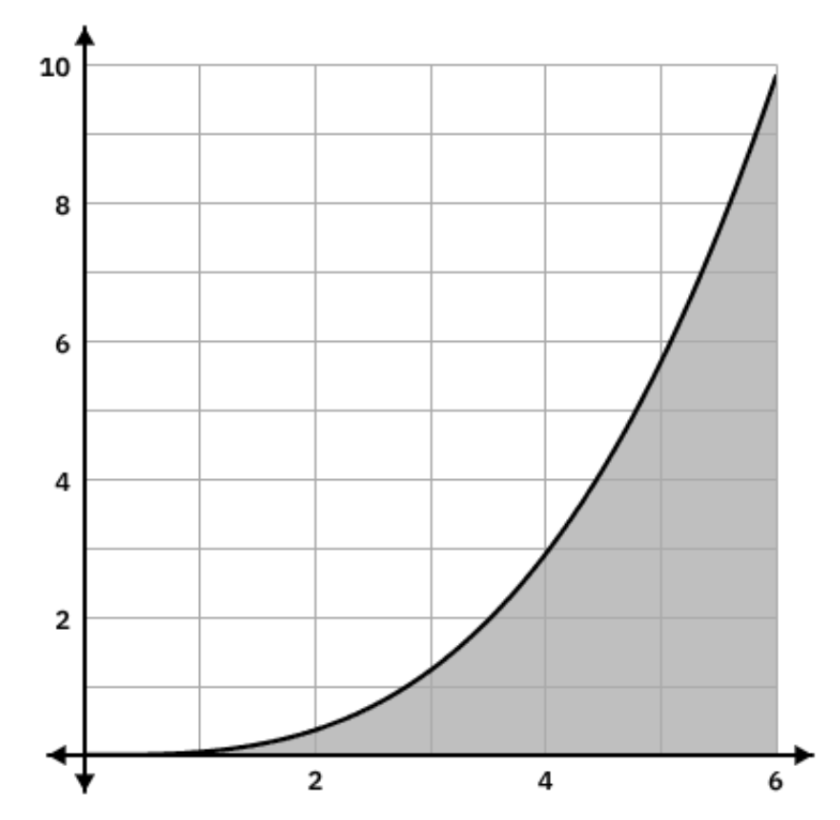
When finding the volume of the solid of revolution, we first have to visualize the shape of the cross section of the solid of revolution. In this case, the solid that is created is ideally going to have circular cross-sections.
The next step is to identify the 3-dimensional shape that can be made by extruding the cross-section. Since the cross-section in this case is a circle, we can extrude it to create a cylinder.
The height of these cylinders is , and the radius is the distance between the graph of and the axis of rotation. In this case, the radius is , which is equal to . Hence, we can find the volume of one of the cylinders on the interval .
Since there are multiple of these cylinders of varying radius within the shaded region, we can use the summation notation to approximate the volume of the solid:
But as we reduce the width of the cylinder and bring it closer to to make the approximation more accurate, we need to use integration:
This evaluates to roughly 260. Since we do not have any units provided in the scenario, we do not add any units to the answer. Do NOT assume any units.
Integration With Respect To y
Revolving and integrating with respect to is cool and all, but let’s make things spicier. Now, it is time to integrate with respect to ! The theory behind it is very similar to the theory behind integration with respect to .
Let’s look at an example. Here, we have the function $f(x) = \sqrt x$. However, this time we are going to find the volume of the solid that is created when rotating this graph around the y-axis between and .
Usually when we integrate with respect to , we find the -values as the bounds for the integral. However, in this case, we are going to find the -values. Since we only have the -values, we have to find the corresponding -values, which are and for the lower- and upper-bounds respectively.
The next step is to see that the function is with respect to . Therefore, since we are integrating with respect to , we need to get in terms of . Doing this yields .
Now, we integrate. Once again, the shape created when we revolve the graph around the -axis is a circle, therefore the integral is .
Upon solving this integral, we get an answer of roughly 20.
Strategy
Ok, that may have seemed like a whole lot of magic and pulling expressions out of thin air. But all there is to it is strategy.
The first step is always to make sure that you know what variable you are integrating with and ensuring that you have the right bounds and right function as the integrand.
The second step is to visualize the solid that would be created. Oftentimes, it is extremely helpful to draw it out. This way, you can find the shape of the cross-section. This shape’s area is what you will be integrating.
The third step is to integrate!
Credits to graphfree.com for the graphs.