
Introduction
Welcome to the FiveHive article for Unit 8.11 of AP Calculus!
In this article, we will be exploring yet another major section of the applications of integral calculus. Namely, we will explore the washer method for finding volume around the x- and y-axes.
As usual, we will only cover the topics included in the CED for unit 8.11.
Define the Region
Similar to when revolving around the normal coordinate axes using the disc method, the first step is to define the region that is going to be revolved.
This is going to be a little bit more complicated than before, as now you have to take into account a second function as a radius. Once again, drawing out the functions on a coordinate plane really helps with visualization.
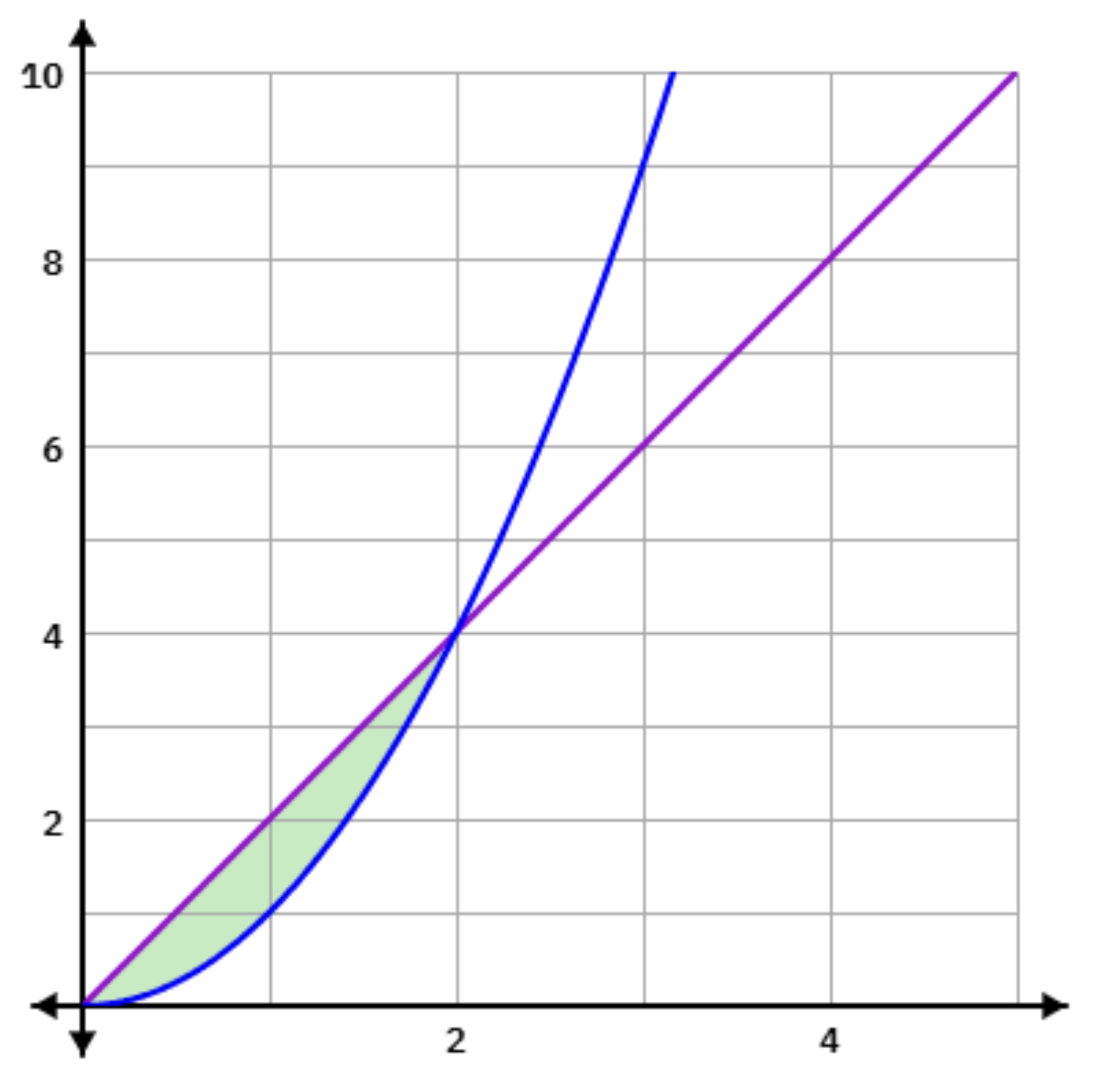
For example, let us consider the functions depicted in the following image. Let us consider the volume of the solid made from revolving the region enclosed by and around the axis. Once again, we would consider the shape of the cross-section to decide what type of integral to evaluate.
Define the Radius
The radius of the solid of revolution is simply defined as the function on top (or right) minus the function on the bottom (or left).
Since we are integrating with functions that are to the right and left of each other, we integrate with respect to the axis, or .
Writing and Solving the Volume Integral
Here, setting up the integral is going to be a little bit more complicated, as now there are two radii to take into account. The process is similar to drilling a hole into a three-dimensional figure and finding the volume of the remaining figure. Therefore, the integral will look something like this:
Since the shapes of the cross-sections are circles, we will integrate the area of a circle. To find the radius of the circles, we shall simply subtract the functions by . Therefore:
and .
Therefore, the areas of the circles created are and .
To find the bounds, we set the two equations equal to each other and solve:
(1)
(2)
(3)
and
This translates to the bounds we will use on the integral:
and .
Now we set up the integral. Since the cross-sections are perpendicular to the axis, we integrate with respect to .
Once we integrate, we find that the .
Strategy
If this seems confusing, the strategy to approach these problems is extremely similar to the strategy for approaching problems that revolve around the - or - axes using the disc method. The only difference is having to find the radii for both the functions.
Practice
That was a great unit! Now, it is time to practice all the skills gathered from this article.