
Section II, Part A - Calculator Active
The following instructions reflect what you will see on the actual AP exam. You should time yourself at 30 minutes for this part of the exam.
If you wish to simulate the exam experience, you may print out a free-response booklet sample from the College Board here.
Note: Beginning with the 2025 AP Calculus AB and BC digital exams, you may no longer go back to the Part A free-response questions once the timer for Part A is over. Previously, you were able to revisit the Part A free-response questions without the use of a calculator; if you are taking the exam with a paper accommodation, you are still allowed to do so. Please take this information into account when taking the free-response section of this mock exam.
Instructions for Section II, Part A - Calculator Active
Section II, Part A has 2 free-response questions and lasts 30 minutes.
A graphing calculator is required for the questions on this part of the exam. You may use a handheld graphing calculator or the calculator available in this application. Make sure your calculator is in radian mode.
You may use the available paper for scratch work, but you must write your answers in the free-response booklet. In the free-response booklet, write your solution to each part of each question in the space provided for that part. For questions that have sub-parts, be sure to label those clearly in your solution. Use a pencil or a pen with black or dark blue ink.
You are permitted to use your calculator to solve an equation, find the derivative of a function at a point, or calculate the value of a definite integral. However, you must clearly indicate the setup of your question, namely the equation, function, or integral you are using. If you use other built-in features or programs, you must show the mathematical steps necessary to produce your results.
Show all of your work, even though a question may not explicitly remind you to do so.
Clearly label any functions, graphs, tables, or other objects that you use. Justifications require that you give mathematical reasons and that you verify the needed conditions under which relevant theorems, properties, definitions, or tests are applied. Your work will be scored on the correctness and completeness of your methods as well as your answers. Answers without supporting work will usually not receive credit.
Your work must be expressed in standard mathematical notation rather than calculator syntax. For example, may not be written as fnInt(X^2, X, 1, 5).
Unless otherwise specified, answers (numeric or algebraic) need not be simplified. If you use decimal approximations in calculations, your work will be scored on accuracy.
Unless otherwise specified, your final answers should be accurate to three places after the decimal point.
Unless otherwise specified, the domain of a function f is assumed to be the set of all real numbers for which is a real number.
Section II, Part A Questions
Question 1
A tank contains 500 gallons of water at time hours. Water flows into the tank at a rate modeled by gallons per hour, and water flows out of the tank at a rate modeled by gallons per hour. Values of and are given in the table below for selected values of .
Note: Your calculator should be in radian mode.
(a) Use the data in the table to approximate at hours. Show the computations that lead to your answer. Using correct units, interpret the meaning of at in the context of this problem.
(b) Using a trapezoidal sum with the four subintervals indicated by the data in the table, approximate . Using correct units, interpret the meaning of in the context of this problem.
(c) For , the amount of water in the tank at time is given by gallons. Is the amount of water in the tank increasing or decreasing at time hours? Give a reason for your answer.
(d) At time hours, the outflow rate changes. For , the outflow rate is modeled by gallons per hour. Using this model and the value from the table, find the rate of change of the amount of water in the tank at time hours. Indicate units of measure.
Question 2
Let be the region in the first quadrant bounded by the graph of , the -axis, and the vertical line .
Note: Your calculator should be in radian mode.
(a) Find the area of region .
(b) Find the volume of the solid generated when region is revolved about the -axis.
(c) The region is the base of a solid. For this solid, each cross section perpendicular to the -axis is a rectangle whose height is three times the length of its base in region . Find the volume of this solid.
(d) Find the average value of the function on the interval .
This is the end of Section II, Part A. If you finish before time is called, you may check your work on Part A only. Do not go on to Part B until you are told to do so.
Section II, Part B - Calculator Not Allowed
The following instructions reflect what you will see on the actual AP exam. You should time yourself at 1 hour for this part of the exam.
If you wish to simulate the exam experience, you may print out a free-response booklet sample from the College Board here.
Instructions for Section II, Part A - Calculator Active
Section II, Part B has 4 free-response questions and lasts 1 hour.
A calculator is not allowed for this part of the exam.
You may use the available paper for scratch work, but you must write your answers in the free-response booklet. In the free-response booklet, write your solution to each part of each question in the space provided for that part. For questions that have sub-parts, be sure to label those clearly in your solution. Use a pencil or a pen with black or dark blue ink.
Show all of your work, even though a question may not explicitly remind you to do so.
Clearly label any functions, graphs, tables, or other objects that you use. Justifications require that you give mathematical reasons and that you verify the needed conditions under which relevant theorems, properties, definitions, or tests are applied. Your work will be scored on the correctness and completeness of your methods as well as your answers. Answers without supporting work will usually not receive credit.
Your work must be expressed in standard mathematical notation rather than calculator syntax. For example, may not be written as fnInt(X^2, X, 1, 5).
Unless otherwise specified, answers (numeric or algebraic) need not be simplified. If you use decimal approximations in calculations, your work will be scored on accuracy.
Unless otherwise specified, your final answers should be accurate to three places after the decimal point.
Unless otherwise specified, the domain of a function f is assumed to be the set of all real numbers for which is a real number.
You can go back and forth between questions in this part until time expires. The clock will turn red when 5 minutes remain-the proctor will not give you any time updates or warnings.
Section II, Part B Questions
Question 3
The graph of , the derivative of the function , is shown in the figure below. The function is twice differentiable for all real numbers.
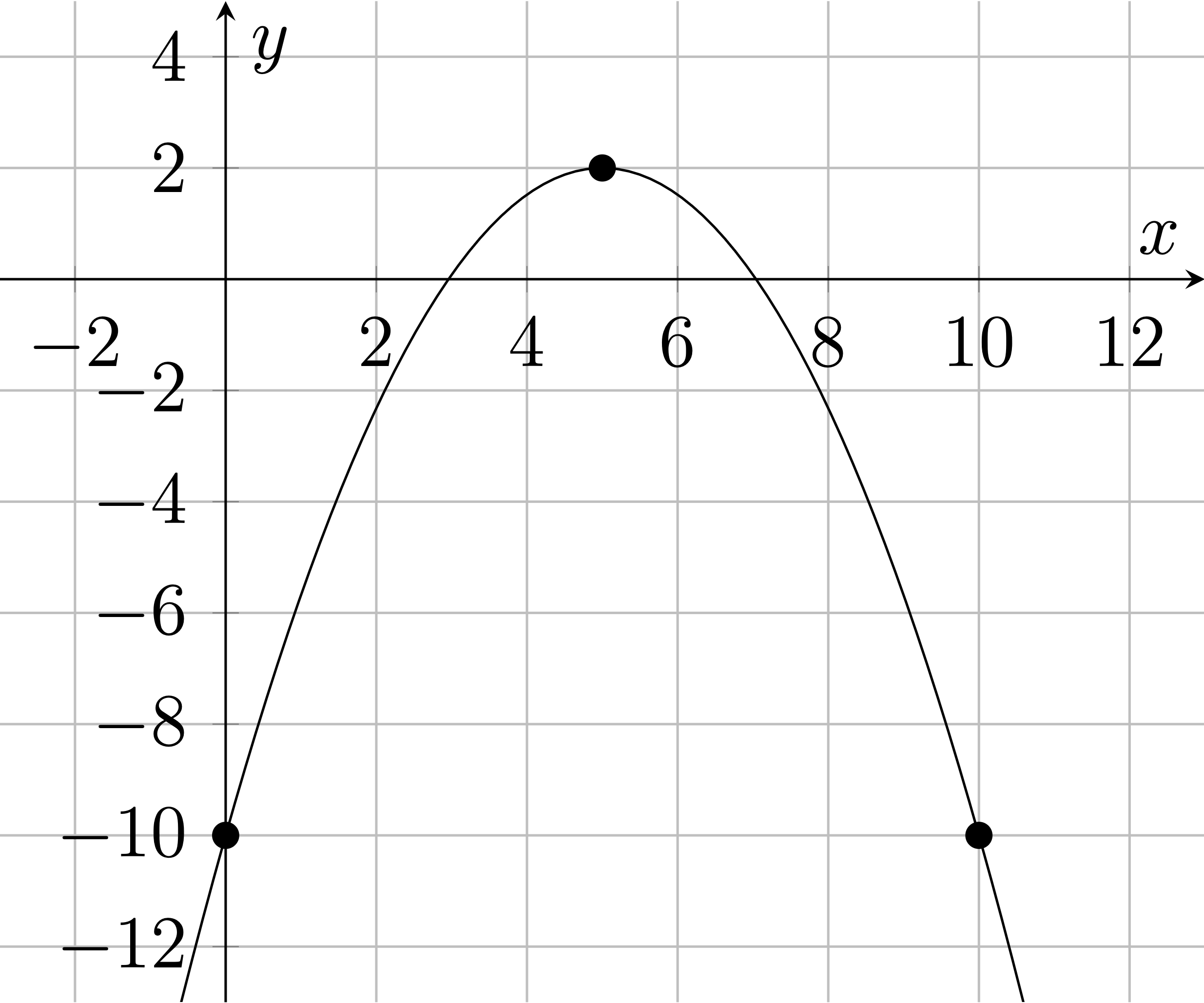
(a) On what open intervals contained in is the function increasing? Justify your answer.
(b) At what values of does have a relative maximum or relative minimum? Use the First Derivative Test to justify your answer.
(c) On what open intervals contained in is the graph of concave up? Justify your answer.
(d) Let . Write an expression for in terms of , , and .
Question 4
A farmer has of fencing and wants to enclose a rectangular area and then divide it into three equal pens with fencing parallel to one side of the rectangle.
(a) Write an expression for the total area of the three pens in terms of , where is the length of fencing perpendicular to the dividing fences.
(b) Find the dimensions that maximize the total area of the three pens. Justify that your answer gives the maximum area.
(c) A ladder long is leaning against a wall. The base of the ladder is sliding away from the wall at a rate of . How fast is the top of the ladder sliding down the wall when the base of the ladder is from the wall?
Question 5
Consider the differential equation .
(a) On the axes provided, sketch a slope field for the given differential equation at the nine points indicated.
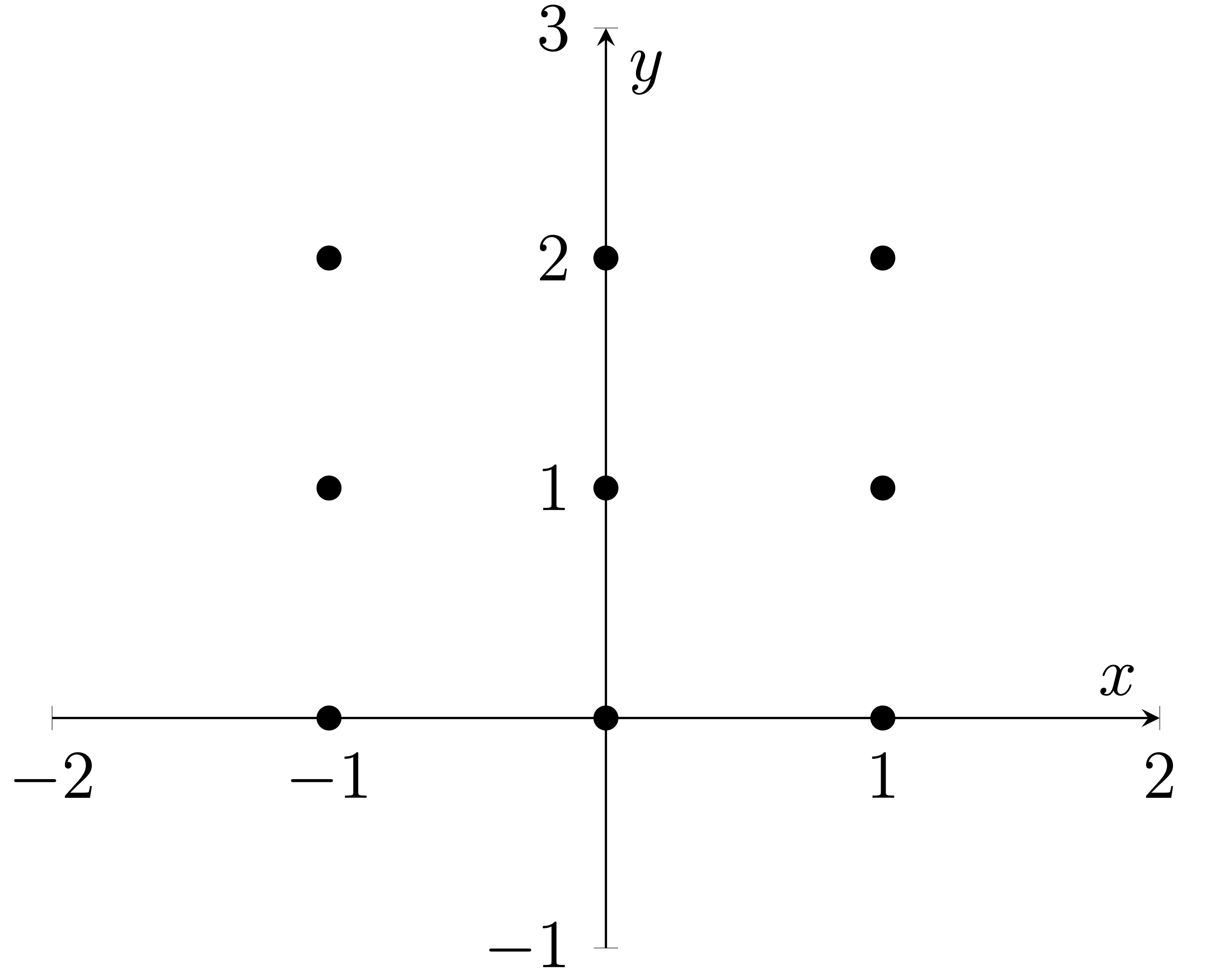
(b) Find in terms of and . Determine whether the solution curve that passes through the point is concave up or concave down at that point. Give a reason for your answer.
(c) Find the particular solution to the differential equation with the initial condition .
(d) For the solution found in part (c), determine whether has a relative minimum, a relative maximum, or neither at . Justify your answer.
Question 6
Let be a twice-differentiable function. Selected values of , , and are given in the table below.
(a) Approximate using the data in the table. Show the computations that lead to your answer.
(b) Evaluate using the data in the table. Show the work that leads to your answer.
(c) Use the line tangent to the graph of at to approximate . Is this approximation greater than or less than ? Give a reason for your answer.
(d) Let be the function defined by for . On what intervals, if any, is decreasing? Justify your answer.
(e) The function is defined by . Find .
This marks the end of the examination.