
Introduction
Welcome to this guide on Taylor Polynomials,, this article will guide you through the following:
- What is Taylor Polynomial?
- How to find a Taylor Polynomial?
What is Taylor Polynomial
In the field of physics and engineering, approximations are as important as finding the actual value, therefore, there needs to be a way of approximating functions. Here is where Taylor Polynomials comes into place.
Definition of Taylor Polynomial
Consider a function , which can be differentiated times at a constant number . We define the Taylor Polynomial of this function around as
We call this polynomial function "the th degree Taylor Polynomial of ", if , the polynomial is called Maclaurin Polynomial.
The details of this will be covered in 10.14 Taylor Series.
Application of Taylor Polynomial
The most important real world application of Taylor Polynomial is approximating a function.
Consider the sine function and its th degree Taylor Polynomial (we will cover how to find this in the next section)
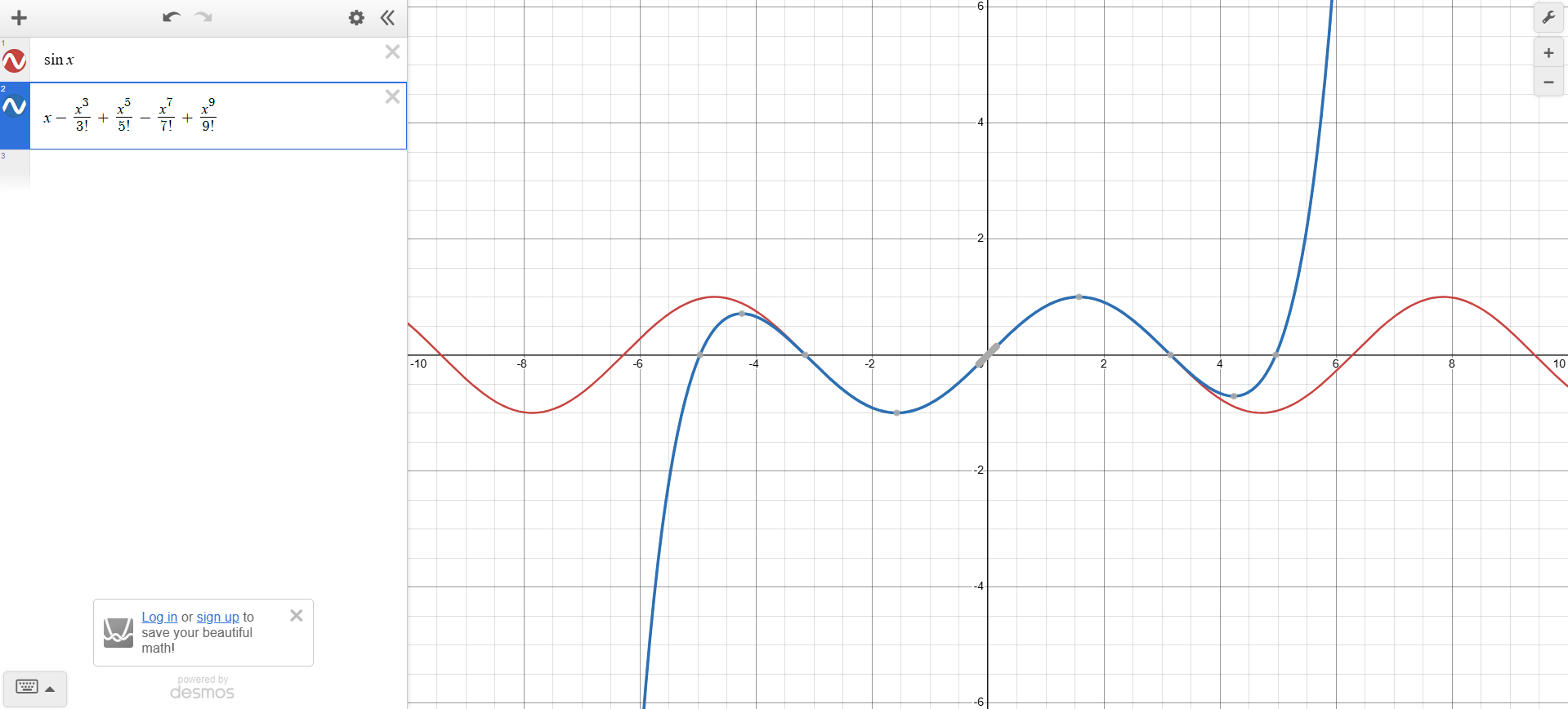
From the graph, one can see that for some part of the graph, the blue line and red line match almost perfectly, it is only after a certain value that the line starts to deviate.
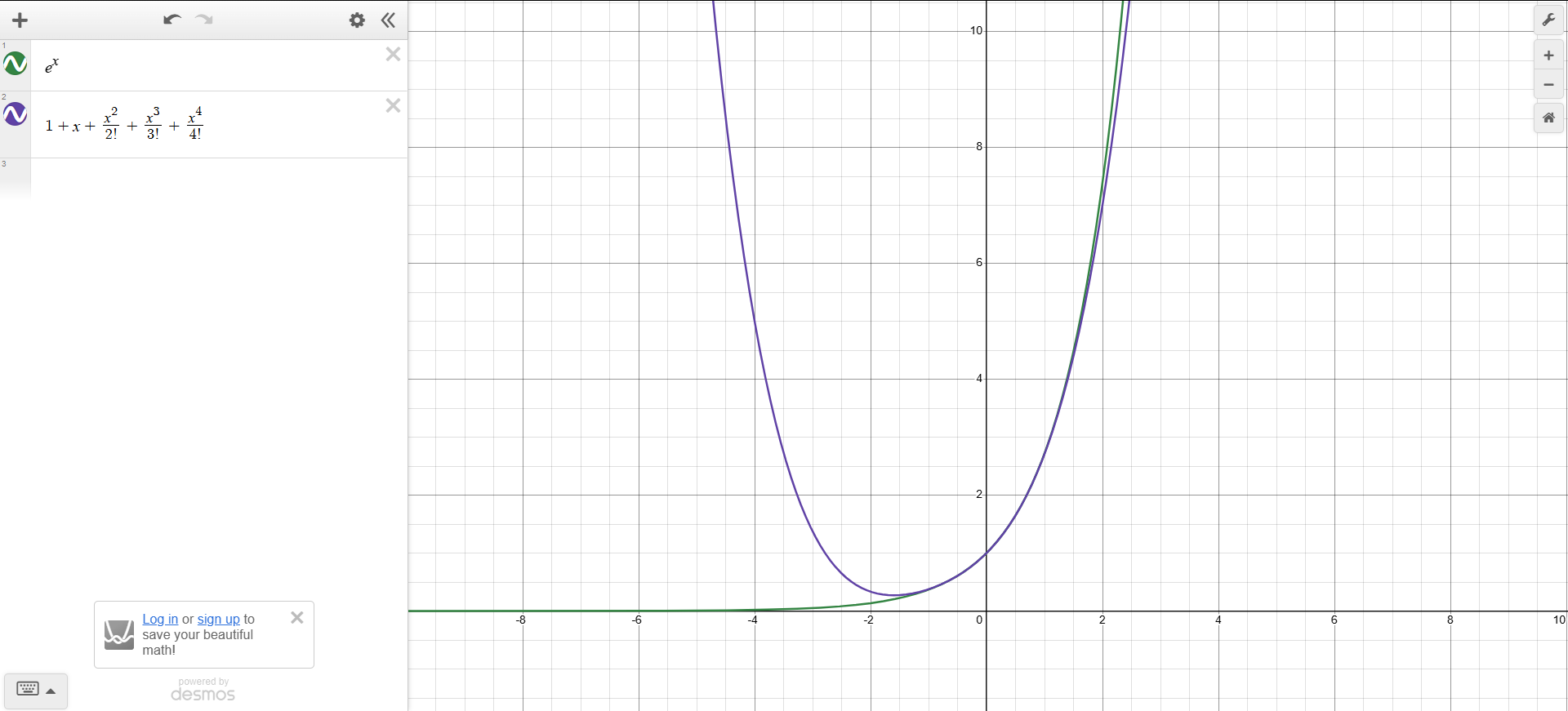
This is the purpose of Taylor Polynomials, to approximate functions, the higher its degree, the better approximation it gets. Here is another example of and its th degree Taylor Polynomial.
Finding Taylor Polynomial
In this section, you will learn how to find Taylor Polynomials.
Example 1:
Find the th degree Taylor Polynomial of centered at
To find the desired polynomial, first find the high order derivatives of at
- ,
- ,
- ,
- ,
- ,
Now substitute the derivatives into the equation for Taylor Polynomial:
Example 2:
Find the th degree Taylor Polynomial of the function center at
To find the desired polynomial, first find the high order derivatives of at
- ,
- ,
- ,
- ,
- ,
Now substitute the derivatives into the equation for Taylor Polynomial,