
Introduction
Welcome back! In today’s article, we’re going to be going over how to use derivatives to solve real-world problems. This is known as related rates, and it is one of the more difficult topics for AP Calculus AB. In order to do this, we will have to use derivatives on formulas that we already know, such as the Pythagorean Theorem or the volume of a rectangular prism, to find specific measurements.
To be able to solve these problems, you should already know how to use the chain, product, and quotient rules for differentiating expressions. The only difference is that instead of differentiating one variable with respect to that same variable, you will be differentiating other independent variables with respect to a different variable (think differentiating y and z with respect to x, giving you and ). One more thing to keep in mind is that since we are dealing with real-world scenarios, your answers should make sense. You shouldn’t end up with unrealistic measurements, like a 2-centimeter pipe filling a tub at a rate of 10 gallons per second.
Example
Before we jump into the practice section, let’s go over an example of a related rates problem and how you could solve it. For this example, we’ll go over a common scenario, namely airplanes flying away from an air traffic control tower.
Two planes are flying away from an air traffic control tower. One plane flies north at a rate of , while the other plane flies east at a rate of . At minutes, how fast is the distance between the planes increasing?
At first glance, this problem might seem extremely confusing, especially since we’re asked to find how fast the distance between the planes is increasing when it’s not mentioned anywhere else in the problem. To make things easier, let’s draw a diagram of the problem.
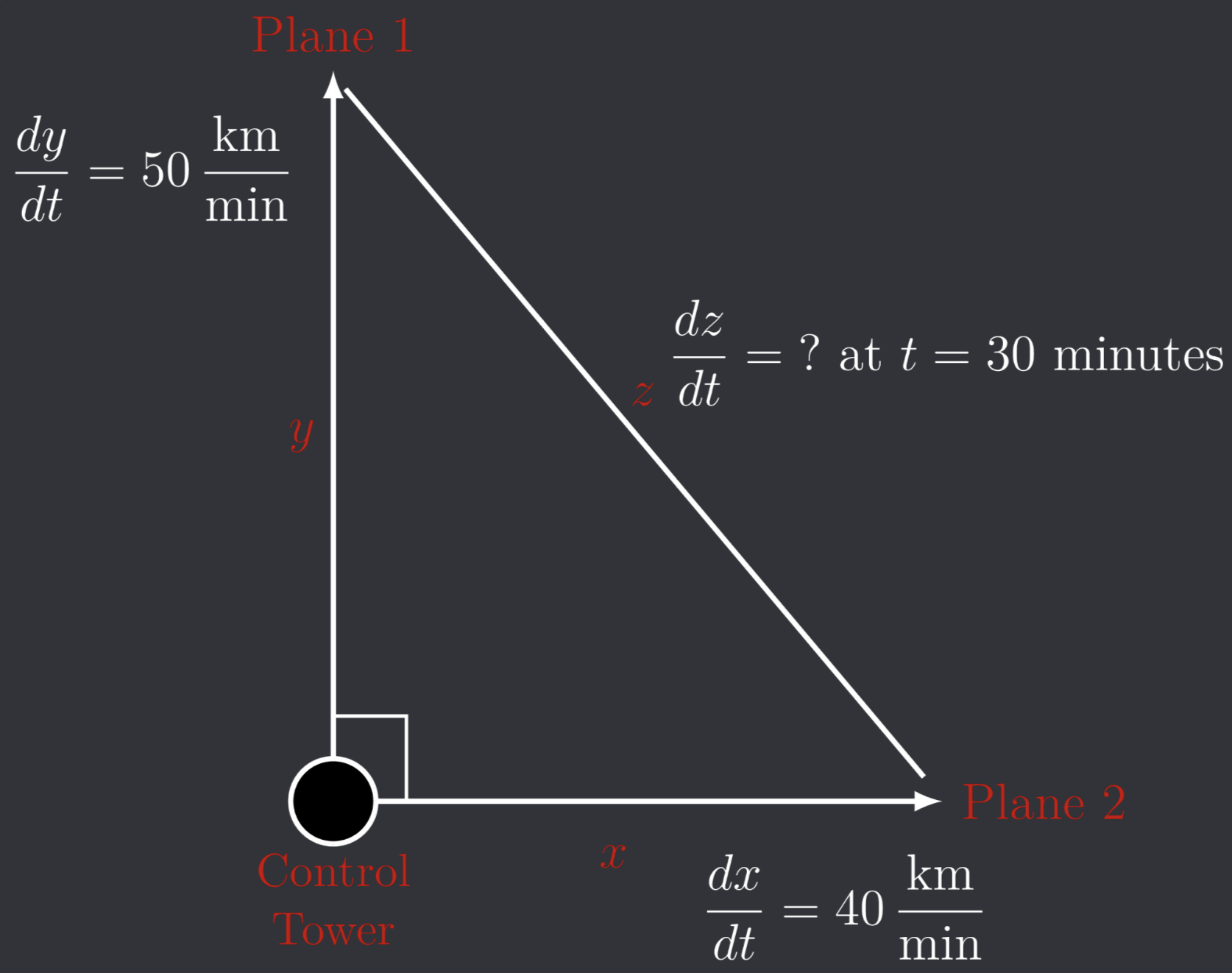
Based on this diagram, we can now see that we’re dealing with a right triangle, so we’ll have to use the Pythagorean Theorem. First, we need to find how far the planes are from the control tower, then we need to find how far apart they are at minutes.
To find the distances of the planes, we’re going to use simple arithmetic. If the north-traveling plane is going for 30 minutes, it’ll travel . Doing the same thing for the other plane gives us .
Now, we can use the Pythagorean Theorem, , to find the length of the hypotenuse at minutes.
.
Now that we have all three side lengths, we’ll take the derivative of the Pythagorean Theorem with respect to time, .
This gives us
In the problem, it asked us to find the rate at which the distance between the two planes, or the hypotenuse of the triangle in our diagram, was increasing. This means we will be solving for .
After plugging in the values we found and were given, we end up with this expression:
Now, we can solve for .
Taking units into account, the distance between the two planes is increasing at a rate of 64.031 kilometers per minute, or
After that lengthy example, let’s try some simpler practice problems!