
Introduction
One of the most elegant applications of integration is finding the arc length of a curve—the distance along a curve between two points. While we can easily measure the straight-line distance between two points, measuring the actual length of a curved path requires calculus.
The arc length formula allows us to calculate the precise length of any smooth curve defined by a function . This has practical applications in physics (distance traveled along a curved path), engineering (length of cables or wires), and geometry (perimeter of curved shapes). The key insight is that we can approximate a curve with many tiny straight-line segments, then use integration to find the exact length as the number of segments approaches infinity.
This topic builds on our understanding of Riemann sums and definite integrals from earlier units. Just as we used integration to find areas and volumes, we now use it to find lengths. The derivation relies on the Pythagorean theorem applied to infinitesimally small segments of the curve.
The Arc Length Formula
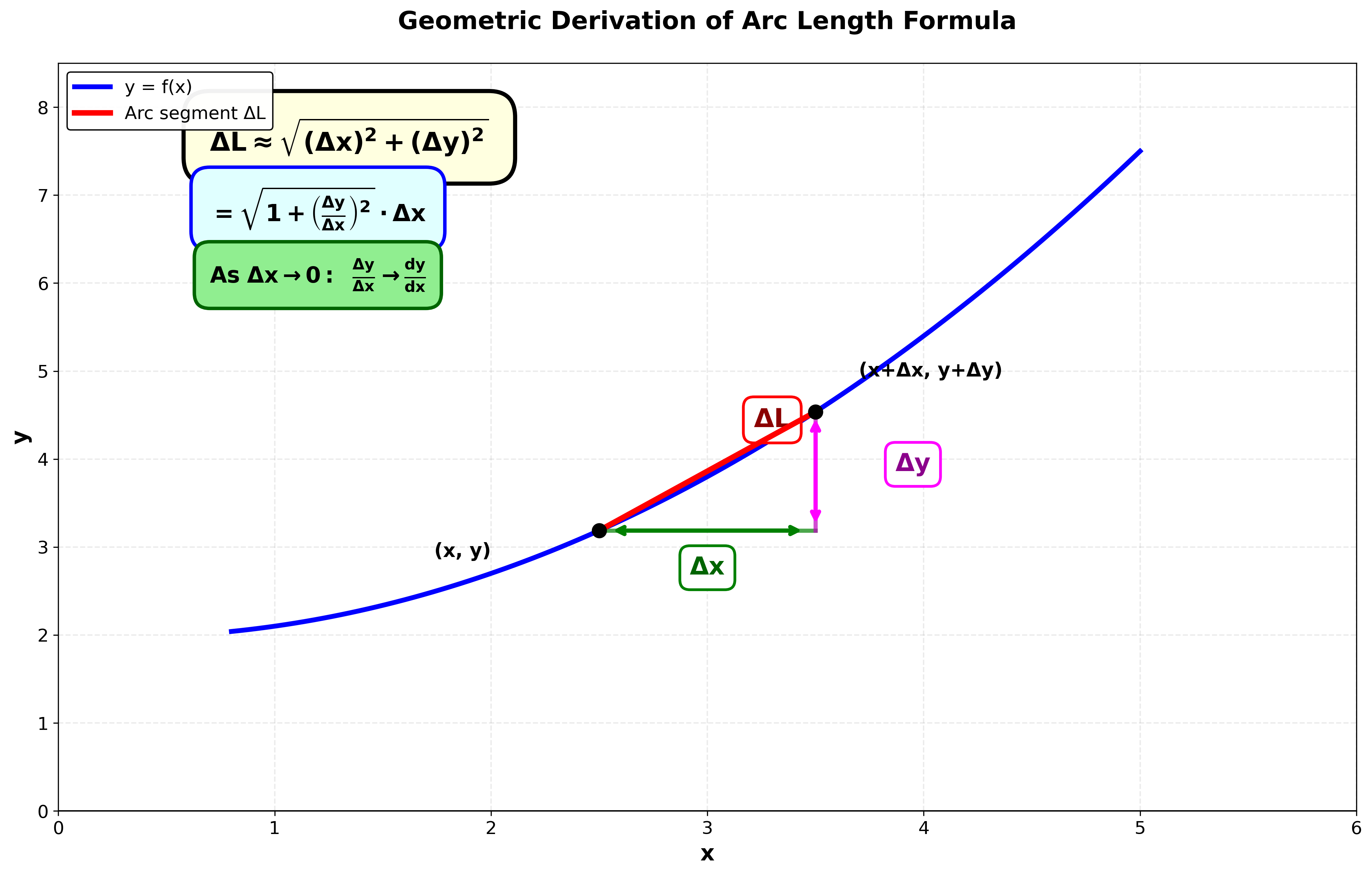
Derivation of the Arc Length Formula
Consider a smooth curve defined by on the interval . To find the length of this curve, we:
- Partition the interval into subintervals of width
- Connect consecutive points on the curve with straight line segments
- Approximate arc length as the sum of these segment lengths
- Take the limit as to get the exact arc length
For a small segment of the curve from to :
Using the Pythagorean theorem:
Factor out :
As :
The arc length is:
Arc Length Formula
For a smooth function on the interval :
or equivalently:
Requirements:
- must be continuous on
- must be continuous on (smooth curve)
Example 1: Arc Length of a Line Segment
Find the arc length of from to .
Solution:
First, find :
Set up the arc length integral:
Evaluate:
Verification using distance formula:
The line goes from to .
Distance: ✓
Example 2: Arc Length of a Parabola
Find the arc length of from to .
Solution:
Find :
Set up the arc length integral:
This integral requires a trigonometric substitution (beyond the scope of typical arc length problems on the AP exam, but shown for completeness).
Let , then
After substitution and simplification (details omitted):
Note: On the AP exam, arc length problems typically have integrals that can be evaluated using standard techniques or are left in integral form.
Example 3: Arc Length with Power Function
Find the arc length of from to .
Solution:
Find :
Set up the arc length integral:
Evaluate using substitution:
Let , then
When : When :
Example 4: Arc Length Requiring Algebraic Manipulation
Find the arc length of from to .
Solution:
Find :
Calculate :
Recognize this as a perfect square:
Therefore:
The arc length integral becomes:
Evaluate:
This type of problem (where the integrand simplifies nicely) is common on the AP exam.
Example 5: Arc Length Requiring Recognition of Perfect Square
Find the arc length of from to .
Solution:
Find :
Calculate :
Recognize as perfect square:
Therefore:
Example 6: Setting Up Arc Length Integral
Set up, but do not evaluate, the integral for the arc length of from to .
Solution:
Find :
Arc length integral:
Note: This integral cannot be evaluated using elementary functions. On the AP exam, you would leave it in this form or use numerical methods to approximate.
Example 7: Arc Length of Cubic Function
Find the arc length of from to .
Solution:
Find :
Calculate :
Therefore:
Distance Traveled
The arc length formula can also represent distance traveled by a particle moving along a curve.
Distance vs. Displacement
Displacement: The straight-line distance from starting point to ending point (can be positive, negative, or zero)
Distance traveled: The total length of the path traveled (always non-negative)
For a particle with position function and velocity :
Distance traveled from to :
Example 8: Distance Traveled in One Dimension
A particle moves along a line with velocity for . Find the total distance traveled.
Solution:
First, find when :
Analyze the sign of :
Distance traveled:
Evaluate each integral:
$
Total distance:
Example 9: Distance Along a Planar Curve
A particle moves along the curve with horizontal velocity . Find the distance traveled from (when ) to (when ).
Solution:
Since is constant, we have .
When : When :
The distance traveled is the arc length of from to .
Find :
Arc length integral:
On the AP exam, this would likely be left in integral form or approximated numerically.
Using numerical integration: units.
Example 10: Speed and Distance
A particle's position is given by for . Find the total distance traveled.
Solution:
Find velocity:
Velocity is zero at and .
Sign analysis:
Distance:
Common Mistakes to Avoid
Mistake 1: Forgetting to square the derivative The formula is , not
Mistake 2: Not recognizing perfect squares Some problems are designed so that is a perfect square. Always check!
Mistake 3: Confusing arc length with area Arc length measures the length of a curve; it's not the same as the area under the curve.
Mistake 4: Forgetting absolute value for distance traveled Distance requires , which means splitting at points where .
Mistake 5: Improper algebra when expanding Be careful with signs and terms when squaring the derivative.