
Introduction
In Unit 4, we defined reactions as the rearrangement of atoms and the cleavage and formation of intramolecular chemical bonds. In this unit, we shift our focus to the acid-base reactions, a new type of reactions that focus on the donation and acceptance of protons () and how they produce other ions and precipitates as a result of acids and bases reacting in aqueous phases.
Acids and Bases
There are three major definitions of acids and bases in chemistry, which are Arrhenius, Brønsted-Lowry, and Lewis acids and bases. For AP Chem, the principal definition is the Brønsted-Lowry definition: An acid is a substance that donates a proton, and a base is a substance that accepts a proton. The other two definitions are the Arrhenius and the Lewis definition. One example of this definition is .
The Arrhenius definition says that an acid releases () in water and a base releases () in water. One example of this is . This definition is only applicable for aqueous solutions, and is limited in scope.
The Lewis definition extends the definition of acids and bases. We have learned the ability to release hydrogen () and hydroxide () ions as stated by Arrhenius definition, and the tendency to donate or accept , or protons, as stated by Brønsted-Lowry definition. The Lewis definition of acids and bases says that an acid is an electron pair acceptor and a base is an electron pair donor. However, this will not be assessed by the AP Chemistry exam.
Definition of pH
In this module, we will often encounter the term called pH. What is pH? pH is a measure of the concentration of ions in an aqueous solution. The lower the pH, the higher the concentration of and the more acidic the solution. The higher the pH, the lower the concentration of and the more basic the solution. We will learn later in Unit 8 that the pH is a logarithmic scale. For instance, the acidity of an aqueous solution of a substance with pH of 2 is 1000 times more concentrated than an aqueous solution of the same substance with pH of 5, because the pH difference is 3 and 10 raised to the power of 3 equals 1000.
Conjugate Acid-Base Pairs
Every acid-base reaction results in a conjugate pair of substances. Specifically, when an acid loses a proton, it becomes its conjugate base, and when a base gains a proton, it becomes its conjugate acid.
In general, an acid-base neutralization reaction can be written as follows:
. In this generalized acid-base neutralization reaction, we can identify as the acid, as the conjugate base, as the base, and as the conjugate acid. The first two and the last two form the “conjugate acid-base pairs” in Brønsted-Lowry acid-base theory.
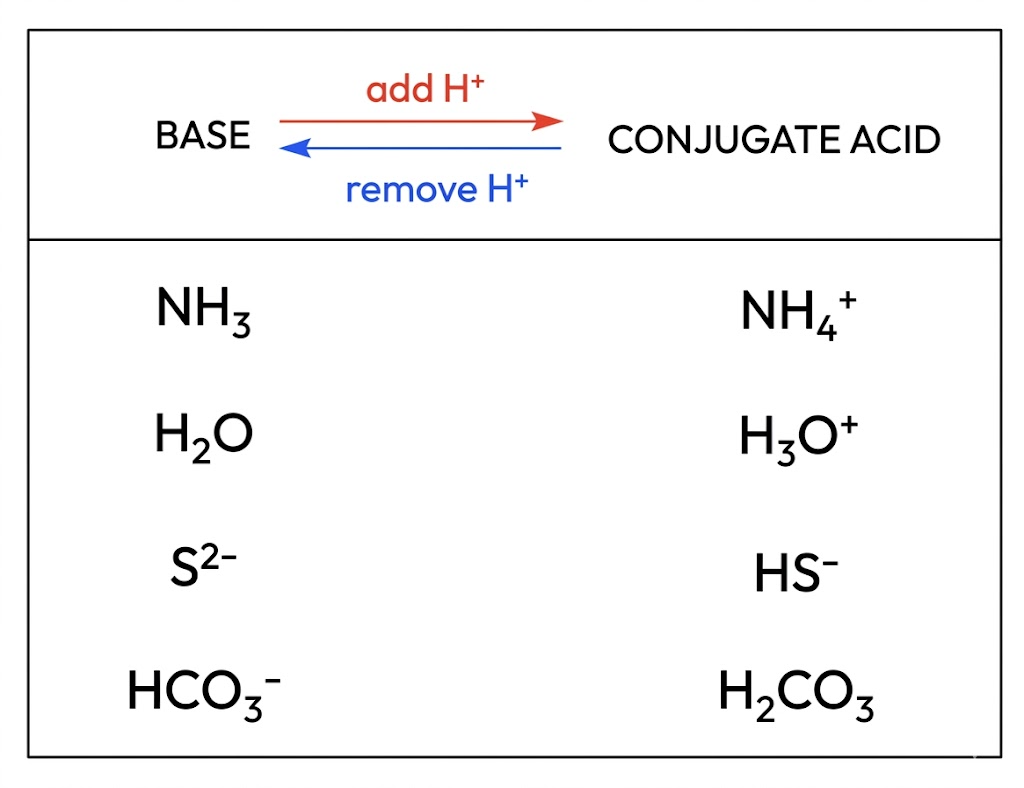
Image Source: 5.1 – Acid-Base Definitions & Conjugate Acid-Base Pairs | Open Library
.png?alt=media&token=17dd934f-01ca-4393-98d9-015c74987a75)
Image Source: 5.1 – Acid-Base Definitions & Conjugate Acid-Base Pairs | Open Library
For example, consider . In this acid-base reaction, the bases are and and the acids are and . In this example, the base is and its conjugate acid is . At the same time, the acid is and its conjugate base is . Our findings for this reaction is summarized in the following image:
.png?alt=media&token=9f3d5436-7585-48e9-984e-c49d45b5aed2)
Image Source: 5.1 – Acid-Base Definitions & Conjugate Acid-Base Pairs | Open Library
As another example, take the reaction .
The conjugate acid-base pair is paired with and the base/conjugate acid pair is paired with .
It is important to note that in an acid-base reaction, stronger Brønsted-Lowry acids and bases will react to form weaker acids and bases. An example is the reaction between acetic acid and sodium hydroxide, whose net ionic reaction can be represented by the following chemical equation: . Here, acetic acid is an acid that is stronger than the conjugate acid of the base, hydroxide , which is water . Because the reaction favors the formation of a weaker acid and a weaker base, the reaction proceeds to the forward direction.
In addition, if an acid or base is strong, its conjugate base or acid will be weak. In particular, if the acid or base is strong enough to essentially dissociate to completion, the resulting basic or acidic character of its conjugate base or acid will be so low that it will not react with water to affect the pH of the solution.
An example of this is shown by the ionization of hydrochloric acid in water:
The acid is , which is strong enough to completely dissociate in water, by donating its proton to water. We recognize that is the conjugate base of . Because is a strong acid, the covalent bond between and practically falls apart completely in water. Therefore, the chloride ion, , has no ability to accept the proton back from or to recreate @\text{Cl}^-$ is an extremely weak base, it remains as a spectator ion in solution and does not shift the equilibrium of water. It has no appreciable effect on the pH.
Another example is shown by the case of complete ionization of in water. In the following hydrolysis reaction (hydrolysis means ionic compounds breaking apart in the presence of water to form ions), we have . The ion is the counter ion (the ion that balances charges by being paired with another ion) to the hydroxide ion, , as found in . As you will learn later, sodium hydroxide, represented by the chemical formula is a strong base. Therefore, it will dissociate completely into and , so there is no way for to proceed to the reverse direction and take back the ion. Therefore, is considered as another spectator ion that will not affect the pH to a notable extent.
Lastly, the conjugate of a moderately weak acid or moderately weak base will also be moderately weak base or acid. Examples of this observation is seen in acetic acid (both and are weak acids and bases) and ammonia (both and are weak bases and acids).
Atmospheric Substances
There are some substances that can act as either an acid or a base depending on the other substance in the reaction. These substances are known as amphoteric (alt amphiprotic) substances. The most common one known is water, as it can donate a proton to form or accept a proton to form . Other notable amphoteric species are bicarbonate and bisulfate .
Strong vs Weak Acids and Bases
Not every substance reacts the same way in water. Strong acids and bases completely dissociate and produce ions practically completely, while weak acids and bases only partially dissociate, producing some ions in equilibrium with their original substance. You would need to memorize seven strong acids and seven strong bases for the AP Chemistry exam.
The seven strong acids are: , , , , , , and .
The seven strong bases are: , , , , , , and .
Every acid and base that does not belong to its respective category as classified above is considered a weak acid or base.
The image below shows some acids and bases and their acid and base strengths:
.png?alt=media&token=16649e1d-3e58-4efa-b10a-d0afdd162fcc)
Image Source: Chemistry the Central Science 12th Edition
Neutralization Reactions
All reactions between an acid and a base are called neutralization reactions, in which acids and bases react to yield a salt and water. For example, . The reaction occurs such that the in the reacts with the in the , forming water, . For neutralization reactions between a strong acid and a strong base, the net ionic equation will often be , assuming that the counter ions are spectator ions. Other neutralization reactions involving other strong acids and strong bases may result in the formation of a precipitate. For example, per one mole reaction, the chemical equation yields two moles of water and one mole of barium sulfate, .
Net Ionic Equations
In net ionic reactions, only the ions that change their identities into new ions or molecules are shown in the reaction, while all other spectator ions, which occur in both sides of the equation, are cancelled out. In the previous example of hydrochloric acid reacting with sodium hydroxide , , we see that there is a formation of water , generated from the reactants and . Meanwhile, the remaining spectator ions are omitted; specifically, in this case, the spectators would be and the .
There are other reactions in which the net ionic equation is not just the formation of water. We look at two examples, one of which involves weak acids and bases and the other which involves a strong acid and a strong base reacting to form a precipitate.