
Introduction
Welcome to the FiveHive article for topic 2.4 of AP CSA!
In this article, we will cover the learning objective of 2.4 as shown in the AP® Computer Science A Course and Exam Description 2025
2.4.A - Develop code to represent nested branching logical processes and determine the result of these processes.
Yuck, that's a mouthful, but it’s simple don’t worry :).
In this article, we’ll continue and finish the topic of selection in Java through if statements. In particular, we’ll cover the rest of Java’s if statements, mainly if-else-if statements.
We’ll also take a look at nested if-statements, which doesn’t really introduce anything new.
Anyways, let’s not waste anymore time and just jump straight in!
Multiway Selection (if-else-if statements, if-else-if-else, etc.)
This method of selection adds on to what we’ve already learned in article 2.3! Here’s the basic syntax:
if (CONDITION)
{
	[DO THING ONE]
}
else if (ANOTHER DIFFERENT CONDITION)
{
	[DO THING TWO]
}
Remember how else statements essentially served as a “fallback” in terms of how the program should proceed if the conditional in the original if statement evaluated to false*?
*by the way when I say stuff like this, I really just mean when the BOOLEAN EXPRESSION OF THE IF STATEMENT evaluates to false (or true), it’s just annoying and a pain in the butt to have to type “the boolean expression of the if statement evaluated to…” every single frickin time.
Well, an else if statement is essentially the same– but different! An else if statement indeed serves as a secondary route of how the program should proceed. This is only if the original if statement evaluated to false, or if another else if statement prior evaluated to false.
HOWEVER, unlike the else statement, the else-if statement checks its own condition BEFORE its content (what is in the brackets) executes. Think about it, it isn’t just “else do this”, it is an ELSE, IF (THIS CONDITION IS TRUE), DO THIS. WHY AM I YELLING.
That was a ton of yappage, sorry. Here’s a simple summary of what else-if statements are:
And here’s a diagram as well, because who likes words:
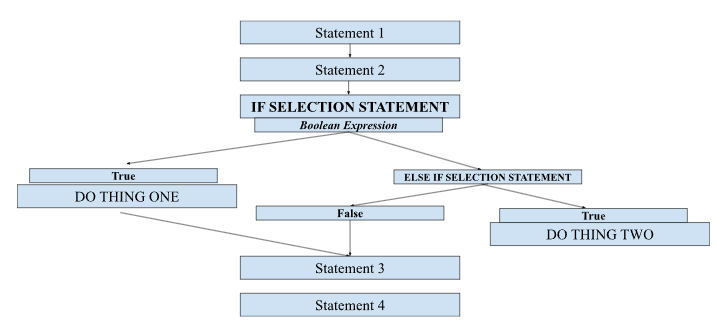
You can also add an else statement to this party, he’s a cool guy, kind of a loser, but he’s chill. All it serves is a fallback option on what to do if none of the if/else-if statements evaluated to true.
No need for another diagram. Instead, let’s have YOU do a practice problem to see if YOU understand.
Nested if Statements
Take a WILD guess what this is.
No, it’s not cobwebs, Jimmy*. It’s an if statement… that’s inside ANOTHER IF STATEMENT!
*Jimmy is an arbitrary name for a spider I made up.
Mind blown, am I right? They sky’s the limit with these, but they might look something like this:
if (condition)
{
	if (condition)
	{
		if (condition)
		{
			…
		}
	}
	else
	{

	}
}
Here’s a diagram as well:
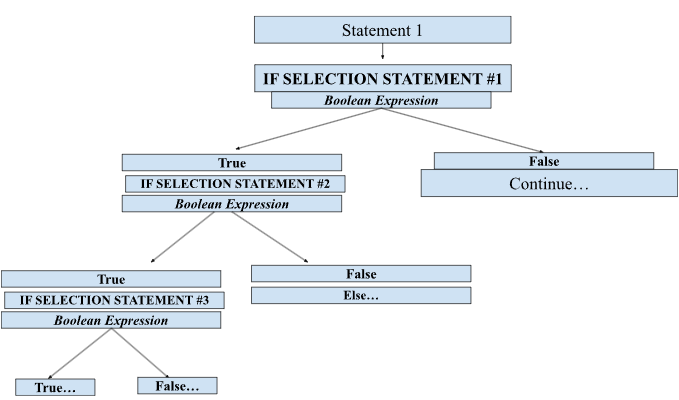
As you can see clearly here, the boolean expression of a nested if statement is only evaluated when the boolean expression of the if statement encapsulating (containing) it evaluates to true.
Practice
You see the article author, you know the drill.