
Introduction
Welcome to the FiveHive article for Unit 4.2 of AP Physics 1!
This article will delve deeper into the concepts of impulse and momentum, specifically the application of changes in momentum.
As usual, we will only cover the topics included in the CED for Unit 4.2.
Impulse and Change in Momentum
Impulse is a vector representing the effect caused by a force acting over a period of time. The standard symbol used to indicate impulse is , using units of , found with the equation .
If we expand the units of impulse, we get , which then simplifies to , which are the same as momentum. This is no coincidence, as the impulse-momentum theorem states that the impulse acting on an object equals the change in momentum of the object.
Change in momentum, like other vector quantities, can also be evaluated as , meaning . This is consistent with Newton’s Second Law, since when mass is constant.
Graphing with Momentum and Impulse
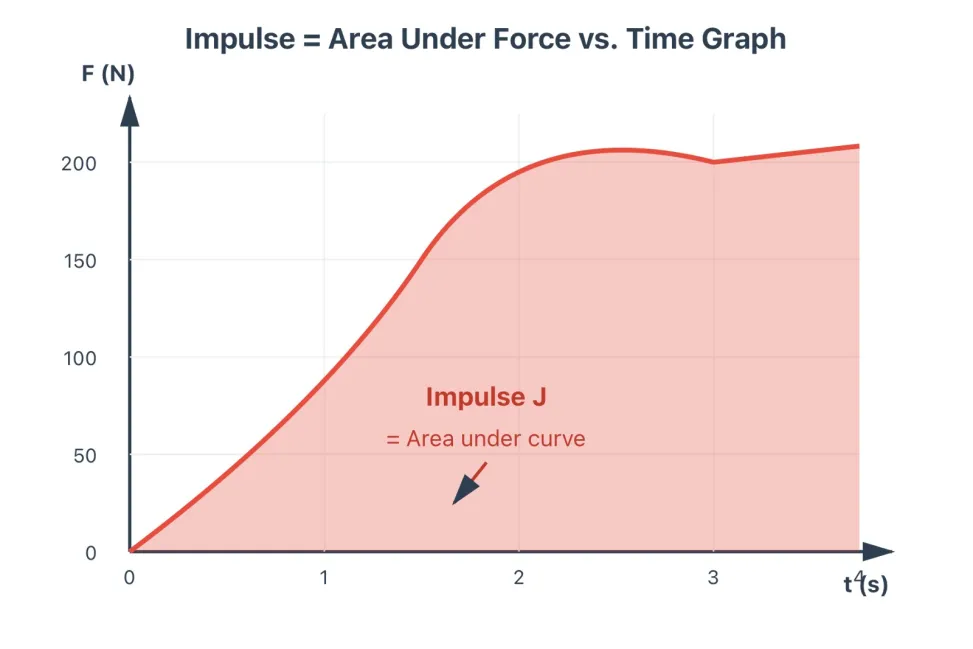
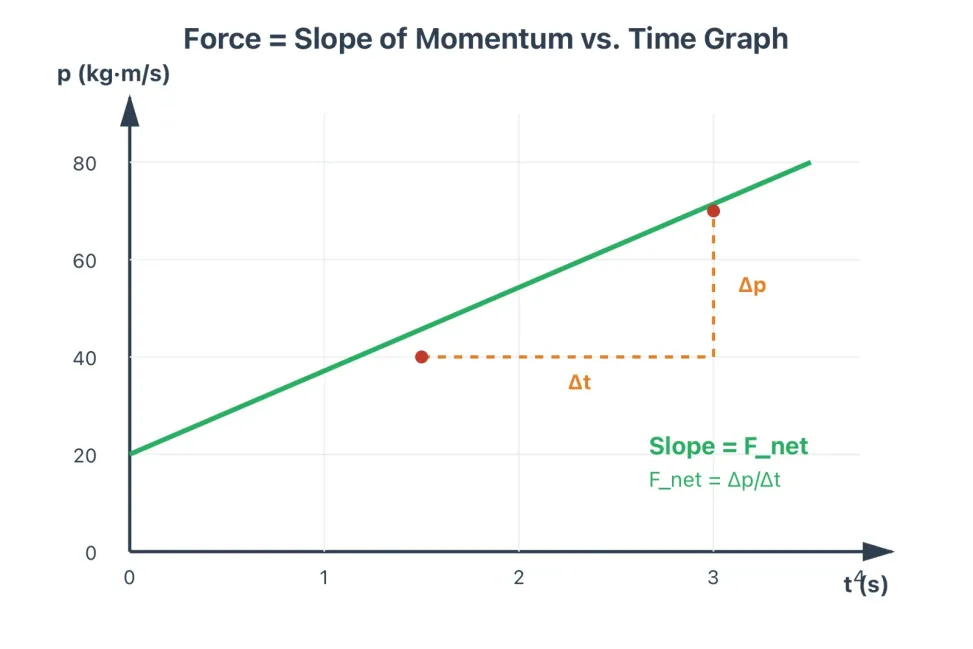
On an graph, the slope would represent the . This also means that the result would be equivalent to dividing the y variable by the x variable. At the same time, the area would represent , meaning the area is the same as the two variables being multiplied.
On a force vs. time graph, the area under the curve represents impulse, since multiplying force () by time () gives units of .
On a momentum vs. time graph, the slope represents net force, since
.
It is important to note that on the AP Physics 1 exam, you will only be expected to find the area under the curve for uniform changes in the -axis and -axis variables—in other words, no calculus.