
Introduction
Welcome to the Fivehive article for AP Physics 1 Unit 4.4!
In this article, we will go over the 3 types of collisions: elastic, inelastic, and perfectly inelastic. This unit will test your understanding of previous units and topics, especially momentum and kinetic energy.
Elastic Collisions
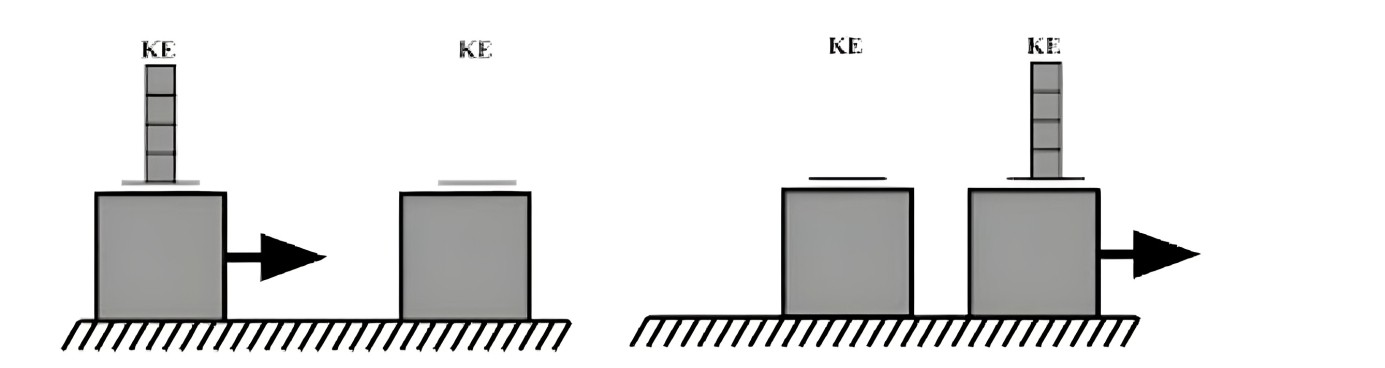
The 1st type of collision we will learn about is an elastic collision. During an elastic collision, both momentum and kinetic energy are conserved. This also implies that the total kinetic energy of the 2 colliding blocks is the same.
However, this does not mean the individual kinetic energies of each block stay the same. One object could gain kinetic energy, while the other could lose kinetic energy. What matters is that total kinetic energy stays the same.
Inelastic collisions
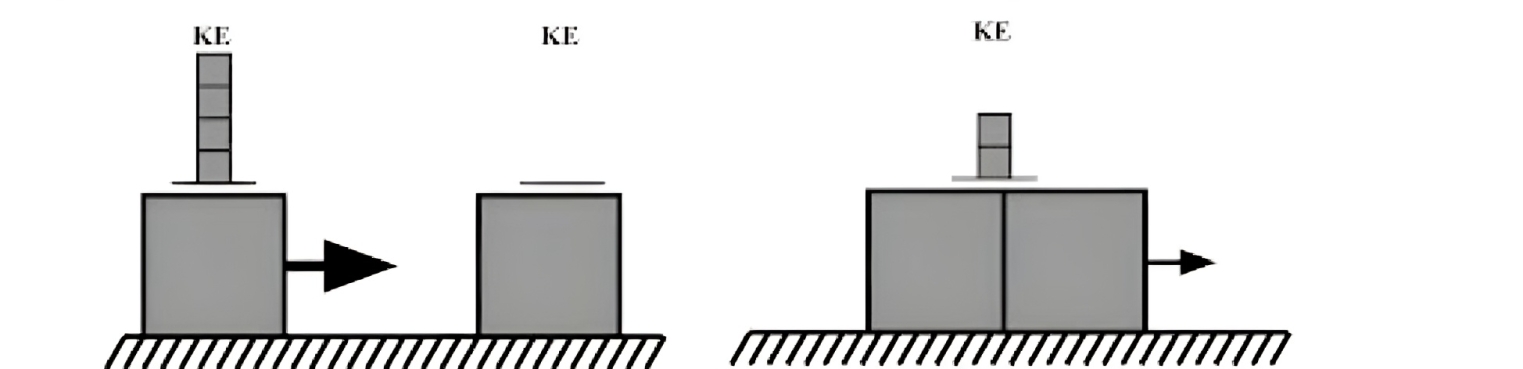
The defining feature of inelastic collisions is that kinetic energy is not conserved. However, momentum is still conserved no matter what.
You might be wondering where the lost kinetic energy goes. In most cases, it is transformed by nonconservative forces and released into the environment as heat or sound.
.png?alt=media&token=f5b990c7-a10d-4fad-9042-f023e62e81a8)
Perfectly Inelastic Collisions
Perfectly inelastic collisions are a special type of inelastic collisions. Similarly to them, kinetic energy is not conserved while momentum is. What sets apart perfectly inelastic collisions from inelastic collisions are that the 2 objects stick together after the collision and move at the same velocity. Similarly to inelastic collisions, kinetic energy is lost, usually to sound or heat.
As a rule of thumb in AP Physics 1, if 2 objects stick together after they collide, you should always think of perfectly inelastic collisions. Since momentum is always conserved, we can now treat the final momentum as .
Summary Table
| Property | Elastic | Inelastic | Perfectly Inelastic |
|---|---|---|---|
| Momentum conserved? | Yes | Yes | Yes |
| Kinetic energy conserved? | Yes | No | No |
| Objects after collision | Seperate | May stick together or be seperate | Stuck together |
Solving Collisions
To solve elastic collisions, we start by setting up conservation of momentum. This gives us an equation like this:
Next up, we can set up conservation of energy. This gives us an equation like this:
If we know the initial masses and velocities of the 2 objects, we have 2 unknowns and 2 equations, allowing us to solve for the final velocities by substitution.
Solving for perfectly inelastic collisions is much simpler. Since the blocks stick together after colliding, we can set up conservation of momentum like this:
Since we know the initial velocities as well as the masses, we can simply sum up the momentum of both masses and divide by total mass.