
Introduction
Work, as you have seen in the translational world, can also be applied to rotational motion. Again, it is imperative in this unit to observe the similarities between translational and rotational quantities and how they differ (see 5.2 - Connecting Linear & Rotational Motion).
Rotational Work vs Translational Work: Constant Applied Torque/Force
In Unit 3, we learned that under a constant force,
In the above diagram, the force is exerted in the same direction as the displacement vector; hence, the work is simply a product where .
In a rotational sense, we define the rotational work to be (under constant torque)
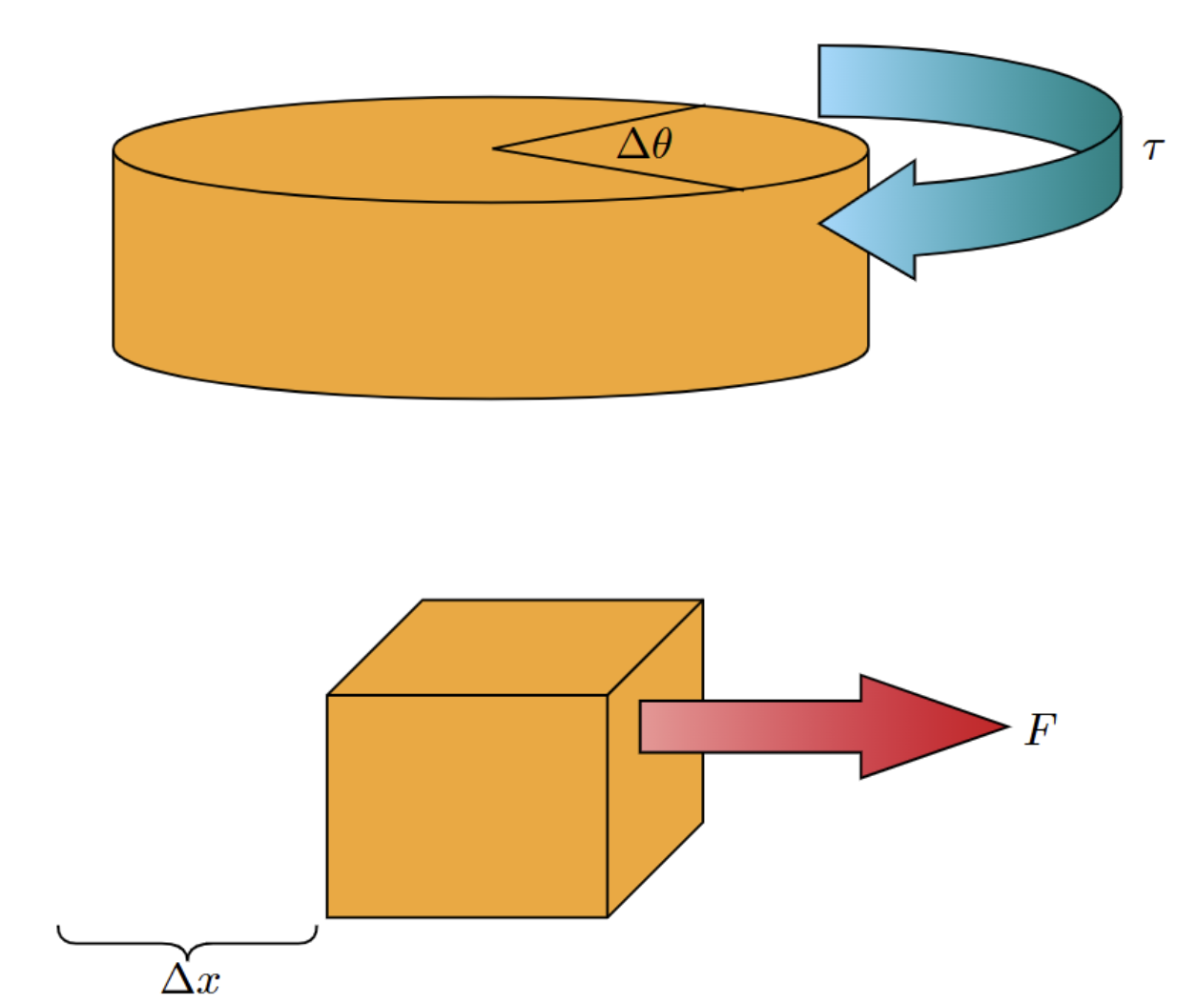
In AP Physics 1, you will only deal with scenarios where the rotational work is
We assign the sign of work the same way we did in the translational case, albeit a bit more unrigorously. Recall in the linear world that if the force applied on an object were in the same direction as its displacement vector (i.e., supporting force), the work would be positive by definition of the dot product. On the other hand, if the force opposed the motion of the displacement vector (i.e., a restoring force like springs), the work is negative by definition.
The same applies here for torque; if the torque appears to spin an object in the direction (clockwise or counter-clockwise) that it is applied in, the rotational work is positive. If the torque appears to spin an object in the opposite direction of how it actually is spinning, the rotational work is negative.
Graphical Analysis
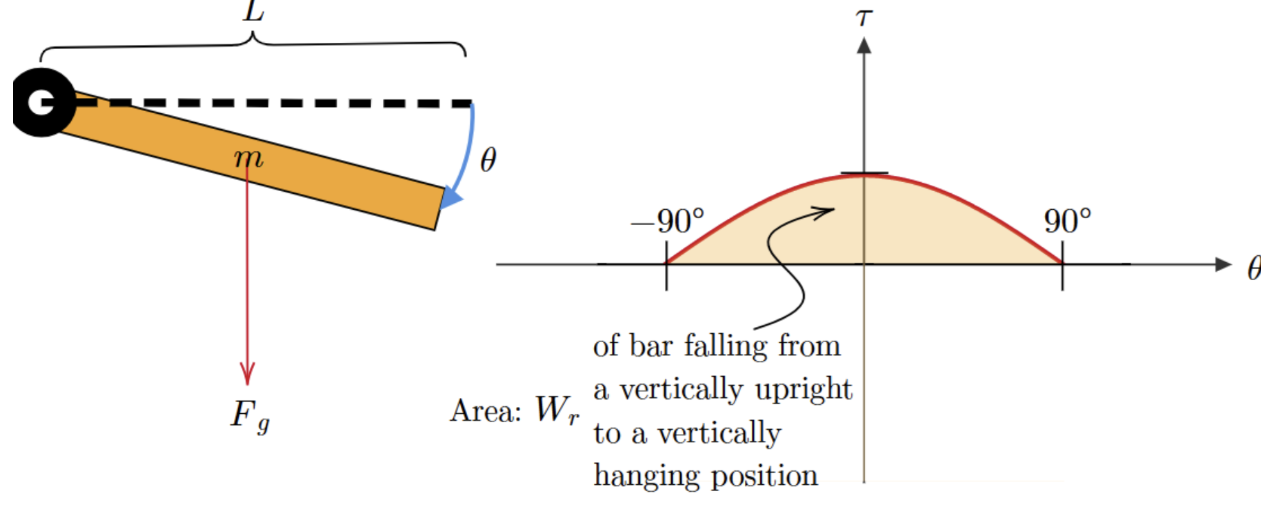
It should come as no surprise that the area under a 𝜏-θ graph is the rotational work done. In AP Physics 1, you are expected to find the rotational work done from a graph with a constant or linear 𝜏. You will not be expected to quantitatively find the work done through a graph as shown above.