
Introduction
Welcome! Today we’ll be looking at exponential functions, which are functions where an initial value is multiplied repeatedly to produce the output. These functions are different from linear or polynomial ones because they grow or decay at a constant rate of multiplication. They are often used to model real-world situations like population growth, interest, or decay, and understanding them is an important part of precalculus.
Essential Knowledge from the CED
According to the AP Precalculus Course and Exam Description (CED), these are the key ideas you’ll be expected to understand about exponential functions for the exam:
- Exponential functions follow the form , where . Exponential growth occurs when and decay when .
- Their domain includes all real numbers.
- Graphs of exponential functions are always increasing or always decreasing, with no extrema or inflection points.
- Recognizing the different types of transformations for exponential functions while retaining that the function remains exponential regardless of the transformation.
- Writing limit statements for exponential functions while emphasizing that the end behavior depends on the base: the values either increase without bound or approach zero.
Introduction to the General Form of Exponential Functions
In AP Precalculus, you will need to recognize and work with the general form of an exponential function. This form looks different from functions you may have studied earlier, such as linear or quadratic functions, because the variable appears in the exponent instead of just in the base. Understanding this setup is key, since it tells us whether the function models exponential growth or exponential decay.
The general form of an exponential function is: where a is the initial value (not equal to 0), and b is the base (greater than 0 and not equal to 1).
- If , the function represents exponential growth.
- If , the function represents exponential decay.
Example 1: Identify growth or decay
Suppose we have the function
Here, and . Since , this function shows exponential growth.
Example 2: Identify growth or decay
Now consider
Here, and . Since , this function shows exponential decay.
Additional Note
It is important to be able to write statements that describe the behavior of an exponential function. For example, consider
Since and , we can write the statement:
“This exponential function represents growth because and .”
The Domain of Exponential Functions
Another important property of exponential functions is their domain. The domain refers to all possible input values, or -values, that can be used in the function.
For exponential functions of the form , the domain is all real numbers. This means that no matter what value of you choose, positive, negative, or zero, you will always get a valid output.
Quick Check 1: Why this is true
Take
If is , , or , the function produces a real output every time.
Quick Check 2: Another case
Take
Even though the base is less than one, you can still plug in any value for , and the function will always give a real output.
The Graphs of Exponential Functions
Graphs of exponential functions have a very consistent shape. They are either always increasing (when the base is greater than one) or always decreasing (when the base is between zero and one). Unlike polynomials, they never have turning points, so there are no maximums, minimums, or inflection points.
Let’s look at an example!
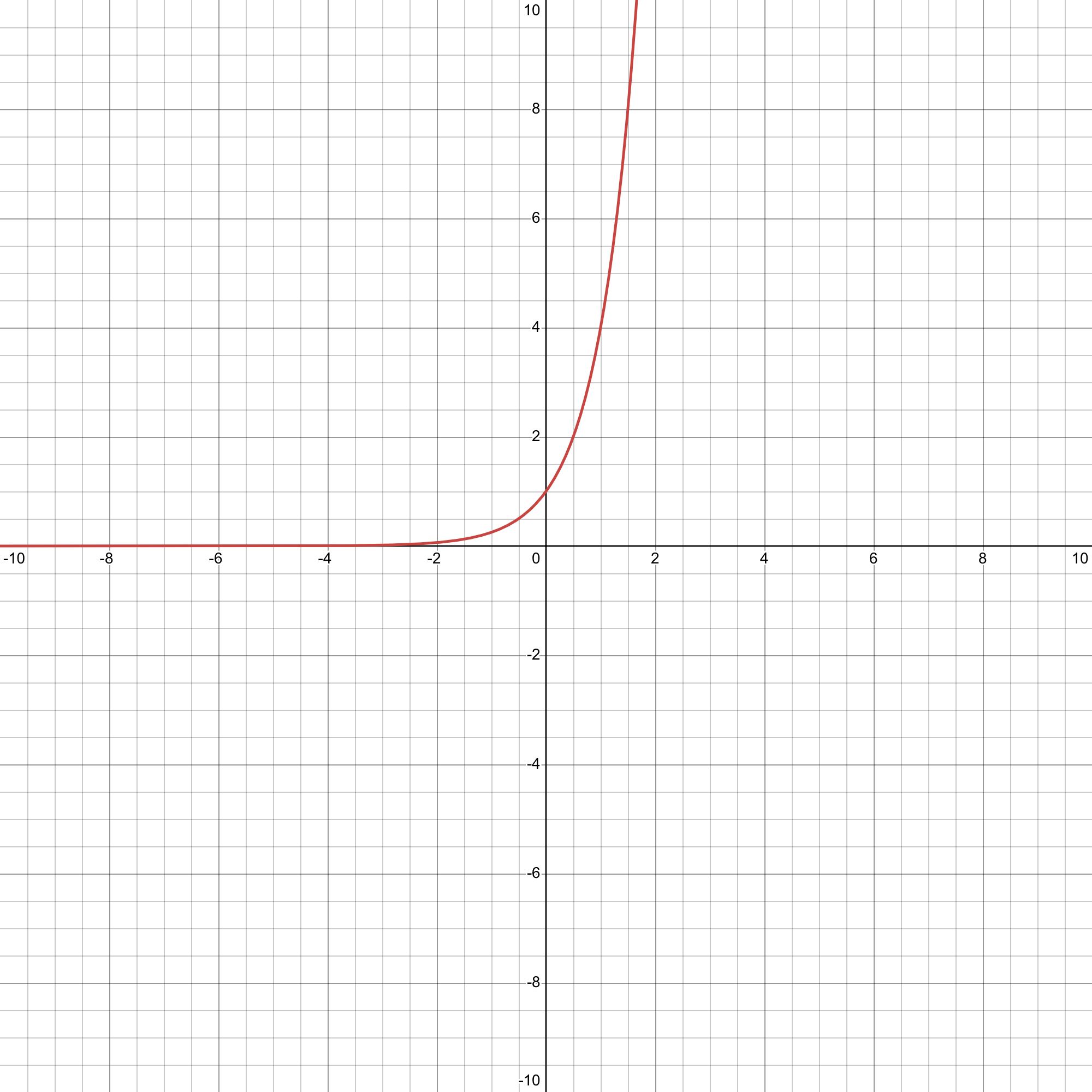
The graph of the function is shown below. Since the base is greater than , this function represents exponential growth. As you can see, the graph is always increasing. There is no maximum, no minimum, and no inflection point anywhere on the graph.
Transformations of Exponential Functions
Just like linear and quadratic functions, exponential functions can also be shifted, stretched, or reflected. These changes are called transformations, and they do not change the fact that the function is exponential.
Let’s start with the base function:
This is our parent exponential function. Now, let’s look at the transformations one at a time.
1. Vertical Shifts (Up or Down)
- Adding or subtracting a number outside the function moves the graph up or down.
- Example:
This graph looks like the base , but it is shifted upward by units.
2. Horizontal Shifts (Left or Right)
- Adding or subtracting a number inside the exponent moves the graph left or right.
- Example:
This graph has the same shape as , but it is shifted units to the right.
3. Vertical Stretches and Compressions
- Multiplying by a constant outside the function makes the graph stretch or compress vertically.
- Example (Stretch):
The factor of 5 makes the graph rise more steeply, which is a vertical stretch.
- Example (Compression):
The factor of reduces every output to one-fourth of its original value, making the graph flatter against the -axis. This is a vertical compression.
4. Reflections
- If the coefficient in front is negative, the graph is reflected across the x-axis.
- Example:
The negative sign flips the graph upside down, but the exponential shape is still there.
5. Horizontal Stretches and Compressions
-
Multiplying the exponent by a constant changes how the function grows horizontally. The effect is the reciprocal of that number:
- If the exponent is multiplied by , the graph is compressed horizontally by a factor of .
- If the exponent is multiplied by , the graph is compressed horizontally by a factor of .
- Example 1:
The factor of in the exponent compresses the graph by
- Example 2:
The factor of in the exponent stretches the graph by .
Let’s see how a transformation looks on a graph!
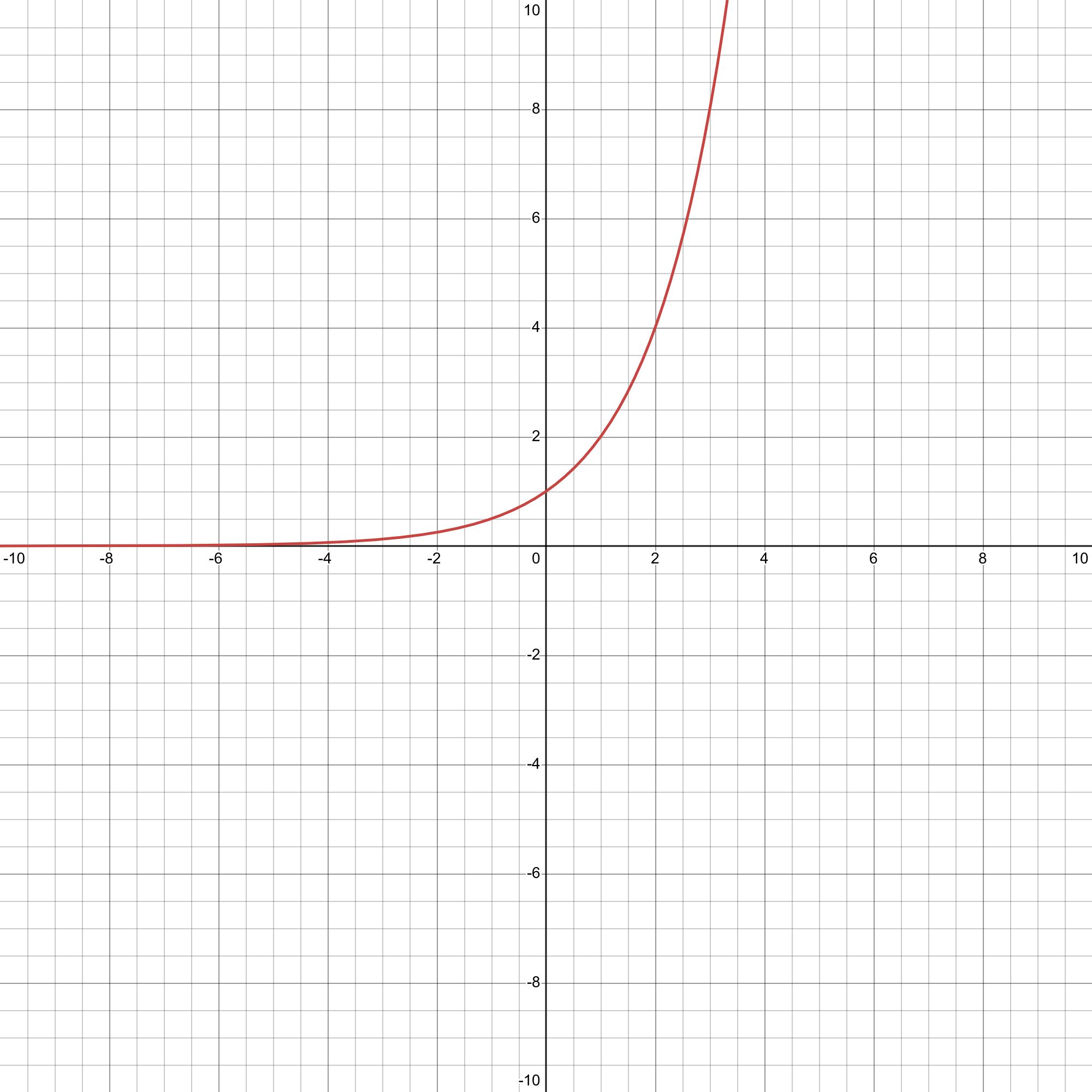
Let’s start with the parent function graphed. This curve goes through the point and rises quickly as increases.
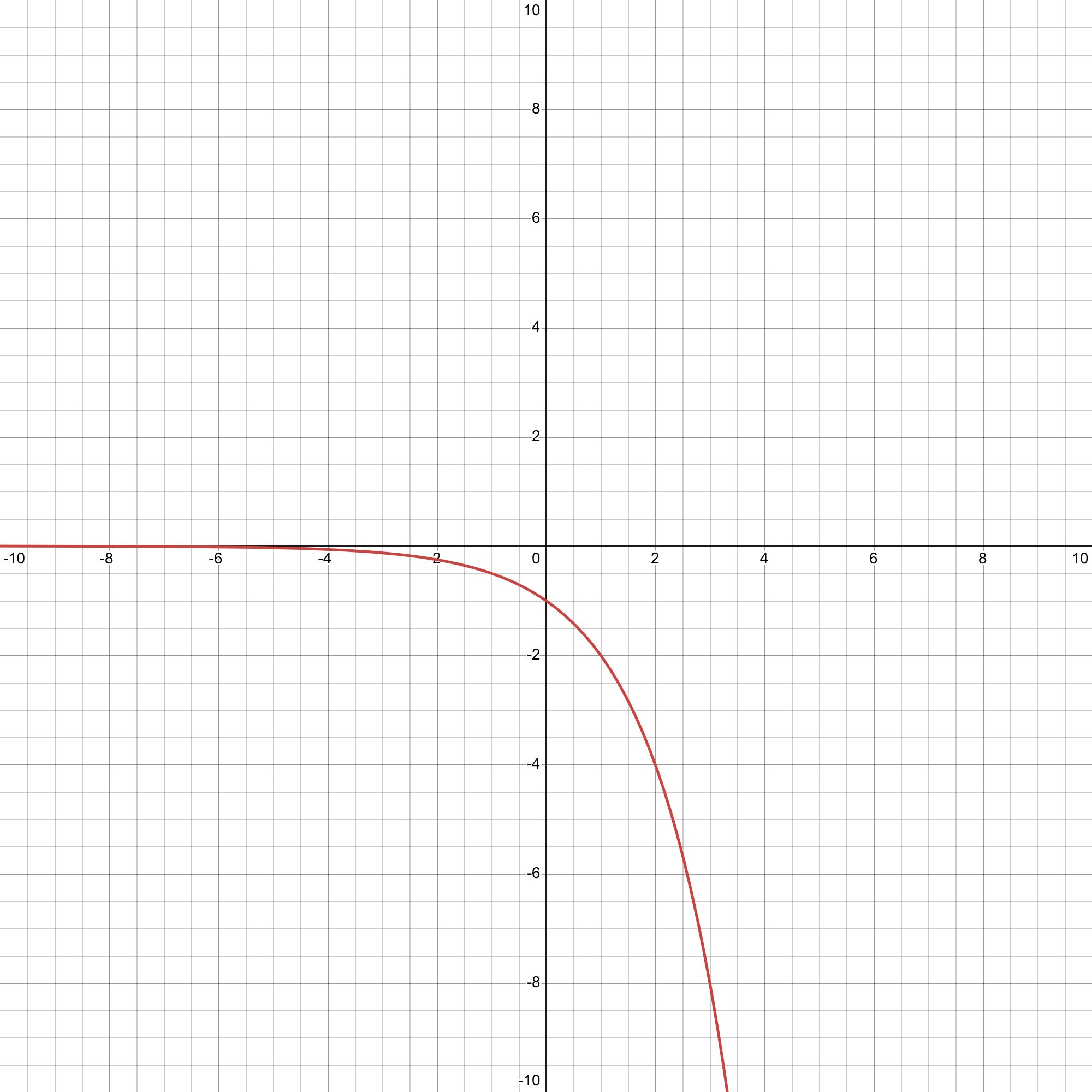
Now, let’s apply a reflection. Consider . The negative sign in front flips the entire graph across the -axis. Instead of rising upward, the reflected graph now points downward, but it keeps the same exponential shape.
End Behavior of Exponential Functions
You have definitely been introduced to limit notation by now, and exponential functions are another place where this idea is very useful. The end behavior of an exponential function describes what happens to the outputs as becomes very large or very small. This behavior depends on the base of the function.
If the base is greater than :
- As becomes very large, the function increases without bound.
- As becomes very small, the function gets closer and closer to zero.
If the base is between and :
- As becomes very large, the function gets closer and closer to zero.
- As becomes very small, the function increases without bound.
Quick Check: Growth
For
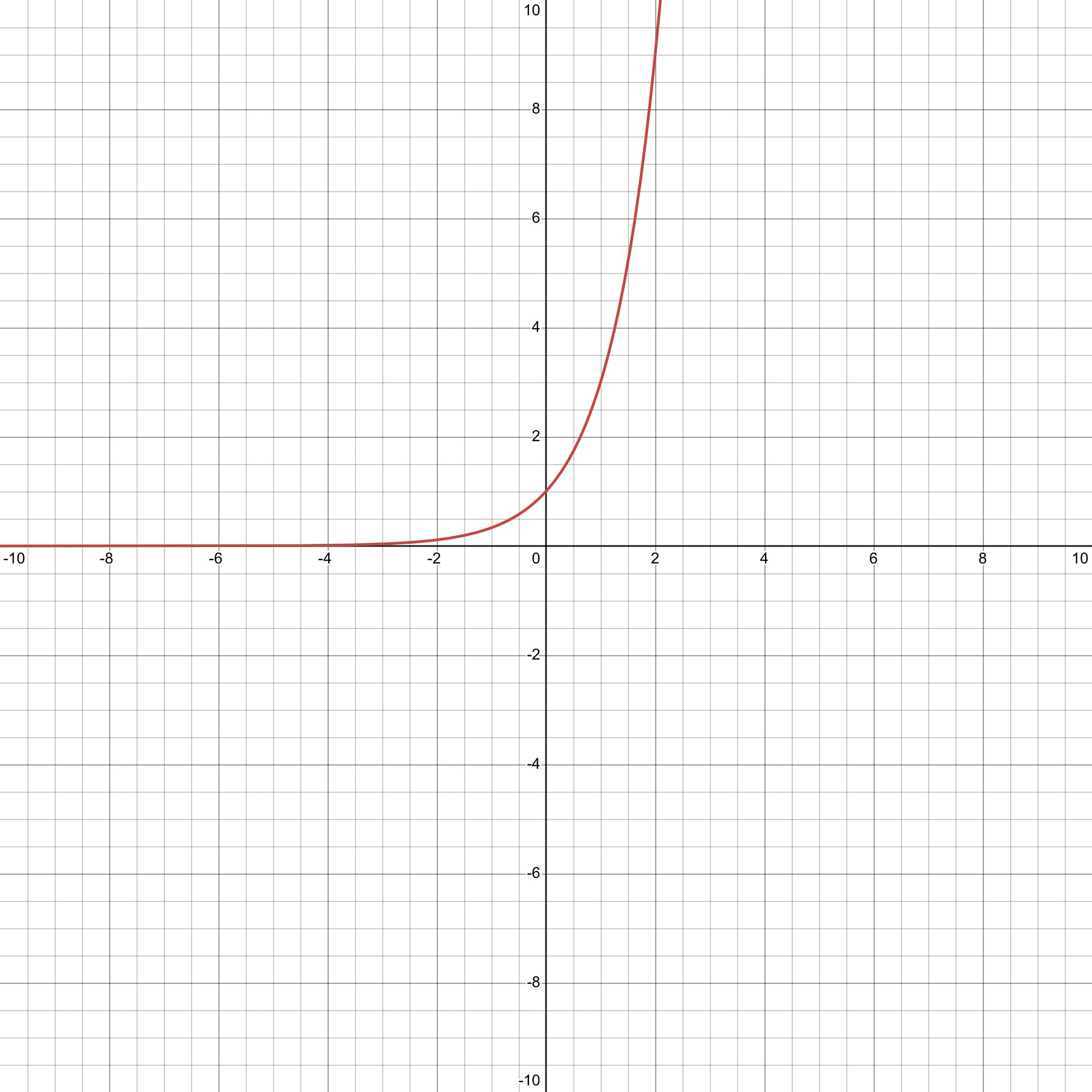
As you can see in the graph of , the curve keeps rising higher and higher as increases. We can express this as:
On the other side, as moves further into the negatives, the graph gets closer and closer to zero. That can be written as:
Quick Check: Decay
For
%5Ex.jpg?alt=media&token=c5d431c0-edae-407a-8953-c4584672df0e)
As you can see in the graph of , the curve shrinks toward zero as increases. In limit notation:
But if we look at negative values of , the graph grows larger and larger without bound. That can be written as: