
Introduction
In 4.10, we covered matrices, which are organized grids of numbers that we use to represent data, solve systems of equations, and even transform shapes in computer graphics. To further build our understanding of matrices, we need to look at two more matrix operations: the Determinant and the Inverse.
Review: What is a Matrix?
A matrix is a rectangular array of numbers arranged in rows and columns. When we talk about a matrix (two by two), we mean it has 2 rows and 2 columns. We usually write it inside square brackets like this:
Where .
Review: The Identity Matrix
In 4.10, we introduced the Identity Matrix, which we need to understand before going into the inverse of a matrix.
The Identity Matrix, denoted by the letter , is the matrix equivalent for multiplication by 1: anything multiplied by the Identity Matrix remains the same.
The Determinant of a Matrix
The determinant is a special number that we can calculate from a square matrix. For a matrix , the determinant is denoted as or .
The Formula
To find the determinant, we multiply the numbers of the main diagonal (the diagonal from the top-left to the bottom-right) and subtract the product of the numbers on the other diagonal:
What does it represent?
1. Area
If you think of the rows of the matrix as vectors, the absolute value of the determinant tells you the area of the parallelogram formed by those two arrows.
2. Invertibility
This is the most important rule. A matrix has an inverse if and only if its determinant is NOT zero (). If the determinant is , the matrix is “singular,” meaning it has no inverse.
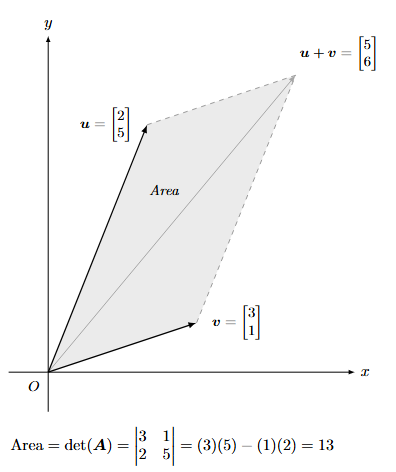
To find the area of this parallelogram, we’ll put the components of and into the first and second rows of the matrix respectively.
Multiplying the top-left entry by the bottom-right entry gives us . Multiplying the top-right entry by the bottom-left entry gives us . Now,
Taking the absolute value gives us
.
Additionally, you may notice that the vectors are described with matrices rather than chevrons (chevrons are the slanted brackets ), we’ll go into what this means in Unit 4.12.
The Inverse of a Matrix
The inverse of a matrix is written as . It is the “opposite” of the matrix. Just like the inverse of is (because ), the inverse of a matrix is the matrix that, when multiplied by , gives you the Identity Matrix .
However, not every matrix is invertible. There are two conditions that must be met:
Firstly, the matrix must have a nonzero determinant. As you’ll see with the formula below, a determinant of zero results in us running into a big off-limits zone in mathematics: division by zero.
Secondly, the matrix must be square. That is, there are an equal number of rows and columns. We’ll go more in depth on this near the end of the article.
Calculating The Inverse
For a matrix , follow these steps to calculate the inverse:
Calculate the determinant
Swap the positions of and .
Put a negative sign in front of and (change their signs).
Divide every number by the determinant.
The formula looks like this:
.
What about a 3 by 3 Determinant?
The following material is enrichment and is not included in the AP Precalculus Course and Exam Description. However, it may still be covered in some classes.
After a matrix, computing determinants becomes much more complicated because the simple diagonal formula no longer works.
A matrix looks like this:
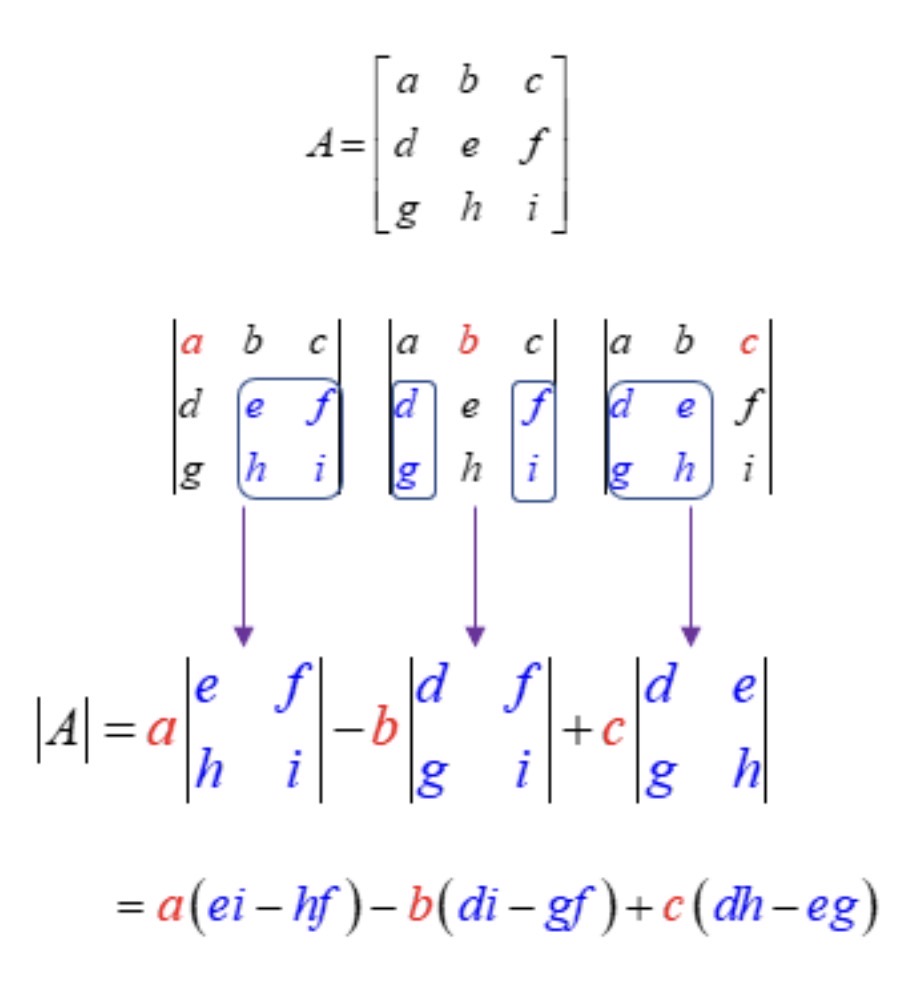
To find the determinant of a matrix, we use a method called Expansion by Co-factors. It’s essentially breaking a big problem down into several matrices.
The Checkerboard of Signs
Before we start, remember this grind of and signs:
To find , we “expand” along the top row (,, and )
Pick ‘’: Cross out the row and column containing . You’re left with a tiny matrix. Multiply by the determinant of that tiny matrix.
Pick ‘’: Cross out the row and column containing . Notice that the checkerboard says gets a negative sign. Multiply by the determinant of the remaining matrix.
Pick ‘’: Cross out the row and column containing . Multiply by the determinant of the remaining matrix.
The Formula
.
Well, what About Non-Square Matrices?
When we talk about the Determinant and the Inverse, we typically limit ourselves to square matrices, but why is this?
In the world of standard linear algebra (the field of math that primarily deals with matrices and vectors), the short answer is that non-square matrices do not have a determinant or standard inverse.
However, there is much more to the story! Let’s take a look at why this is the case, and what mathematicians do instead.
This section is not a part of the AP Precalculus course, so don’t worry too much about it.
The Non-Square Determinant
Recall that the determinant represents the area (for ) or, by extension, volume (for ) of a shape formed by the matrix’s vectors,
A matrix has vectors, but they only live in a 2D space. Imagine trying to find the “volume” of three arrows lying flat on a piece of paper; it’s not possible.
Furthermore, the formula for a determinant requires the matrix to be square so that every row and every column “pairs up” perfectly. Without a square shape, the diagonal multiplication we used earlier () simply has nowhere to go.
The Non-Square Inverse
A standard inverse must satisfy two conditions:
- (Right Inverse)
- (Left Inverse)
For a non-square matrix, it is physically impossible for one matrix to do both. Let’s say is a matrix. To multiply it, would have to be .
results in a identity matrix.
results in a identity matrix.
Because these identity matrices are different sizes, cannot be a true inverse.
So, What do we do Instead?
Then, what do mathematicians do when a matrix isn’t square or the determinant is zero? In 1920, mathematician Eliakim Hastings Moore discovered what we call the Moore-Penrose Psuedoinverse. Unfortunately, the psuedoinverse is quite complicated, so we won’t be getting too far into it.
The Psuedoinverse works for any matrix, no matter its shape. It works by finding the “closest thing” to an inverse.
In everyday life, the Psuedoinverse is what helps your phone’s GPS calculate your position even when the signals from satellites aren’t perfectly aligned!
See Wikipedia: Moore-Penrose inverse