
Introduction:
Welcome to the first article in FiveHive’s comprehensive AP Biology review. We understand biology is difficult, and we’re here to help! Remember, you are capable of getting a 5 on this test!
We’re going to be breaking everything down as simply as possible and include lots of images and diagrams to enhance your understanding. At the end of each article, there will be a practice section with answer explanations. We may go a bit more in-depth than what you actually need to know, but it’s important to understand the core concepts behind everything.
This article covers AP Biology Topic 1.1 - Properties of Water. We will be reviewing types of bonds, electronegativity, pH, and some unique properties of water. Let’s get into it!
Basic Chemistry Review:
In order to understand the different types of bonds, we must first understand the concept of electronegativity, which is an atom’s ability to attract the electrons of other atoms. Bond strength, polarity, and other factors all depend on the electronegativity of the atoms involved. Here is a video that explains electronegativity in relation to what you need to know.
It is also important to know electronegativity’s trends on the periodic table and be able to apply that knowledge (Q1 in the practice section). Electronegativity increases going down-to-up and left-to-right across the periodic table. Below is an image to help you visualize this trend.
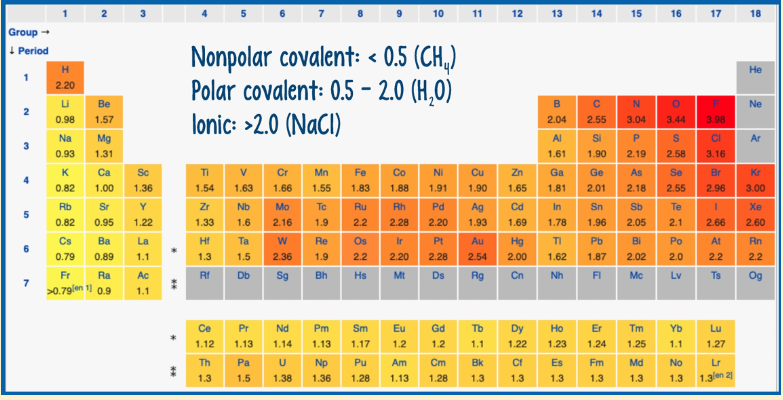
Polar covalent bonds form when the electronegativity difference between two atoms is 0.5 to 2. Ionic bonds form when the electronegativity difference is greater than 2.
Note that if two atoms of the same element form a bond, for example, in oxygen gas (), the electronegativity difference will be zero, and the bond is classified as nonpolar covalent.
That being said, these are not solid rules, like much of chemistry. Please do not view this as gospel and categorize all bonds based on electronegativity! You will never be given a multiple-choice question in the vein of “If atom A has electronegativity 0.4 and atom B has electronegativity 2.1, what type of bond is formed?”
Ionic bonds form when electrons are transferred between atoms. Below is a picture showing how (Sodium) and (Chlorine) come together to form (Sodium Chloride). Generally, ionic bonds form between a metal and a nonmetal.
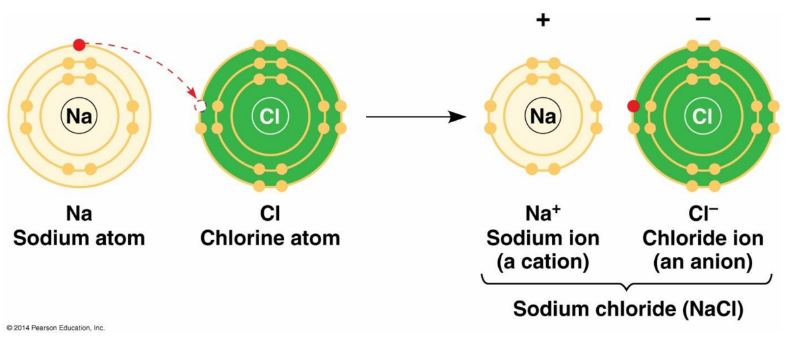
But how do these types of bonds form? It all depends on the electronegativity of the atoms involved. Atoms with high electronegativity (such as Chlorine and Fluorine) tend to form ionic bonds with atoms that have low electronegativity values (such as Lithium and Sodium). A great way to think about it is that highly electronegative atoms “pull” other atoms towards them by “holding onto” their electron clouds.
Covalent bonds form when two atoms come together and share their electrons with one another (sort of like when two people hold hands).
In AP Biology, there are two types of covalent bonds you should be familiar with: polar and nonpolar. A bond is classified as either polar covalent or nonpolar covalent depending on the electronegativity difference between the atoms involved. In nonpolar covalent bonds, the electrons are equally shared between the two atoms. In polar covalent bonds, that isn’t the case.
Molecules with polar bonds (such as acids) are generally soluble in water. Molecules with nonpolar bonds (such as fats and oils) are not usually soluble in water.
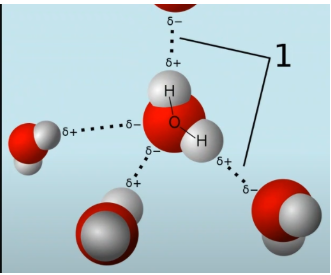
The last type of bond we’ll be reviewing is hydrogen bonds (see the below image). Hydrogen bonds are intermolecular forces that are formed when a hydrogen on one molecule is attracted to a highly electronegative atom (either fluorine, oxygen, or nitrogen) in another molecule. They are fairly weak bonds. (Q8) We will discuss more about these bonds in later units when we talk about DNA, but it is important to remember that water uses hydrogen bonding.
Below is a list of a few molecules and their properties that you should memorize.
| Molecule | Polarity | Type of Bonding |
|---|---|---|
| Water (H2O) | Polar | Hydrogen bonding |
| Carbon Dioxide (CO2) | Nonpolar | Nonpolar covalent |
| Methane (CH4) | Nonpolar | Nonpolar covalent |
Key Takeaway: Electronegativity is an atom’s ability to attract the electrons of other atoms. Electronegativity increases going up and right across the periodic table. Ionic bonds form when a highly electronegative atom “pulls” electrons from an atom with very low electronegativity, thereby leading to an electron transfer and bonding the two atoms together. Covalent bonds form when two atoms “share electrons.” In nonpolar covalent bonds, electrons are equally shared between the two atoms, but in polar covalent bonds, they aren’t. A bond is classified as nonpolar covalent, polar covalent, or ionic depending on the electronegativity difference between the atoms involved. Hydrogen bonds are weak bonds that form between hydrogen and either fluorine, nitrogen, or oxygen, such as in water.
Properties of Water:
There are four main properties of water that you should be familiar with.
- Cohesion
- Adhesion
- High Heat Capacity
- High Surface Tension
Cohesion and adhesion refer to water’s ability to “stick” to other things. Cohesion is water’s tendency to stick to other water molecules, and adhesion is water’s tendency to stick to its surroundings (aka the reason water is considered “wet”).
The most common example of this, and what you may see on the AP Bio exam, is how water works its way through trees.
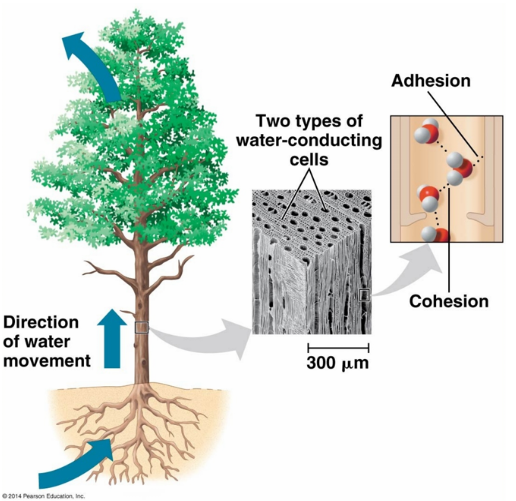
Water is brought in through the roots of trees, and works its way up the tree as one long chain of water molecules. Adhesion allows water to stick to the sides of the plant tissue, and cohesion allows water molecules to stay linked together. The two forces work together to fight the force of gravity. When a water molecule evaporates from a leaf or is used, the entire chain is pulled up, so the next water molecule can be used. (Q3)
Water also has a high specific heat, meaning that it can absorb large amounts of heat without changing its temperature. This also allows it to hold onto heat energy longer than other substances. In practice, this means that water takes lots of energy to warm up and lots of time to cool down (relative to other molecules). (Q6)
Another property of water we’ll cover is surface tension. Water has a high surface tension, meaning that it takes a considerable amount of force for water molecules at the surface of a body of water to break apart. (Q2)
The last topic we’ll cover in this article is pH, the measure of how acidic or basic a solution is. But first, we need to understand how acids and bases work.
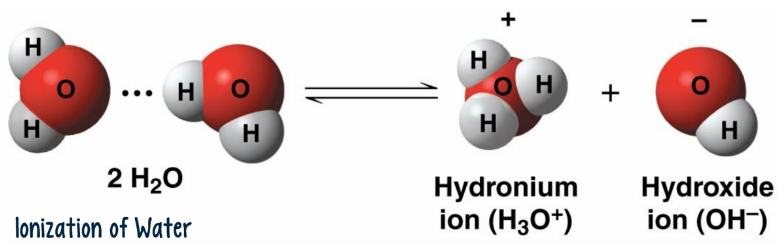
Acids donate protons (Hydrogens) to bases, which are hydrogen/proton acceptors. Let’s use the self ionization of water pictured above as an example. One of the water molecules is acting as an acid and donating an ion (proton) to the other water molecule, which is the base. This forms a hydronium ion () and a hydroxide ion ().
Please note that in practice, there is a slight difference between and but it’s beyond the scope of both AP Biology and AP Chemistry. For the purposes of this exam, they mean the same thing.
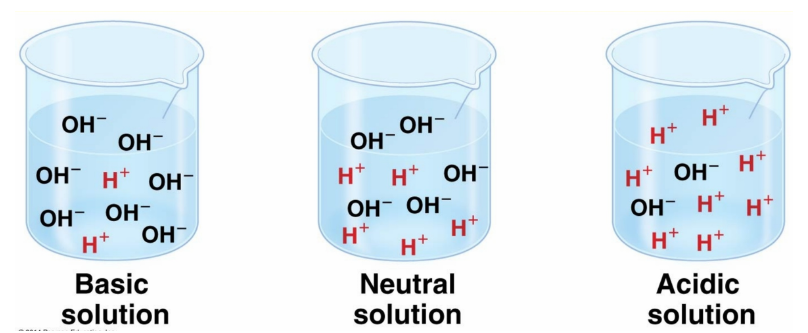
Solutions with more hydronium ions than hydroxides are acidic. Solutions with more hydroxide ions are basic. Below is a picture for your reference.
The pH of a solution is determined by the hydronium/hydroxide balance within the solution. Solutions with low pHs (less than 7) are considered acidic, with acidity increasing as pH decreases. Solutions with a pH of around 7 are considered neutral, and solutions with high pHs (greater than 7) are considered basic, with basicity increasing as pH increases. (Q5) Below is a picture to help you visualize:
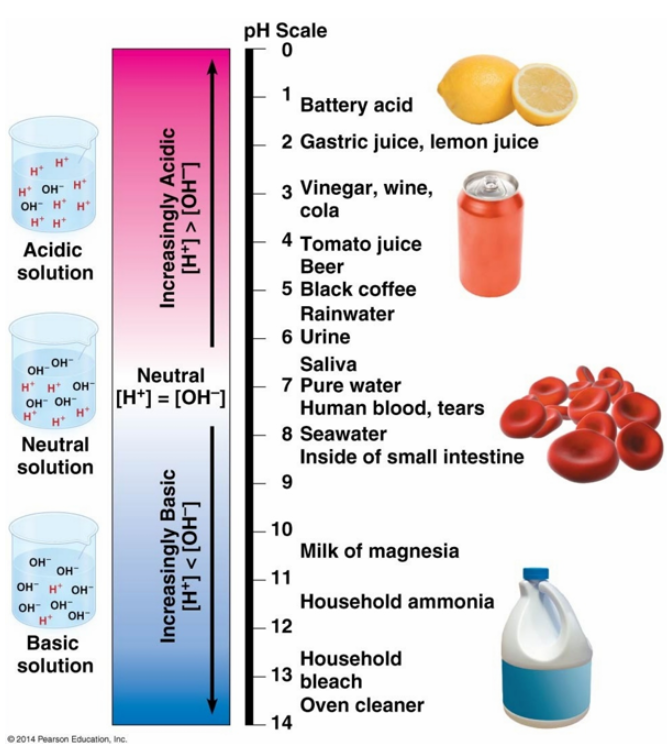
The formula to find the pH of a solution is where is the hydronium ion concentration of the solution. The opposite of pH is pOH, which can be found using the formula . By definition, . (Q4) It’s also worth noting that since the pH scale is logarithmic, the number of protons increases or decreases by a factor of 10 for a decrease or an increase in pH by 1 unit, respectively.
Key Takeaway: Water has four main properties: cohesion (water molecules’ ability to stick to each other), adhesion (water molecules’ ability to stick to other things), high specific heat (meaning it takes a lot of heat to get water to increase its temperature and a lot of time to get water to lost heat), and high surface tension. Cohesion and adhesion work together to allow for specific functions in organisms, such as how water works its way up trees. pH is a measure of how acidic or basic a solution is. The lower the pH, the more acidic the solution. The higher the pH, the more basic the solution.