
Introduction:
Welcome to AP Biology Topic 1.2: the elements of life and carbon. We will be reviewing the six biological elements you should be familiar with and why Carbon is so special. Let’s get right into it!
Elements of Life:
There are tons of elements on the periodic table, but luckily for us we only have to be familiar with six of them! To help you remember this, you can use the abbreviation CHNOPS (or CHONPS):
- Carbon
- Hydrogen
- Nitrogen
- Oxygen
- Phosphorous
- Sulfur
Out of the elements listed above, carbon, hydrogen, and oxygen are the most common ones (in biology); you will find them in most, if not all, biological molecules. We won’t go too much in-depth about them right now, but just know that they serve various key biological functions. (Q1)
Why is carbon special?
Out of the six elements listed above, carbon is perhaps the most useful and versatile of them all. This is because carbon has a few key features that no other element has…
- Its ability to form long chains, and those chains can branch off in multiple directions
- Its willingness to form double bonds (double bonds are much more stable than single bonds)
- Its ability to create ring-like structures
- Its ability to form long chains, and those chains can branch off in multiple directions
-
Its willingness to form double bonds (double bonds are much more stable than single bonds)
- Note that any element can form a double bond except hydrogen and helium. Carbon is special because it “likes” to form them more than the other elements.
- Its ability to create ring-like structures
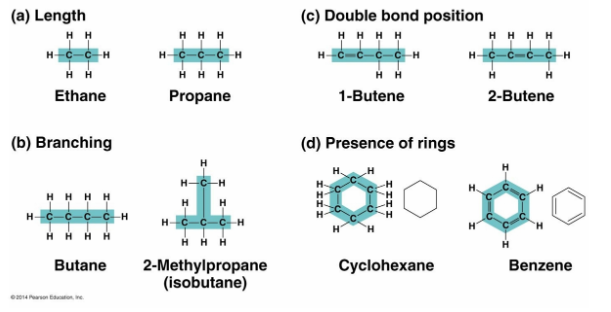
Although these features may not seem like anything crazy, they matter a lot in relation to biology.
Key Takeaway: The six elements of life are carbon, hydrogen, nitrogen, oxygen, phosphorus, and sulfur. What’s unique about carbon is that it can form long, branched (or unbranched) chains and ring-like structures, and it has a tendency to form double bonds. (Q2)