
Introduction:
Welcome to AP Biology Topic 1.3: Introduction to Macromolecules. We will be reviewing what macromolecules are and how they’re created and broken down. Let’s get started!
Macromolecules:
What’s the point of learning everything that was above? Ok, there’s a few elements that are special, and Carbon can do cool stuff, so what? The reason understanding all of that is important is so that you understand macromolecules. As the name suggests, macromolecules are, simply put, VERY large molecules. They are responsible for carrying out cellular functions and they are all carbon-based.
The concept of macromolecules can be difficult to wrap your head around, so we’re going to use the analogy of a train. Trains consist of multiple train cars that are linked together. The structure of macromolecules works in the same way. Macromolecules consist of many smaller subunits, called monomers, that are linked together. A molecule that consists of multiple monomers linked together is called a polymer.
The table below lists the four types of macromolecules and some relevant information about them. (Q1) We recommend that you have this table memorized for the AP exam.
| Type | Monomer Name | Polymer Name | Primary Cellular Function | CHNOPS Generally Present |
|---|---|---|---|---|
| Carbohydrate | Monosaccharide | Polysaccharide | Quick energy | C, H, O |
| Lipid | No single name, examples include Fatty Acids and Glycerol | No single name, examples include triglycerides and phospholipids | Cell membrane bilayer, cell signaling, long-term energy storage (fat) | C, H, O |
| Protein | Amino acid | Polypeptide | Various functions | C, H, O, N, S |
| Nucleic Acid | Nucleotide | DNA / RNA | Store and transmit genetic information | C, H, O, N, P |
Key Takeaway: Macromolecules are large molecules that are made up of subunits (monomers) that are chained together to form polymers. Macromolecules carry out all cellular functions. There are four main types: carbohydrates, lipids, proteins, and nucleic acids.
Bonding & Breaking Monomers:
So we know that monomers join together to form polymers, but how? People love to overcomplicate this, but we’re gonna keep it as simple as possible. Use the images below to follow along with the explanations.
In the image below, you have a monomer on the top (a long carbohydrate chain). In between each numbered monomer is a black line that represents a bond. In order to break apart a bond, a water molecule “forces” its way into the bond (and gets broken up in the process). On one end, you’re left with a hydrogen atom, and on the other end you’re left with a hydroxyl () group.
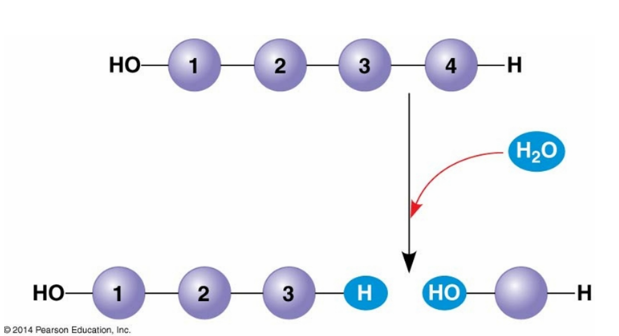
Our polysaccharide has been broken into two parts. Monomer 4 is now its own monomer and can be used for energy, and monomers 1, 2, and 3 are still stuck together. In order to separate the three monomers further, all you need to do is perform more hydrolysis reactions (Q2). This reaction is called hydrolysis. If you’re one of those people who likes to use the spelling of a word to infer its meaning, hydro- means water and -lysis (in this case) means break. Hence, the name of the reaction means breaking with water!
But what if we wanted to connect monomer 4 back to monomer 3? Turns out it’s pretty simple! Remember that water molecule that was split up to separate the two monomers? If you form that water molecule again, the bond between the two monomers will also be formed again. Take the Hydrogen from the chain and the OH that’s attached to monomer 4, and combine those into a water molecule. The two monomers will connect again! This reaction has a bunch of names, but we like to call it dehydration synthesis because you’re removing the water (dehydrating the molecule) and joining (synthesizing) the two monomers together.
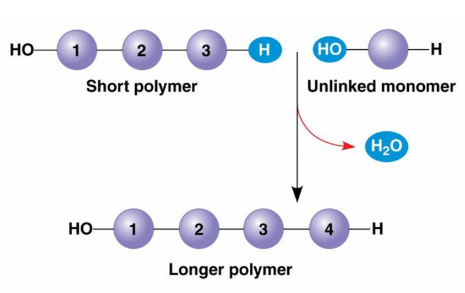
Key Takeaway: Hydrolysis reactions break polymers into monomers by introducing a water molecule that splits into a hydrogen atom and an OH group. Each group attaches to one end of the two molecules that are formed. Dehydration synthesis reactions connect two monomers by removing a water molecule from the bond between the two monomers. (Q3)