
Introduction:
Now that we’ve studied the properties of molecules, what macromolecules are, and how macromolecules are formed and broken down, we can go into the different types of macromolecules and their individual properties and functions. The rest of the articles for this unit will each focus on one category of macromolecules. This article (Topic 1.4) will cover carbohydrates. Each article (1.4 - 1.7) will consist of three sections: a general overview of the macromolecule, its structural properties, and its functional properties. There’ll be a table at the end summarizing everything along with practice questions. Let’s begin!
General Overview
The first word you should think of when you think of carbohydrates should be “sugar!” Carbohydrates are generally sweet-tasting, highly water-soluble molecules that have the general chemical formula of , meaning that there is a ratio of carbon, hydrogen, and oxygen (for example glucose has the formula ). Carbohydrate monomers are called monosaccharides or simple sugars, and polymers are called polysaccharides or complex sugars. They are most commonly found in a ring-shaped form and are used for quick energy and for forming cell walls in plants and fungi.
Structure
Monosaccharides are usually ring-shaped and only contain carbon, hydrogen, and oxygen. Take the pictures below, for example.
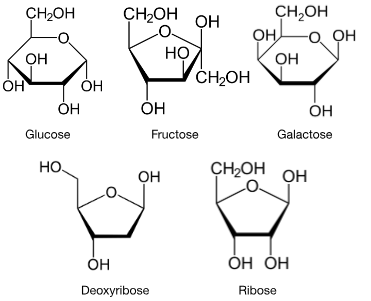
Monosaccharides will look mostly the same, save for a few modifications. As you can see above, the structure of the monomers remains relatively unchanged, save for the presence and positioning of some atoms.
Polysaccharides are simply long chains of monosaccharides connected via glycosidic bonds. What differentiates polysaccharides from each other is usually the orientation of the monomers within the polymer. Take starch and cellulose, for example.
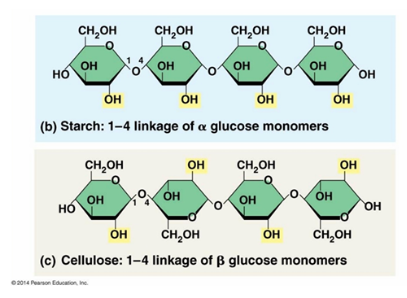
As you can see, the monomers in both molecules are the same, but in starch, all the monomers are oriented the same way. In cellulose, the orientation of the monomers alternates. There is a functional reason for this, which we will elaborate on in the next section.
Function
Carbohydrates serve two main functions in cells: energy and cell structure. There are two forms of carbohydrates that you should be familiar with in AP Biology: starch and cellulose. Although both are found in plants, starch is used for energy, whereas cellulose makes up the cell walls of plants.
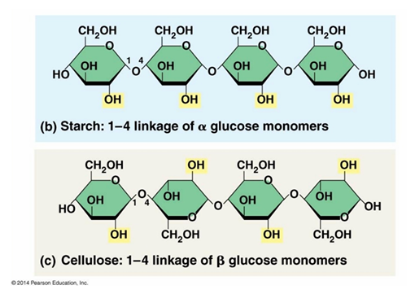
Let’s take another look at the structures of starch and cellulose. Specifically, the highlighted groups. We see in starch that all the s are on one side, whereas in cellulose, they alternate. What do you think could be the reason for this?
The reason has to do with the functions of the molecules. Cellulose, being used in plant cell walls to provide structure, needs to have a structure that is strong and rigid. By having the molecules alternate, when there are multiple stacks of molecules on top of each other, they can “slot” into each other like Lego bricks, creating a single, solid structure. This is why cell walls are so strong.
On the other hand, having the groups on the same side as starch prevents the molecules from being packed together so tightly. This allows them to be separated into monomers easily. This is necessary because cells get energy from individual glucose monomers. While polymers make it easier to store large quantities of energy, eventually they must be broken down. Having a structure that keeps the polysaccharide chains separated helps with that. (Q1)
NOTE: You are not expected to memorize the structure of specific carbohydrate polymers for the AP exam. The above examples are used for explanation’s sake.
Key Takeaway: The structure and function of carbohydrates are closely linked. Structural polysaccharides have alternating alpha-beta glucose monomers to help them “slot” together to allow for a stronger structure, while polysaccharides that are used for energy have structures that keep them easier to break apart.
Summary
| Structure | Monomer / Polymer Name | Function |
|---|---|---|
| Ring-like. Contain C, H, O | Monosaccharide / Polysaccharide | 1) Energy storage<br>2) Make up cell walls |