
Introduction
Welcome to AP Biology Topic 1.5: Lipids. This article will consist of three sections: a general overview of lipids, their structural properties, and their functional properties. There’ll be a table at the end summarizing everything, along with practice questions. Let’s begin!
General Overview
The first word you should think of when you think of lipids should be “fat!” They are generally water-insoluble (meaning they don’t like water, they’re hydrophobic) and are mostly composed of carbon and hydrogen (although there may be a few oxygens present).
Structure
Lipids are mostly made up of carbons and hydrogens (which create hydrocarbon chains as shown in the image below). This leads to them being generally nonpolar and hydrophobic, as carbon and hydrogen are nonpolar atoms. Below is a table that you should memorize:
| Oxygens Present | Polar | Hydrophilic |
|---|---|---|
| No/Little Oxygens Present | Nonpolar | Hydrophobic |
Because lipids come in many different forms, there is not one single monomer or polymer type/name. Some common monomers you should know for the AP exam include glycerol and fatty acids, while some common polymers are triglycerides and phospholipids. Below is an example of a fatty acid monomer (Notice the long hydrocarbon chain? That’s the reason the molecule is a lipid):
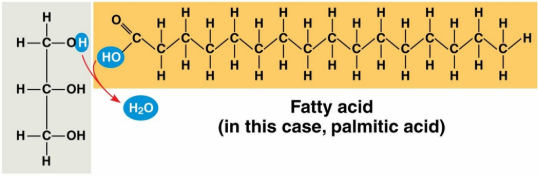
The bonds present in lipids are called ester bonds/linkages. Unlike the other macromolecules, lipid polymers are NOT a repeating series of monomers. Ester bonds form within lipid monomers to help hold them together. In the image above, there is an ester bond between the blue H and blue OH.
To help clarify this concept, let’s take a look at starch from the previous article:
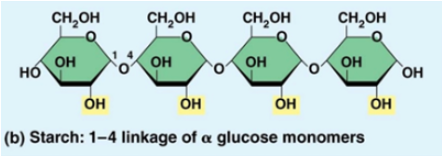
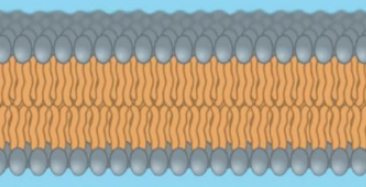
Unlike starch, the phospholipid bilayer (aka the cell membrane) is not made up of linked monomers. Instead, it is made of multiple monomers that are packed tightly against each other.
Key Takeaway: Lipids are nonpolar, hydrophobic macromolecules. Lipid polymers are special in that they are not a repeating series of monomers, unlike the polymers from the other macromolecule groups.
Function
In AP Biology, you should be familiar with the following lipids and their functions:
- Steroids (hormones)
- Fats (energy storage and insulation)
- Phospholipids (form cell membranes)
- Cholesterol (structural stability to animal cell membranes)
Hormones are molecules that travel throughout the body and instigate certain reactions in certain types of cells. We get more into what hormones do in THIS (hyperlink) article in Unit 4. Below is an example of a steroid, a type of synthetic hormone.
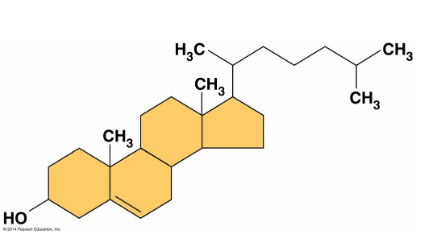
You can see that it’s a lipid because it mainly consists of only carbons and hydrogens.
The second function of lipids is in composing the cell membrane. This is done by phospholipids, which have hydrophilic heads and hydrophobic tails. This polar/nonpolar nature of phospholipids makes them great for making up cell membranes. We talk more about cell membranes in THIS (hyperlink) article in Unit 2. Below is an image of a phospholipid:
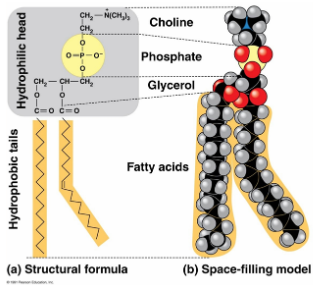
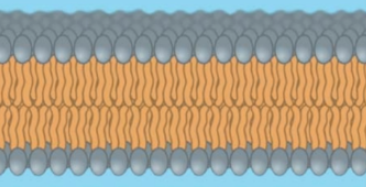
As you can see, the head of the phospholipid contains lots of different atoms that contribute to it being hydrophilic. However, the tail only consists of a hydrocarbon chain. This is what gives phospholipids their dual nature. In a cell membrane, the heads of the phospholipids face the outside and inside of the cell, which are water-filled environments, whereas the tails face each other, creating a bilayer. (Q3) Below is a visual representation:
Another lipid found in the cell membrane is cholesterol. While cholesterol is generally regarded as a “bad” thing, it is crucial for cell membranes as it helps provide structural stability.
A unique property that phospholipids have is that they can be saturated or unsaturated. These terms refer to the presence of kinks or bends in their hydrocarbon tails.
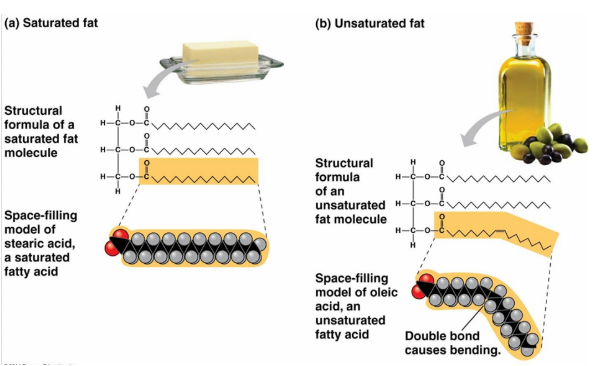
As seen in the image above, when unsaturated fatty acids are present, the solution is a liquid at room temperature. When saturated fatty acids are present, the solution is usually solid at room temperature. This is because saturated fatty acids can pack tightly together, therefore staying solid. (Q1)
We don’t freeze in cold environments, though, or at least not immediately. In fact, some organisms, such as polar bears, live in freezing cold environments! This is because cell membranes have some unsaturated fatty acids in their bilayers, which prevent them from freezing. Unlike saturated fatty acids, which contain only single bonds between carbon atoms,
unsaturated fatty acids contain at least one double bond between carbon atoms, which causes the carbon chain to kink, and thus prevents lipids from freezing together. The more double bonds a fatty acid has, the more kinks it has, meaning it is more resistant to freezing (will be “more liquid” at room temperature).
One of the first words we used to describe lipids in this article was “fat.” Lipids are what make up fat, and they play an essential role in the body. While we generally regard fat as a bad thing, it is important for the body to have some fat for energy storage and to support bodily functions. For organisms living in cold climates, such as polar bears, fat acts as an essential layer of insulation, helping to keep them warm.
Key Takeaway: Hormones are lipids that are used in long-distance cell-to-cell communication. Phospholipids form bilayers to make up cell membranes; their hydrophilic heads face the outside and inside of the cell, and their tails face inwards. Phospholipids can be saturated or unsaturated. Unsaturated phospholipids are less prone to freezing, which is why they are present in cell membranes.
Summary
Structure: Varies. Phospholipids have hydrophilic heads and hydrophobic tails.
Monomer / Polymer Name: N/A
Function: Long-term energy storage, hormones used in long-distance cellular signalling, phospholipids make up the bilayer in the cell membrane