
Welcome to AP Biology Topic 1.6: Nucleic Acids. This article will introduce us to nucleic acids, which we’ll focus on in later units, and discuss their structural properties. There’ll be a table at the end summarizing everything, along with practice questions. Let’s begin!
General Overview
The first word you should think of when you think of nucleic acids should be “data!” Nucleic acids contain all the genetic information that life needs to survive. There are two types of nucleic acids: deoxyribonucleic acid (DNA) and ribonucleic acid (RNA).
Structure
DNA and RNA polymers are made up of nucleotide chains that are called “strands.” These strands have two distinct ends: a 5’ (five prime) end, which has a phosphate, and the 3’ (three prime) end, which has a hydroxyl () group on the sugar of the nucleotide. When nucleic acids are synthesized, nucleotides are added to the 3’ end of the growing strand, forming covalent bonds.
DNA is composed of two antiparallel strands, one running in the 5’ (five prime) to 3’ (three prime) direction and the other 3’ to 5’. Each strand is composed of a repeating series of nucleotide monomers, as you can see in the image below. RNA is composed of a single strand.
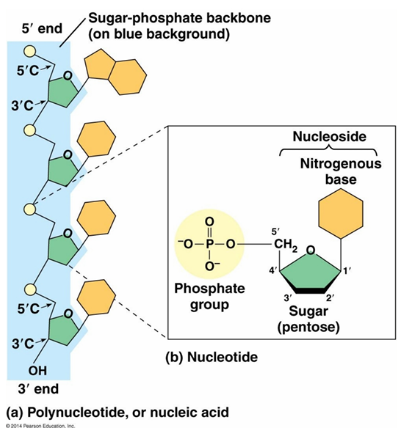
Each nucleotide is composed of a sugar-phosphate backbone (a phosphate group called PO4 attached to a sugar) and a nitrogenous base. In DNA, the sugar is deoxyribose, while in RNA, the sugar is ribose. They are both pentose sugars (meaning they have five carbons); however, deoxyribose has one less oxygen atom than ribose at its second carbon. (Q1)
Nucleotides can have any one of five nitrogenous bases: adenine, thymine, cytosine, guanine, and uracil. Cytosine, guanine, and adenine are present in both DNA and RNA. Thymine is only present in DNA, and uracil is only present in RNA. (Q2)
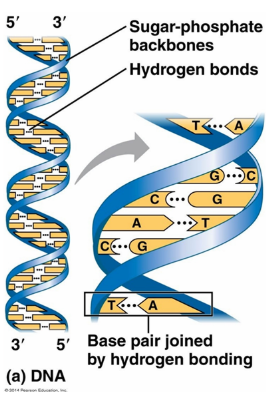
As seen in the image above, DNA consists of two antiparallel strands connected in the middle with hydrogen bonds. (Q3) The weak nature of hydrogen bonds makes them ideal for keeping DNA together when necessary, but allowing for it to be easily split during replication or transcription.
Not all nitrogenous bases can pair with each other. Adenine only pairs with thymine, and cytosine only pairs with guanine. In RNA, adenine pairs with uracil.
Summary
The table below highlights the differences between DNA and RNA:
| Nucleic Acid | # of strands | Sugar | Nitrogenous Bases |
|---|---|---|---|
| DNA | 2 | deoxyribose | Cytosine<br>Guanine<br>Adenine<br>Thymine |
| RNA | 1 | ribose | Cytosine<br>Guanine<br>Adenine<br>Uracil |