
Welcome to AP Biology Topic 1.7: Proteins. This article will deep dive into the various properties and unique functions of proteins. There’ll be a table at the end summarizing everything along with practice questions. Let’s begin!
General Overview
The first word you should think of when you think of proteins should be “everything!” This is for two reasons:
- Unlike the other macromolecules, proteins can contain all the CHNOPS
- They carry out most cellular functions
Because proteins play so many roles, their structure/function relationship is extremely important. The properties we’re about to go into are called the variable properties of proteins.
Structure of Amino Acids:
Protein monomers are called amino acids. Polymers are called polypeptides (or just proteins). The general structure for proteins is illustrated in the image below:
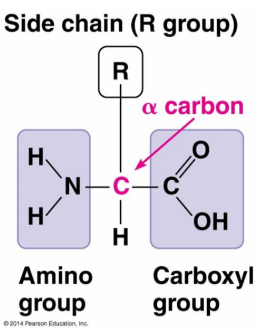
The structure of proteins is very similar. As you can see in the image above, all proteins have a central carbon (also called the alpha carbon) with a hydrogen, an amino group, and an acidic carboxyl group (this is why protein monomers are called amino acids).
Where they differ is the R-group. Each R-group has a different structure, so when multiple amino acids are connected to form a protein, the difference in R-groups between two polypeptides leads to their differing functions. R groups can be hydrophobic (nonpolar), hydrophilic (polar), and ionic.
The interaction between these groups can determine the structure and function of a protein. (Q1) The twenty most common amino acids each have their own R-group, but don’t worry, you won’t be expected to memorize them.
Structure of Polypeptides:
Another way proteins differ from the other macromolecules is that they have four “structural levels:” primary, secondary, tertiary, and quaternary. These structures describe the order in which proteins are formed. We will use images to help describe each structural level. Remember that all of these structures play a role in determining a protein’s function.
The primary structure of a protein is simply the amino acid sequence, as shown in the image below:
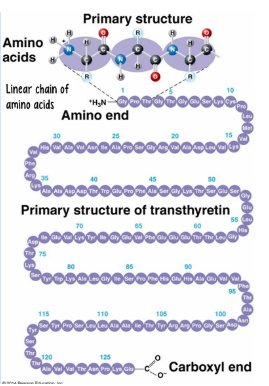
One end of the amino acid chain is called the amino end due to the presence of ammonia. The other is called the carboxyl end due to the presence of a carboxyl group.
The primary structure of a protein is a long chain of amino acids that determines the overall shape of the protein. Once it’s formed, it begins folding into the final form of the protein. Each amino acid in a protein is connected by covalent bonds, called peptide bonds.
The long chain of amino acids first forms into one of two shapes through hydrogen bonding in the peptide backbone: a spiral or a folded sheet. These shapes are called alpha helices and beta pleated sheets, and represent the protein’s secondary structure. Interactions (such as hydrogen bonds, disulfide bridges, ionic bonds, and hydrophobic interactions) between the polypeptide’s R-groups cause the helices and sheets to fold into a new shape, which is called the tertiary structure.
For some proteins, the tertiary structure is their “final structure,” meaning that once it is achieved, the protein is fully functional. However, more complex proteins require multiple tertiary structures (or polypeptides) to combine. This is called a quaternary structure.
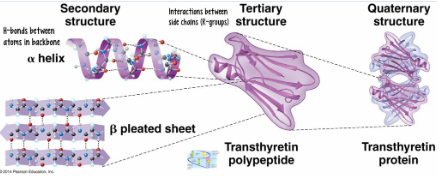
The process is illustrated in the image above. Simply put, the first step to making a protein is creating the appropriate amino acid sequence. Amino acids fold into alpha helices or beta pleated sheets, which come together to form a tertiary structure. Some proteins require multiple tertiary structures/polypeptides to come together to form a quaternary structure.
Key Takeaway: Proteins are responsible for most cellular functions. All proteins have a central alpha carbon with a hydrogen, an amino group, and a carboxyl group. Where they differ is the R-group. Proteins cycle through three to four structures before becoming fully functional.
Even though proteins have many structures, each structure is dependent on the previous one. (Q2) The various protein structures are all derived from the folding of the primary structure. In some cases, proteins can “unfold” back to their primary structure. This is called denaturation and is illustrated in the image below.
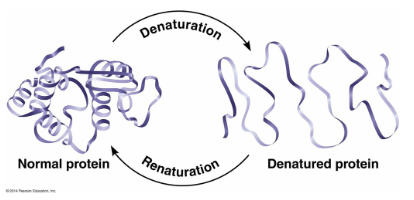
For the purposes of AP Biology, denaturation can be caused by one of three things: (Q3)
- Excess heat
- pH changes
- Mechanical agitation (vigorous shaking/stirring)
In some cases, renaturation can also occur, bringing the protein back to its original shape. An example of this is the pepsin enzyme. Pepsin is one of the main enzymes of stomach acid. If the pH of pepsin’s environment is too high, it will denature; however, if the pH is brought back down, pepsin can renature into a functional enzyme.
Function
Proteins have many functions in the body:
- Enzymes: Speed up chemical reactions
- Defensive Proteins: Antibodies help the immune system recognize viruses
- Transport Proteins: Facilitate transport of large/polar molecules across cell membranes
- Storage Proteins: Proteins can be used for their amino acids (nutrients), such as in milk
- Receptor Proteins: Useful in cell signaling
- Contractile / Motor Proteins: Help muscles contract and cells with tails move
- Structural Proteins: Make up hair, nails, and scars
While you don’t necessarily need to memorize the list above, it is helpful to know because you can use the examples above as examples in FRQs.
Summary
| Structure | Monomer / Polymer Name | Function |
|---|---|---|
| All proteins have a central alpha carbon with a hydrogen, an amino group, and a carboxyl group. However, they have different R-groups, which lead to structural and functional differences. | Monomer: Amino Acid<br>Polymer: Polypeptide | Most cellular and body functions |