Introduction:
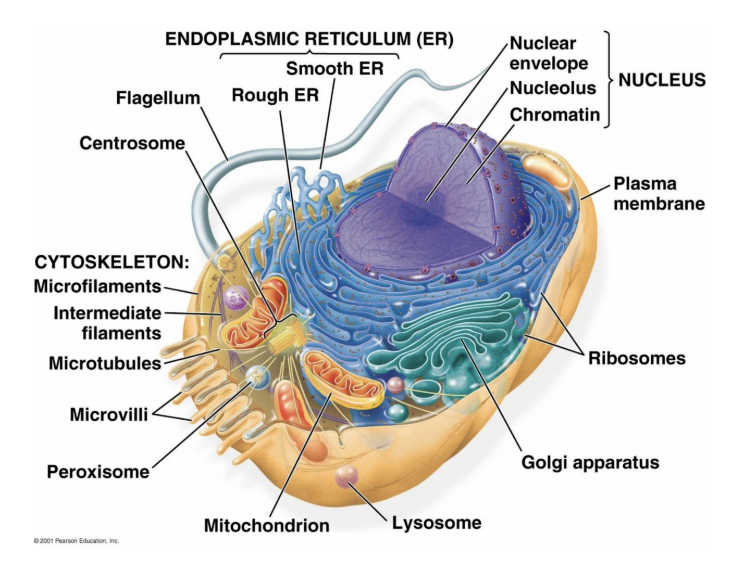
Welcome to Unit 2 of AP Biology: Cells! This article discusses Topic 2.1: Cell Structure & Function. Or, in normal people’s terms, parts of the cell. Similar to how we have organs that are each responsible for their own job that is crucial for our survival, cells have organelles that each play a critical role in the cell’s survival. This article will cover all the organelles you need to be familiar with for the AP Bio exam. There’ll be a table at the end summarizing everything, along with some practice questions. Let’s get into it!
Ribosome
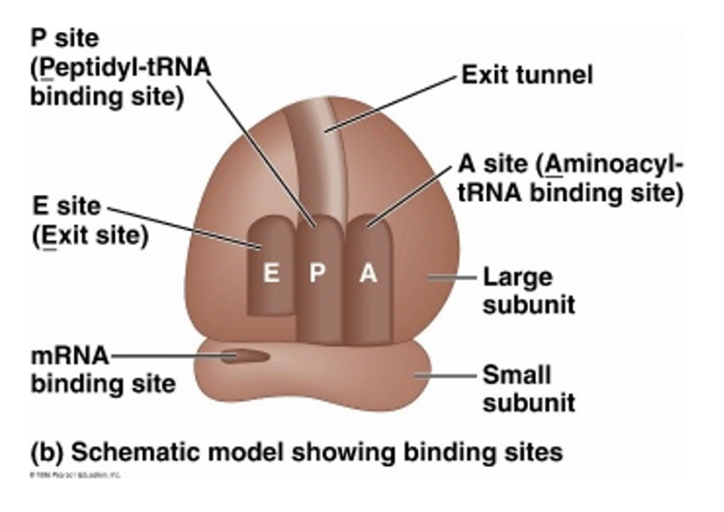
We know from Unit 1 that proteins play a HUGE role in living organisms; they do almost everything! But where are they made? The answer is in ribosomes. Ribosomes are tiny, modular organelles that contain proteins and RNA. They are not membrane-bound (meaning they don’t have their own phospholipid bilayer surrounding them), and they are the only organelle that is shared among every single living organism (hint for when answering Unit 7 FRQs: this is a piece of evidence you can use to support the theories of common ancestry and evolution!). Ribosomes produce proteins according to an mRNA sequence (we talk more about the central dogma in THIS article in Unit 5/6).
Below is a picture showing a ribosomal cross-section (in simple terms, what the inside of a ribosome looks like). You can see that there are two subunits, the small and the large. During translation, the two ribosomal subunits come together, putting the mRNA strand in between them.
Endoplasmic Reticulum
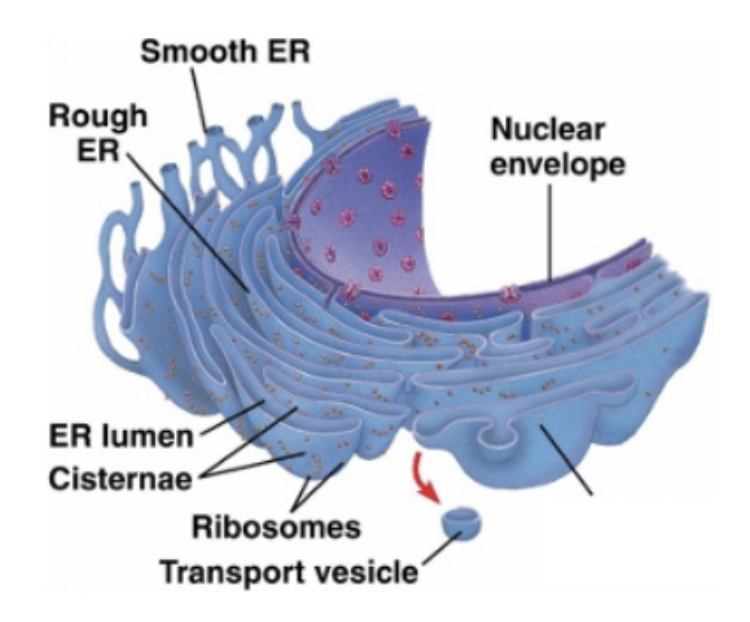
Similar to peanut butter, the endoplasmic reticulum comes in two variations: rough and smooth. The rough ER (called rough because it contains ribosomes) separates the nucleus from the rest of the cell and assists in protein production (specifically protein folding) and trafficking.
The smooth ER (which doesn’t have ribosomes) can be found on the outer edges of the rough ER, and is responsible for detoxifying poisons and synthesizing lipids.
The endoplasmic reticulum is one large organelle that, similar to DNA, must be folded up in order to fit in the cell and work efficiently. The folds in the rough ER are called cisternae.
Golgi Apparatus/Complex
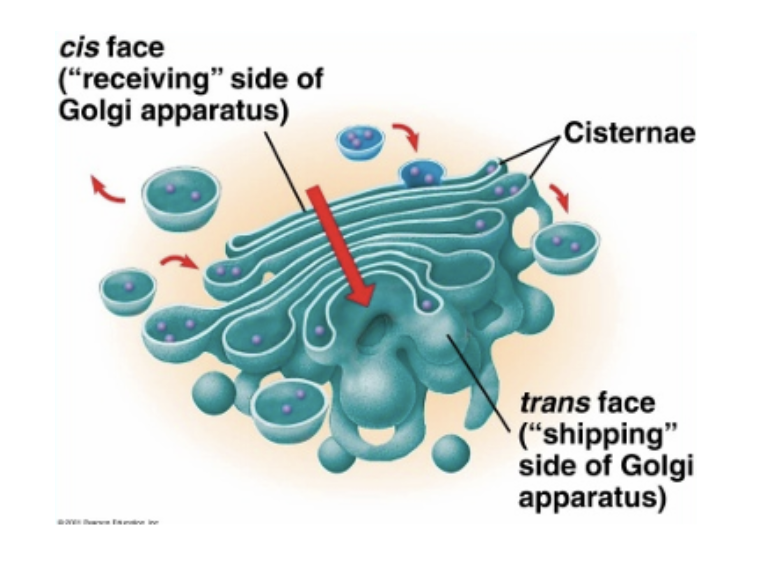
The Golgi apparatus (also called the Golgi or the Golgi complex) is a series of membrane-bound sacs that are involved in protein trafficking (in other words, helping proteins get to where they need to be). The Golgi has two sides: a “receiving” (cis) face and a “shipping” (trans) face. Proteins move through the complex as they get prepared to be shipped out.
Lysosome
Lysosomes are pretty simple organelles in terms of structure; they are made of membrane-bound sacs that contain digestive enzymes. They play three key roles in a cell:
- Nutrient Digestion during phagocytosis
- Organelle Recycling (also called autophagy)
- Programmed Cell Death (aka apoptosis, which you can learn more about in THIS article).
Below is a photo that describes the first two functions of lysosomes:
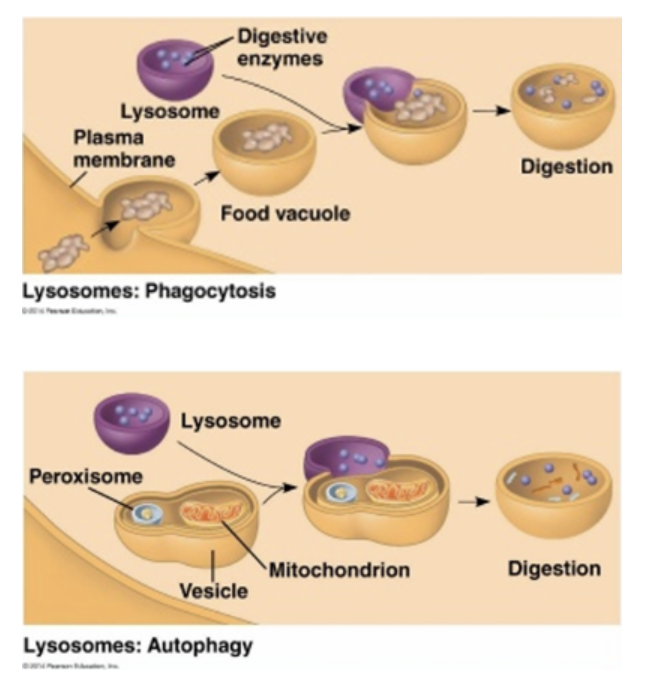
Phagocytosis, which you can learn more about in THIS (hyperlink) article in unit 4, is one process through which food enters a cell. Once a vesicle containing food is brought into the cell, a lysosome attaches to it and releases its digestive enzymes in order to digest the food. During organelle recycling (autophagy), a lysosome attaches to the vesicle containing the damaged organelles and releases its digestive enzymes, which break down the organelle into simple molecules that can be reused.
But what about during apoptosis? The answer is simpler than you think: they burst. Since the only thing separating the digestive enzymes in lysosomes from the rest of the cell is the lysosome’s membrane, their membrane disintegrates. This allows for the digestive enzymes to be let loose and wreak havoc, leading to the death of the cell.
Vacuole
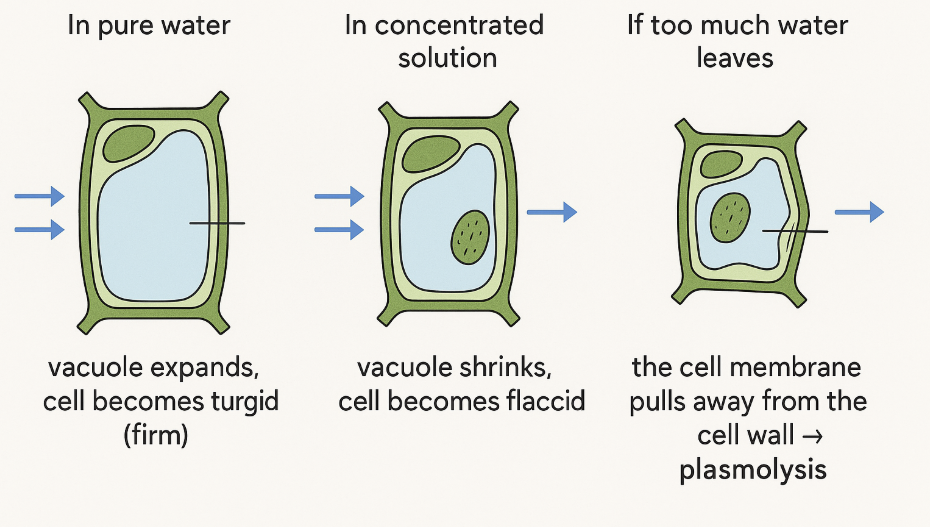
Moving on to probably the easiest organelle that you have to know: the vacuole. The vacuole is a large sac that serves as a cell’s storage area (mostly for water). Another one of its key responsibilities is maintaining turgor pressure in plants (which prevents them from wilting).
Endomembrane System
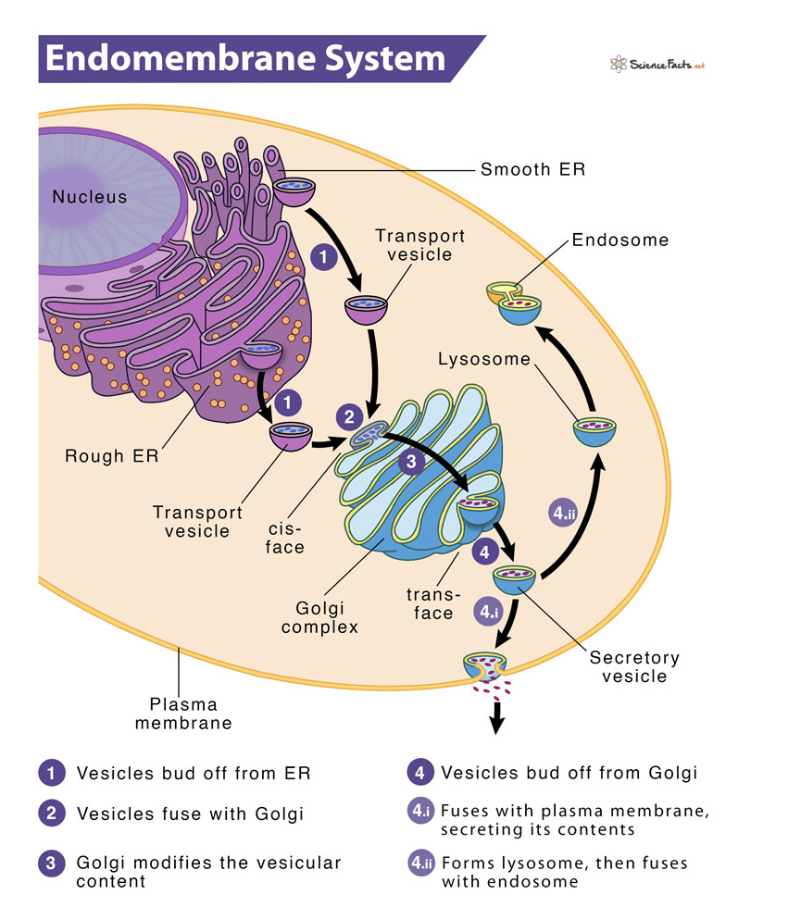
The endomembrane system’s function is to synthesize, modify, package and transport proteins, polysaccharides, and lipids. It is comprised of the soft and rough ER, golgi complex, lysosomes, vacuoles and transport vesicles, the nuclear envelope (separates the nucleus from the cytoplasm), and the plasma membrane (which you can learn more about in our Topic 2.3 article).
Mitochondria
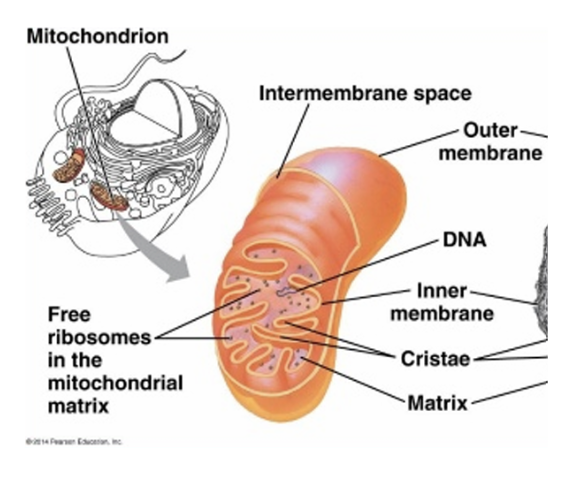
The powerhouse of the cell! The cell’s mitochondria (singular: mitochondrion) are where cellular respiration occurs. The mitochondria is a fairly complex organelle, containing a double-membrane structure. The outer membrane is smooth and serves to contain the rest of the organelle. The inner membrane, where electron transport (which you can learn more about in THIS article from Unit 3) and ATP production occur, contains folds called cristae. Inside the membranes is the matrix, where the Krebs/citric acid cycle occurs.
Chloroplast
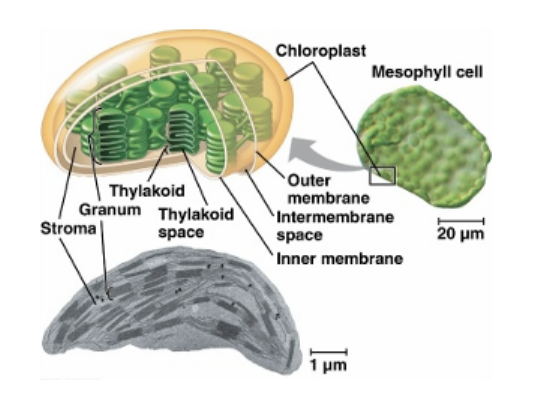
The last organelle we’ll discuss here is the chloroplast, the energy-generating organelle in plants. Similar to mitochondria, chloroplasts also have two membranes. However, all the reactions occur inside. The chloroplast has two main parts: grana (singular: granum), stacks of thylakoids, which are where photosynthesis’ light-dependent reactions occur, and stroma, the space between the grana where carbon fixation (the Calvin Cycle) occurs.
Key Takeaway
Ribosomes are small, modular organelles that contain two parts that come together to translate mRNA into protein sequences. They can be found in the cytoplasm and on the Rough ER, which helps with protein production and separates the nucleus from the rest of the cell. The Smooth ER helps with creating lipids and detoxifying poisons. The Golgi Complex is a series of membrane-bound sacs that help with protein trafficking. Lysosomes are membrane-bound sacs that contain digestive enzymes. They perform three key roles: nutrient digestion, organelle recycling, and apoptosis. Vacuoles are large central storage areas found in some cells that contain water. They also help maintain turgor pressure in plants. Mitochondria are where cellular respiration occurs. Chloroplasts are where photosynthesis occurs. Both mitochondria and chloroplasts have a double membrane structure.
Below is a table that summarizes all the organelles. You should memorize the key words as it will greatly help you if you can associate certain terms with certain organelles.
| Organelle | Membrane Bound? | Key Word(s) | Function |
|---|---|---|---|
| Ribosome | No | Modular, Proteins | Translate mRNA into proteins |
| Rough Endoplasmic Reticulum (ER) | No | Ribosomes, separating the cell, protein production | Separates the cell, helps with protein production |
| Smooth Endoplasmic Reticulum (ER) | No | Detoxifying, synthesizing | Detoxifying poisons, synthesizing lipids |
| Golgi Apparatus/Complex | No | Protein Trafficking/Packaging/Folding/Modifying | Protein Trafficking/Packaging/Folding/Modifying |
| Lysosome | Yes | Digestive enzymes, Apoptosis, Recycling (waste) | Nutrient Digestion, Apoptosis, Organelle/Waste recycling |
| Vacuole | No | Central Storage, Turgor (pressure) | Central storage area that holds water, maintains turgor pressure in plants |
| Mitochondria | Yes | Energy, double-membrane | Powerhouse of the cell. Where a majority of ATP production occurs |
| Chloroplast | Yes | Photosynthesis | Where photosynthesis takes place |
Lastly, below is an animated picture that shows what an actual cell looks like, with all its organelles: