
Introduction
Welcome to AP Biology Topic 2.2: Cell Size! In topic 2.1, we learned about the different organelles present in cells, but I’m sure you would’ve noticed weird characteristics, such as many organelles having a folded structure or folds in their membranes. What if we told you that those weird characteristics have something in common with why cells are so small? The truth is, these characteristics share a common purpose: increasing the cell’s surface-area-to-volume ratio. In this article, we will cover what the SA:V ratio is, why it’s so important, and the math needed to calculate it.
Efficiency: The Key to Life
In the real game of life, everything is about efficiency. In cells, there’s a lot going on: DNA replication, energy generation, phosphorylation cascades sending signals, protein synthesis, and more, in addition to the cell’s overall role. To do all this, cells need to be able to exchange food, waste, thermal energy, and chemicals across their membranes in relatively large quantities. If they can’t do that fast enough or in enough quantities:
- Cells won’t get enough resources and will die.
- Waste will build up in the cells, eventually leading to cell death.
- Cells will get either too hot or too cold.
- Cells won’t be able to exchange chemicals/energy with the environment.
In order to prevent those two not-so-great things from happening, cells need to ensure that there’s enough membrane (surface area) to “handle” the needs of the cell’s internals (volume).
The Surface Area-to-Volume Ratio
According to math, as a cell increases in size, its volume increases much faster than its surface area. For example, the surface area of a sphere increases with the square of the radius (4πr2), while volume increases with the cube of the radius (4/3πr3). Let’s take a look at this visually. In the image below, pretend the cubes are cells. The sides of each cube are its cell membranes.
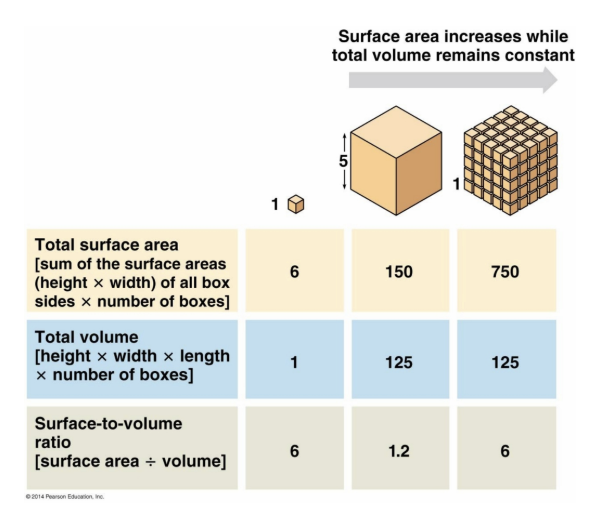
As you can see in the image above, the smaller the cube, the higher the SA:V ratio (the 1 x 1 x 1 cube has a ratio of 6, while the 5 x 5 x 5 cube has a ratio of only 1.2).
However, we also see that putting 225 1x1x1 cubes together gives us the same volume as one giant 5x5x5 cube, but we have way more exposed sides and as such, way more cell membrane for stuff to go through! Kinda cool, right?
On the AP Exam, you may be responsible for calculating the surface area, volume, and/or the SA:V ratio for certain shapes. Below are all the formulas you could see or be expected to use on the AP Exam in May (they will be given on your formula sheet):
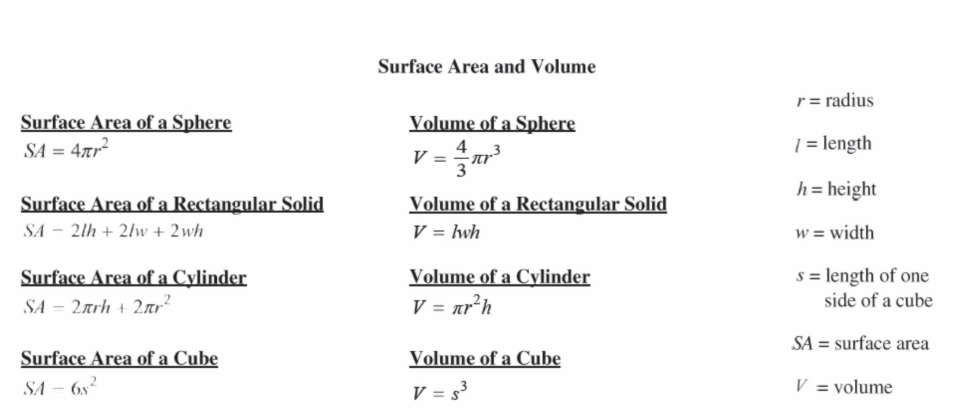
We recommend that you get comfortable using these formulas and performing the necessary calculations.
SA:V Ratio in Real Life
So how can cells implement the math we discussed in the previous section in real life? It turns out there are two main ways:
- The smaller the cell, the larger the ratio. So cells want to be as small as possible in order to maximize their SA:V ratio.
- Membranes are fluidlike, meaning they can morph into whatever shape suits them best.
We see #2 in action all the time. For example, remember what the rough ER looks like?
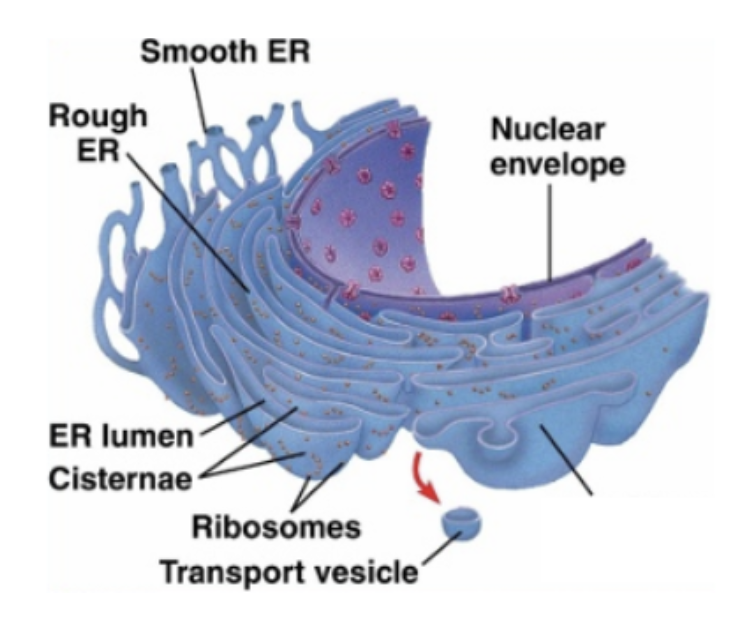
The folds in the rough ER allow for more surface area for ribosomes to attach, meaning the cell has more space to synthesize proteins and can synthesize more proteins!
Key Takeaway: Cells with a higher SA:V ratio can exchange resources, waste, thermal energy, and other chemicals with their environment better, which helps them be more productive and efficient. As cells/organisms increase in size, their SA:V ratio decreases, the demand for resources increases, and they become less efficient in their ability to exchange things like heat with their environment. To increase their SA:V ratio, cells tend to be small and have folds in their membranes and some organelles.