
Welcome to FiveHive’s AP Biology Multiple Choice Question (MCQ) Guide! In this article, we’ll be covering how to best tackle MCQs you’ll find on the AP Biology Exam. We’ll do this by discussing a series of “tips” in chronological order.
Tip 0: Breathe
In those final moments before the test, when you unwrap the shrink wrap of the MCQ booklet and hear the fateful word “BEGIN,” you’re probably going to feel some sort of anxiety, and it’s important to acknowledge that. In fact, this study found a negative correlation between test anxiety and test scores.
The first thing you have to do, when you get a chance, is breathe. Even if it’s just five deep breaths. You’ve probably been preparing the whole year for this test and it all comes down to those three hours in the testing room. We get it, it’s stressful, we’ve been there. What’s important to realize is you can do it as long as you’re in the right headspace!
Tip 1: Understanding the Question
Read through every question twice. Go a little slower the second time. After the two read-throughs, ask yourself: “do I understand everything that this question is telling me and what it's asking?” If you don’t, read it again. If you’re confused even after three tries, read through the answer choices; sometimes they’ll help you realize the question. Or if you saw a question that was somewhat related earlier in the test, flip back to it.
Tip 2: Pulling Out Key Information
In those final moments before the test, when you unwrap the shrink wrap of the MCQ booklet and hear the fateful word “BEGIN,” you’re probably going to feel some sort of anxiety, and it’s important to acknowledge that. In fact, this study found a negative correlation between test anxiety and test scores.
AP Exam questions often have jargon in there to confuse you. The key is reading through the jargon and being able to pull out the key information. Take sample question #1 from the CED, for example:
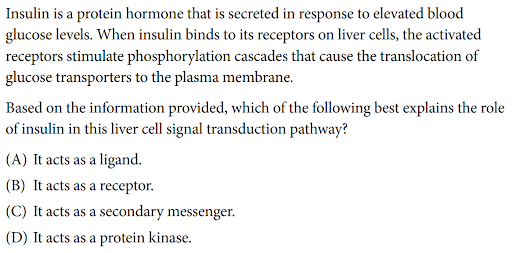
After your first read through, you may have been left thinking “What the actual ****? Translocation of glucose transporters? We never learned that!” But read through the question again, and this time, try to pull out just the key information. Come back when you’re done.
The question gives you the following key information:
- Insulin is a hormone
- Insulin binds to receptors on liver cells
- Insulin activates phosphorylation cascades
By pulling the key information out, we know that the answer is something, and we are given all the clues as to what that thing could be! What binds to receptors and activates phosphorylation cascades? Ligands! Thus, the answer is A.
Alternatively, you could have just remembered that hormones = ligands and answered the question that way. There are multiple ways to solve a question, so don’t force yourself to stick to one method. Let’s move on to another MCQ crushing method.
Tip 3: Recognizing the Concepts Behind the Question
You can think of the AP exam as a checklist of topics you learned in AP Bio, and each question wants to see if you can check off concept(s) from the list. The concepts are almost always from the Essential Knowledge portions of the Learning Objectives in the Course & Exam Description (CED) which you can find here.
After you read the question (even if you don’t quite understand it fully), ask yourself two questions.
- What unit is this question from?
- What are the concept(s) behind it?
For example, take this question from our Topic 1.3 article:
After an intense workout, an athlete consumes a protein shake containing complex carbohydrates and proteins. Over the next few hours, their digestive system begins breaking down these macromolecules into absorbable units. Later, those monomers are transported to cells and used to build new muscle fibers. Which of the following best explains the chemical processes occurring in the athlete's body during and after digestion?
- Hydrolysis reactions occur in cells to assemble proteins and glycogen from absorbed amino acids and glucose
- Dehydration synthesis reactions in the digestive tract use the amino acids from the protein shake to build new muscle fibers
- Hydrolysis reactions break down macromolecules during digestion, while dehydration synthesis assembles monomers into new macromolecules inside cells
- Dehydration synthesis is used to generate energy by breaking apart glucose molecules in muscle cells.
Once you think you have an answer, keep reading. Did you use one (or part of one) of the two strategies discussed below?
Strategy 1: After reading through that absolute behemoth of a question, pull out some familiar terms such as “breaking down macromolecules” “absorbable units” and “monomers.” We learned about these things in Unit 1! Now that you know that the question is testing you on something from Unit 1, let’s think for a moment. What did we learn about in Unit 1 that had to do with “breaking down macromolecules?” Hydrolysis! What does hydrolysis do? Break polymers into monomers. We know that dehydration synthesis does the opposite, so option C has to be correct.
Strategy 2: Read through the question and then read through the answer choices. From doing so, you can tell that the question is asking about hydrolysis and dehydration synthesis. You know that hydrolysis breaks down, while dehydration synthesis builds. Pick the answer choice that most closely aligns with that philosophy, which is choice C. You don’t have to be familiar with all the extra jargon as long as you can identify the concept and pick the answer that most closely aligns with that concept.
Tip 4: Double Checking
Here’s some advice you don’t hear often: double check right after you pick your answer. Clear your mind, read through the question and answer choices again, and go through why each choice you didn’t pick is wrong and why the choice you picked is right. If there is a glaring mistake, you’ll catch it. Trust us, it works.
The reason we say to do this and not to wait until the end is because people often get strapped for time on AP Exams. You’re most likely not going to get every question right, and you don’t need to in order to get a 5. The strategy outlined above also helps prevent a common pitfall students have with double checking: changing the original answer they had (which was right) to a wrong answer because they “didn’t feel confident enough.”
DO NOT CHANGE AN ANSWER CHOICE UNLESS YOU ARE AT LEAST 90% CERTAIN THAT YOUR ORIGINAL ANSWER CHOICE WAS WRONG. Most of the time, students end up choosing the right answer the first time.
If you do have time after completing the section, go back and review. The depth of your review should be based on the amount of time that you have left. If you only have a few minutes (which is the case for most people), go back to the questions that you found the hardest and ask yourself, “why do I think the wrong answers are wrong, and the answer I picked is right?” If there’s math involved, run the math through the calculator from scratch again.
Tip 5: Damage Control & Letter of the Day
We usually don’t like to think of worst case scenarios, but it is important to be prepared for them. In an AP Exam, the worst case scenario usually consists of there being just a few minutes left and you having unanswered questions. Questions are usually left unanswered for two reasons:
- You were having trouble with that question earlier
- You didn’t get to the question at all yet
At this point in the test, the focus shouldn’t be on scoring a 5, it should be on damage control. The damage control strategy you should use depends on whether or not you’re in situation 1 or 2.
Situation 1: You have a bunch of questions left and three minutes left on the clock. Your best chances at this point are to pick a letter and choose that letter for every single blank question. This strategy is called the “Letter of the Day” strategy, and you can google why it’s statistically the most effective.
Situation 2: Chances are, you have eliminated at least one answer choice for each question. If the answer choice you have eliminated is your Letter of the Day (and you know for sure or really think it’s wrong), make a quick educated guess on what the answer could be using the strategies we talked about earlier in the article. However, if your Letter of the Day isn’t one of the eliminated answer choices, choose it as your answer.
Conclusion
As is always the case with FiveHive, this article was written by people who took and scored well on the AP Biology exam. This article listed the tricks that we used when we took the test, and they worked for us. This does not mean that these strategies will work every time and with everyone. We encourage you to figure out what works for you and take practice tests in advance, and please, do not cram.
Chances are, if you studied for this test a good amount, you will be fine. Really, it’ll be okay.
Cheers!
- Stealth & The FiveHive Team :)