
Welcome to FiveHive’s AP Biology Free Response Question (FRQ) Guide! In this article, we’ll be covering how to best tackle FRQs you’ll find on the AP Biology Exam.
Step 1: Breathe
In those final moments before the test, when you unwrap the shrink wrap of the FRQ booklet and hear the fateful word “BEGIN,” you’re probably going to feel some sort of anxiety, and it’s important to acknowledge that. In fact, this study found a negative correlation between test anxiety and test scores.
The first thing you have to do, when you get a chance, is breathe. Even if it’s just five deep breaths. You’ve probably been preparing the whole year for this test and it all comes down to those three hours in the testing room. We get it, it’s stressful, we’ve been there. What’s important to realize is you can do it as long as you’re in the right headspace!
Step 2: Highlight Directive Words
What’s nice about the FRQ section is that the College Board is very clear with how they want you to answer. They do this through task verbs. Below is an example with the task verbs highlighted:
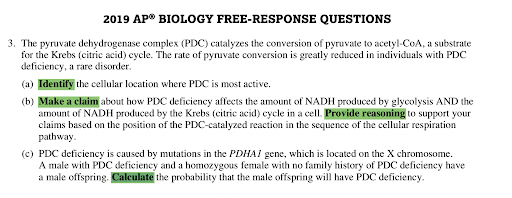
As you can see, task verbs will be bolded so they’re easy to spot. Below is a list of the directive words and simplified versions of what they mean. If you want the full descriptions, you can refer to the CED:
- Calculate: Do math
- Construct / Draw: Create a diagram, graph (FRQ #2), representation, or model that illustrates or explains relationships or phenomena
- Describe: Provide characteristics of a specified topic.
- Determine: Decide/Conclude after reasoning/observation/calculations
- Evaluate: Determine the significance of information or the accuracy of a claim
- Explain: Provide information about how or why a relationship, process/pattern/situation/outcome occurs, using evidence and/or reasoning to support or qualify a claim
- Identify: Identify something without elaborating.
- Justify: Provide evidence and reasoning to support a claim
- Make a Claim: Make a claim based on evidence/knowledge
- Predict/Make a Prediction: Predict the causes/effects of a change in, or disruption to, one or more components in a relationship/process/pattern/system
- Represent: Use graphs/words/symbols/illustrations/tables to describe biological concepts/characteristics/relationships
- State the (null) hypothesis: Create a hypothesis or null hypothesis based on a given experiment
- Support a Claim: Similar to justify. Provide reasoning to explain how evidence supports/qualifies a claim.
It is in your best interest to memorize these task verbs. You don’t have to know what they mean word for word, but have a general idea of what each one is looking for.
Step 3: Responding
- Take your time to read and understand each question before responding
- Don’t rush your writing. You’re writing in pen so it’ll be harder to change mistakes.
- Respond to questions in a chronological order
- Use neat handwriting, even if it means you have to write slower than usual
- Leave a blank line/some space in between responses to different parts of a question
- Always start a response to a new question on a new page.
- If you make a mistake, simply strike through it. Don’t make a mess.
Example FRQ & Responses
We’re now going to walk through, step by step, how we would respond to the FRQ we saw earlier in the article:
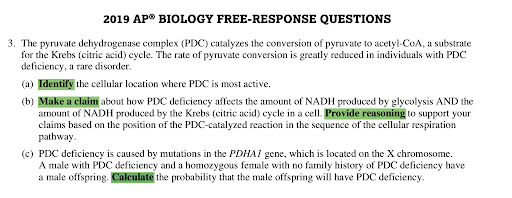
After reading this through for the first time and highlighting the task verbs, it’s time to answer. Looking at part A, you may be thinking that you have no idea what “pyruvate dehydrogenase complex” is. That’s on purpose: it’s a common AP Biology question tactic to get you confused. Within the question, it directly tells you what PDC is: “(PDC) catalyzes the conversion of pyruvate to acetyl-CoA.”
Moving on to part A, it is asking you to identify. No need to explain anything, just write exactly what the question is asking for. The question is asking for the location where PDC is most active. Knowing that PDC catalyzes the conversion of pyruvate to acetyl-CoA and that it is a part of the Krebs cycle, we can know that it is likely most active in the mitochondria.
Part B asks us to make a claim and provide reasoning for our claim. This question requires in depth knowledge of glycolysis and the Krebs cycle. Since there are two parts to this question, we should look at each independently, as each part provides an opportunity to get a point.
For making a claim:
-
A PDC deficiency indicates a decrease in PDC, which results in a decrease in the conversion of pyruvate to acetyl-CoA. Knowing that acetyl-CoA is a substrate for the Krebs cycle, we know that this also decreases the activity of the Krebs cycle too.
- Glycolysis is before the Krebs Cycle, so there is no effect on it
- Krebs Cycle sees a decrease in activity
- Putting this together, our full claim would be that Glycolysis sees no change but the Krebs cycle sees a decrease in NADH produced.
Since we made a claim and now have to support it, we can provide our reasoning as follows using the concepts that we based our claims on:
- Glycolysis sees no change because it occurs before the conversion of pyruvate to Acetyl-CoA
- The Krebs cycle sees a decrease because there is less Acetyl-CoA.
Moving on to part C, this is a simple calculation. You don’t need sentences here. Writing the answer by itself and labelling it is often good enough for getting the point.
For this problem specifically, we can calculate that there is a 0% chance that the male offspring will have a PDC deficiency by making a pedigree chart.
We would label our final answer in some form, like “Probability is 0%”.
Conclusion
As is always the case with FiveHive, this article was written by people who took and scored well on the AP Biology exam. This article walked you through how we took the test. This does not mean these strategies will work every time and with everyone. We encourage you to figure out what works for you and take practice tests in advance, and please, do not cram.
It’s also important to remember that you don’t lose points for wrong answers on AP Exams, you earn points for questions you get right. This means that you should try to earn as many points as possible. There will be some FRQs you’ll breeze through, and others that you may have to think a little more on. You don’t HAVE to answer the FRQs in order, and it’s a smart idea to start planning around that fact.
Chances are, if you studied for this test a good amount, you will be fine. Really, it’ll be okay.
Cheers!
- Stealth & the FiveHive Team :)