
Introduction:
Welcome to AP Biology Topic 2.7: Tonicity & Osmoregulation! In this article, we’ll be exploring the effects of concentration gradients on cells. We’ll also be discussing water potential calculations (it’s not that bad, we promise).
Solutes and Solvents
The key to understanding the content in this lesson is to understand two key terms: solute and solvent. Every solution consists of a solute (what’s dissolved in the solution) and the solvent (the surroundings), which is oftentimes water. For the purposes of AP Biology, it’s safe to assume that there will always be more solvent than solute in a solution.
Suppose you decide to wake up one morning and drink some salt water (for whatever bizarre reason). You fill a glass of water, put some salt in it, and mix it so the salt dissolves in the water. In this example, water is the solvent and salt is the solute.
Here's a practice question:

Osmolarity
Osmolarity and tonicity are often mixed up. Although they have the same principles, they are different in terms of what they are referring to.
Osmolarity refers to the concentration of a solute in two solutions. Notice we didn’t say amounts, we said concentrations. To illustrate this concept, we’ll use an example: let’s say you have two beakers filled with sugar water. One beaker has 10g of sugar dissolved in 1L of water. The second beaker has 20g of sugar dissolved in 2L of water. Although beaker 2 has double the sugar as beaker 1, the concentrations of sugar to water in each beaker are the same, because beaker 2 also has double the water as beaker 1. Note that on the AP exam, the numbers might not be so easy/obvious, so we suggest using your calculator, even if you’re confident.
It’s time to introduce some prefixes: hyper-, iso-, and hypo-. These prefixes are used when comparing two or more solutions. For the sake of explanation, we’re going to call these two solutions solution 1 and solution 2. Solution 1 is hypertonic to solution 2 if solution 1’s solute concentration is higher than solution 2’s. Solutions are considered isotonic to each other if their solute concentrations are the same. Lastly, solution 1 is considered hypotonic to solution 2 if solution 1’s solute concentration is less than solution 2’s.
You can use the prefixes to help you remember which term means what:
-
Hypo = “less than”
- If Beaker 1 is hypoosmolar to Beaker 2, Beaker 1 has less solute concentration than Beaker 2
-
Iso = “equal”
- If Beaker 1 is isoosmolar to Beaker 2, Beaker 1 and Beaker 2 have equal solute concentrations
-
Hyper = “more than”
- If Beaker 1 is hyperosmolar to Beaker 2, Beaker 1 has more solute concentration than Beaker 2
Tonicity
Tonicity is similar to osmolarity, and the prefixes refer to the same concepts. However, instead of relating two solutions, tonicity focuses on relating the inside and outside environments of cells. A cell is hypertonic when its intracellular solute concentration is higher than the solute concentration of the environment. A cell is isotonic with its environment if the solute concentrations of both are equal. Lastly, a cell is hypotonic if its solute concentration is less than that of the environment.
The basis behind tonicity is that water will diffuse from an area with less solute to an area with more solute to try and even out the solute concentrations. How a cell reacts to its tonicity level depends on the type of cell it is. In AP Biology, we’re going to focus on two cell types. Below is a picture that will help illustrate what we’re talking about:
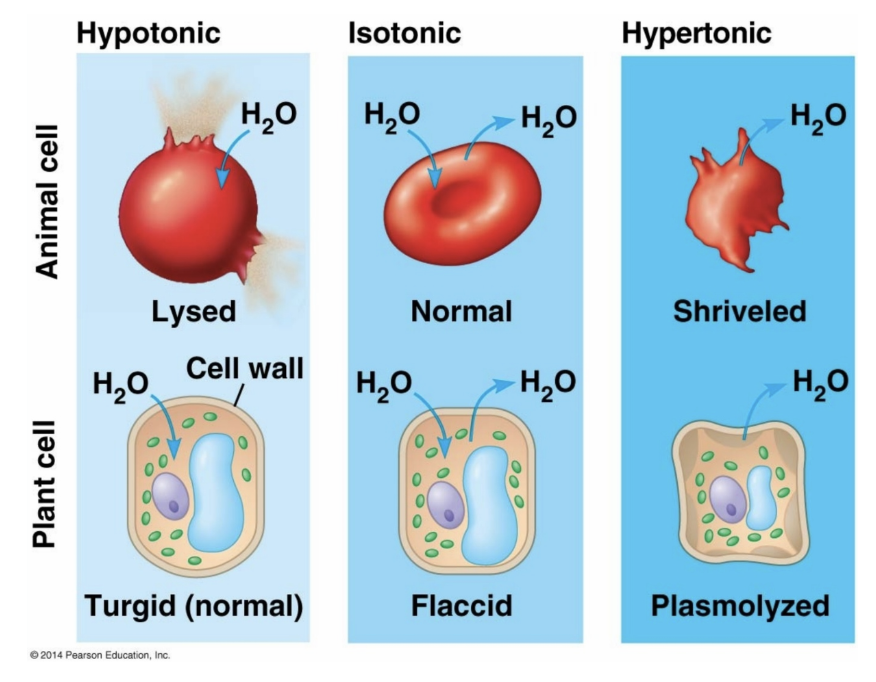
We’ll discuss animal cells first. These include the cells in our bodies. In a hypotonic environment (meaning the cell is hypertonic to the environment), animal cells burst (lyse) because a large amount of water tries to rush in to balance the higher solute concentration that’s inside the cell with the lower solute concentration outside of the cell. In an isotonic environment, animal cells are normal and remain in equilibrium, while in hypertonic environments (meaning the cell is hypotonic to the environment), animal cells shrivel because water escapes the cell to balance the high extracellular solute concentration. In hypo- and hypertonic environments, animal cells will die.
Plants don’t have bones to support themselves. As such, plant cells must be strong enough to hold up the weight of a plant. How do they do this? Stop and think for a second (you can use the picture above to help you)...
The answer is to overfill themselves with water so they can maintain their structure. You can think of plants as similar to an inflatable kiddie pool: when the pool is inflated with air, it maintains its structure. Plant cells have cell walls that allow them to maintain their structure without bursting when there’s a high water concentration inside the cell. As such, the normal (aka turgid) state for a plant cell is when it’s in a hypotonic environment. When a plant cell is in an isotonic environment, it becomes flaccid (and the plant begins to wilt), and when a plant cell is in a hypertonic environment, it dies due to plasmolysis, which is when the cell membrane rips away from the cell wall. This is also why you can revive a wilting plant by giving it water, but after a certain point (when the plant’s cells become plasmolyzed), no amount of water will help the plant recover.
Big Thing to Remember:
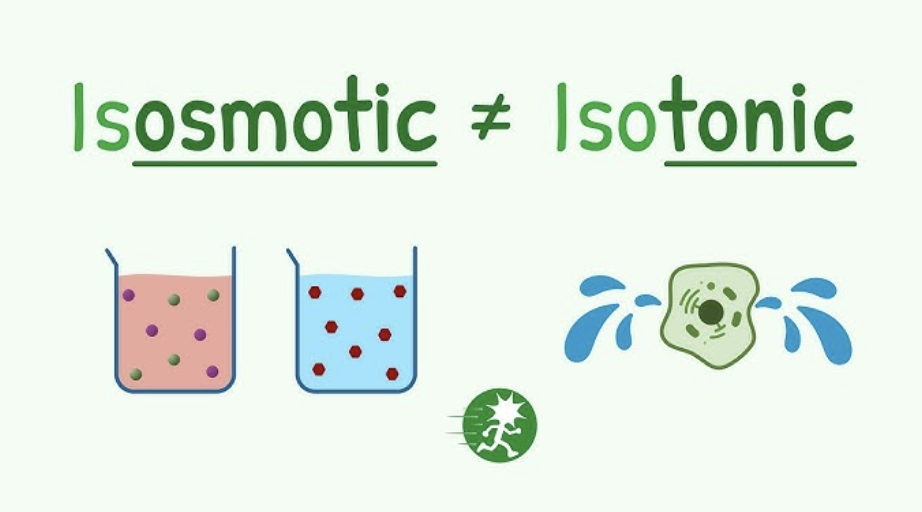
Two environments are isoosmotic if they have the same solute concentrations. However, if you put cells in those environments, whether they are isotonic to the cells depends on the solute concentration inside the cells as well.
Remember: Osmolarity compares two environments. Tonicity compares a cell to its environment.
As AP Biology students, math is not our forte. Water potential is one of the most feared calculations that aspiring AP Biologists must be able to do for the exam. Water potential is water’s ability to move from an area of high solute concentration to a low water concentration. Water will move from regions with higher water potentials (more likely to move) to areas with lower water potentials (less likely to move). An example of this is water moving up the roots of a plant to its leaves during transpiration. Water moves from the soil to the roots and eventually to the leaves to evaporate. The water is moving from areas with a higher concentration of water to low concentration of water as it moves through transpiration.
In general, when having a term with the word ‘potential’ in it, it describes the possibility for a substance to move (ex., Water potential being the likelihood for water to move, and solute potential being the likelihood for the solute to move).
Below are the equations that you will be using to calculate water potential:
Formula:
(Solute potential): always negative; more solute = more negative
(Pressure potential): can be positive (turgor) or negative (tension)
Oh, and also: , where:
- = # of molecules the solute dissociates into
- = molar concentration of solute
- = pressure constant (will be given to you)
- = temperature in Kelvin
, , , and will always be given to you. i will depend on the solute, with sugars (e.g. glucose and sucrose) having is of 1.