
Topics 2.5, 2.6 & 2.8 - Membrane Transport
Introduction:
Welcome to AP Biology Topics 2.5 and 2.6, which cover membrane transport! These topics will introduce you to how cells exchange nutrients, waste, and water with their environment.
Where It All Starts: Diffusion (Topic 2.5)
If you ask any AP Biology instructor what the most important concept in the class is, you’ll get a variety of answers, but “diffusion” will be one of the most common ones, not only because of how important it is in this class, but because it’s a super important concept for many classes you’ll take in the future (if you’re planning to study biology later on). Concentration gradients play a massive role in many biological functions, such as nerve impulses and muscle contraction.
Simply put, diffusion is the movement of a substance from an area of high concentration to an area of low concentration. When this happens, the substance is said to be moving down its concentration gradient. Once the substance is present in equal concentrations on both sides of the divider, (for the purposes of AP Biology, the divider will always be a membrane, whether artificial or a cell membrane), the solutions are said to be at equilibrium with one another. These concepts are illustrated in the image below:
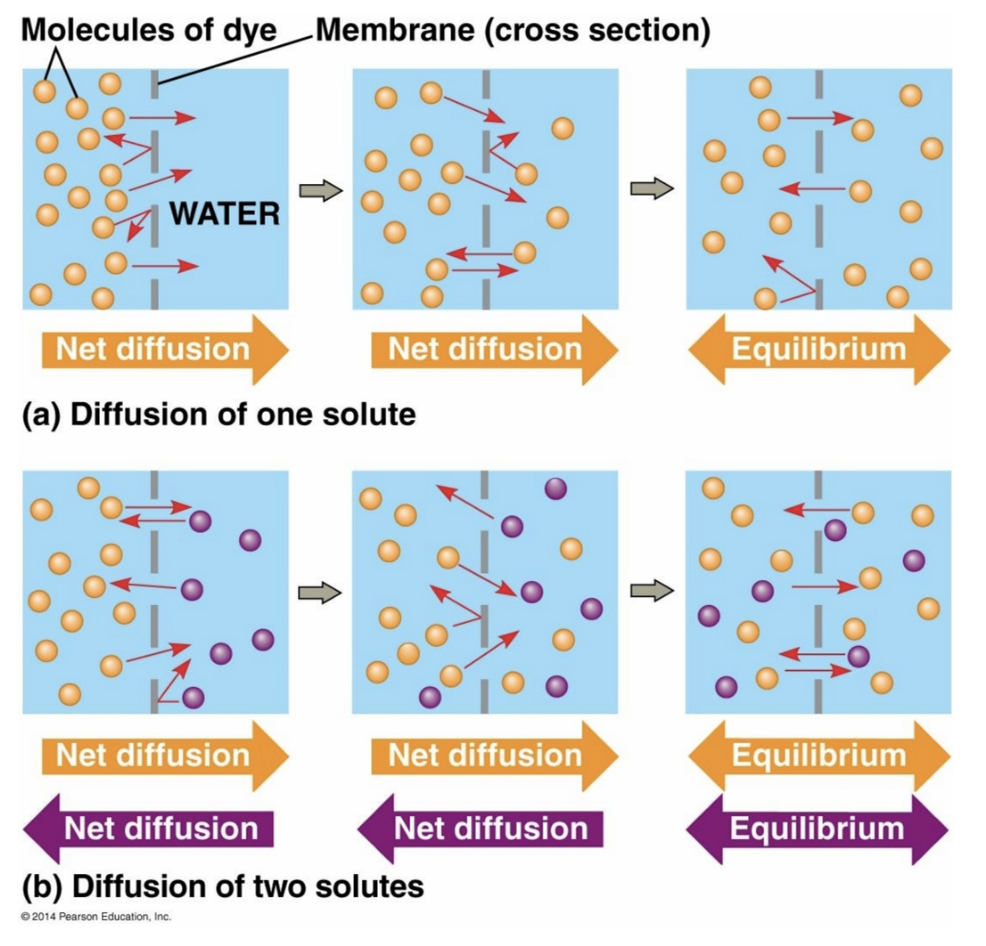
Concentration gradients are possible because of membranes. The selective permeability of cell membranes allow them to “control” the concentrations of certain solutes on either side.
Passive Transport (Topic 2.6)
- Small, nonpolar molecules such as , , and can easily pass through, and thus diffuse across, the cell membrane by themselves. This is called simple diffusion.
- Channel proteins and carrier proteins allow ions and large particles to diffuse across the membrane down their concentration gradient. This is called facilitated diffusion.
- Aquaporins (dedicated channel proteins for water molecules) allow water to move down its concentration gradient.
These concepts are illustrated in the image below:
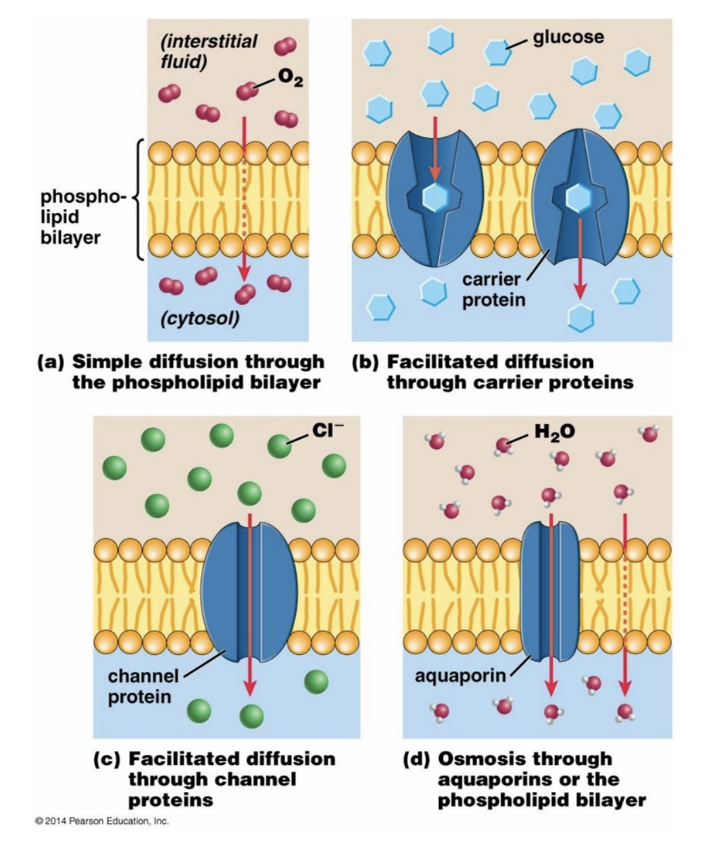
The key fact to remember about passive transport is that it does not require the use of energy. Substances do not need help to move down their concentration gradient, similar to how a floating log doesn’t need help moving down a river. Carrier and channel proteins (including aquaporins) simply give molecules (the “logs”) a “river” to move down.
Active Transport (Topic 2.8)
When you hear active transport, the first word you should think of is “energy!” Simply put, active transport is the movement of substances against their concentration gradient. To explain this, we’re going to use an example (see the images below):
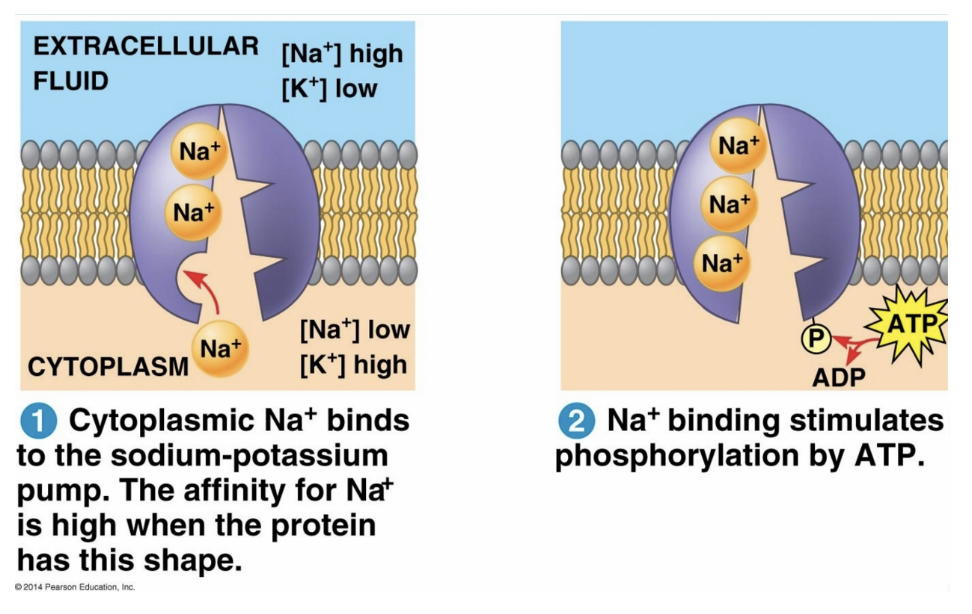
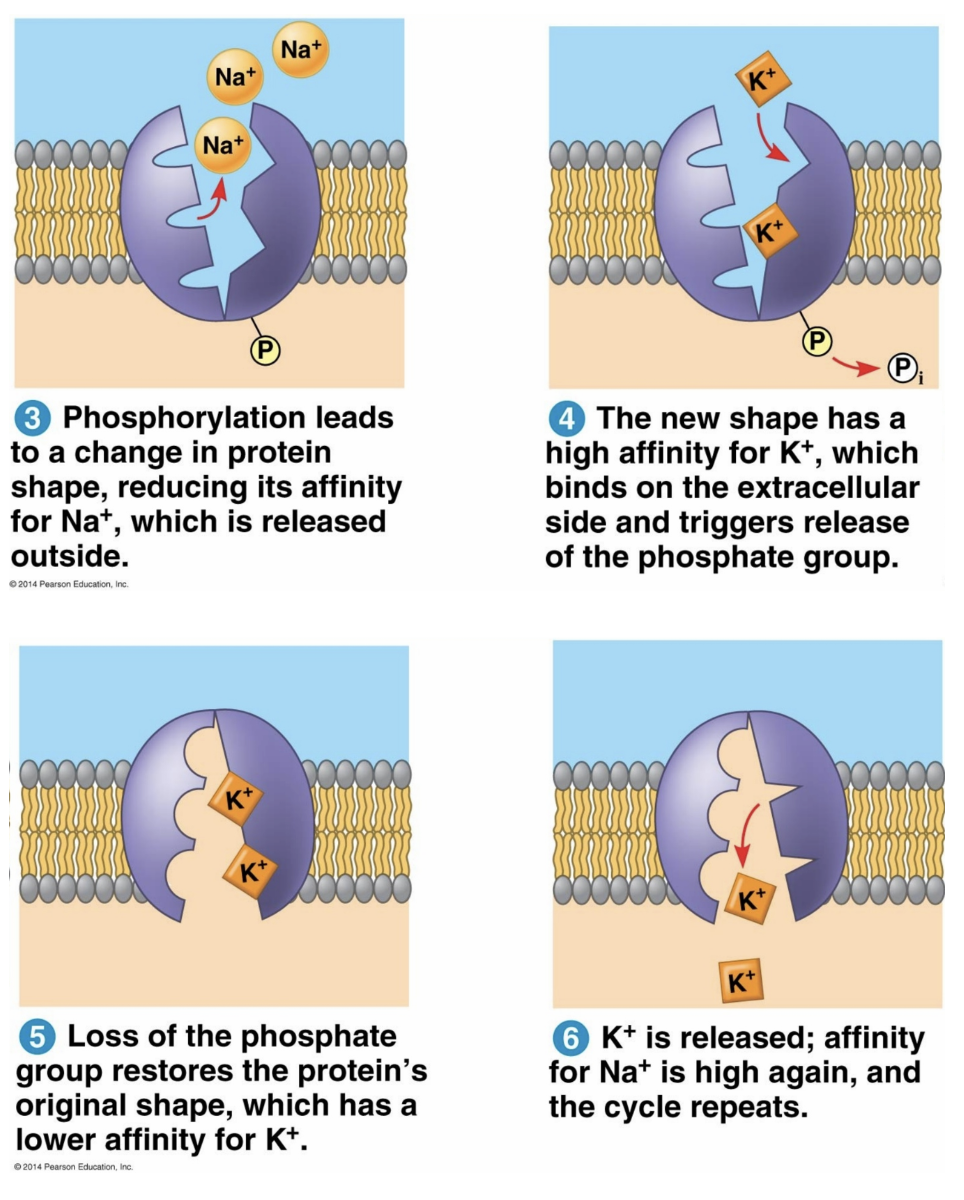
The Na⁺/K⁺-ATPase pump, shown in the images below, is how neurons maintain their resting membrane potential. Essentially, when a neuron is “resting,” the cell’s cytoplasm is negatively charged compared to the ECM. This is because the cell maintains certain concentrations of Na+ and K+ ions on the inside and outside of the cell, creating concentration gradients.
When a neuron activates to send a signal, the Na⁺/K⁺-ATPase pump activates. It opens up facing inward, allowing 3 sodium molecules to bind to it. Once the pump is saturated with sodium molecules, ATP is used to change the shape of the pump so the opening is facing outward. This allows the sodium molecules to be transported outside of the cell. When the pump opens outwards, 2 potassium ions bind to it, triggering the release of a phosphate group from ATP, thereby shutting down its energy supply and restoring the pump back to its original position, with the opening facing inwards. This brings potassium ions back into the cell with it, thereby restoring the negative resting potential of the membrane.
This concept can be tricky to wrap your head around if you aren’t familiar with how ATP works. Check out THIS article in Unit 3 to learn more about ATP!
Cotransport, Endocytosis, & Exocytosis (Topic 2.5)
There are two other main ways that cells use active transport: cotransport and bulk transport. We’ll discuss cotransport first, which is mainly used for nutrient absorption.
Some molecules, like sucrose, are necessary for the cell to produce energy. However, if we allowed these molecules to freely move down their concentration gradient, they would want to move outside of the cell. This means that we need to somehow get these molecules to move against their concentration gradient, which means we’re going to be using active transport.
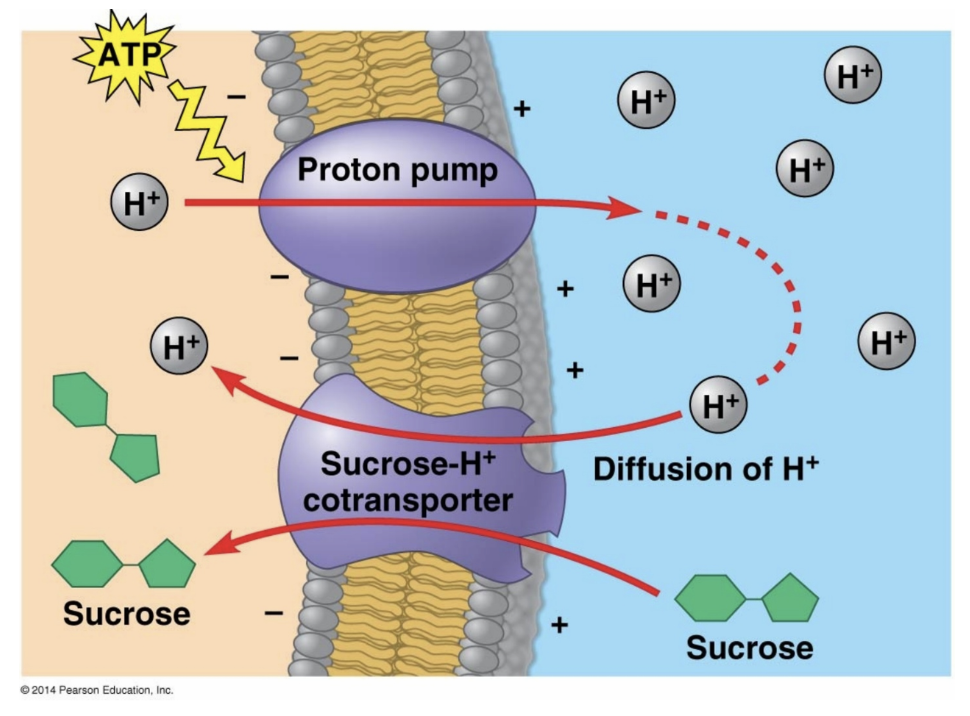
We know active transport requires energy. However, some tasks require so much energy that using ATP is not feasible. The Sucrose-H⁺ transporter is an example of this, as sucrose needs to be constantly pumped into the cell, and it is a large molecule that requires a lot of energy to be brought in. Pause here and think for a sec: how must we be generating all that energy if we can’t use ATP directly? The answer is: we use ATP indirectly!
It may be difficult to pump a large molecule like sucrose across the membrane, but pumping a small molecule like a hydrogen (H⁺) ion? Light work. As such, the cell pumps H⁺ ions out of the cell, against their concentration gradient. When they try to diffuse back into the cell, they need help because charged ions can’t freely pass through the membrane. As such, using facilitated diffusion, they pass through a special protein called a cotransporter to get back into the cell. As the H⁺ ions are flowing through the cotransporter, the cotransporter generates enough energy to pull sucrose along into the cell with the H⁺ ions. This process is illustrated in the picture below:
Ok, so cotransporters work for large molecules, but what if the cell wants to take in a massive food particle, or hundreds of smaller particles all at once? Having a protein embedded in the cell membrane that’s as wide as hundreds or thousands of phospholipids isn’t practical. Pause for a second and think, how do you think cells overcome this challenge?
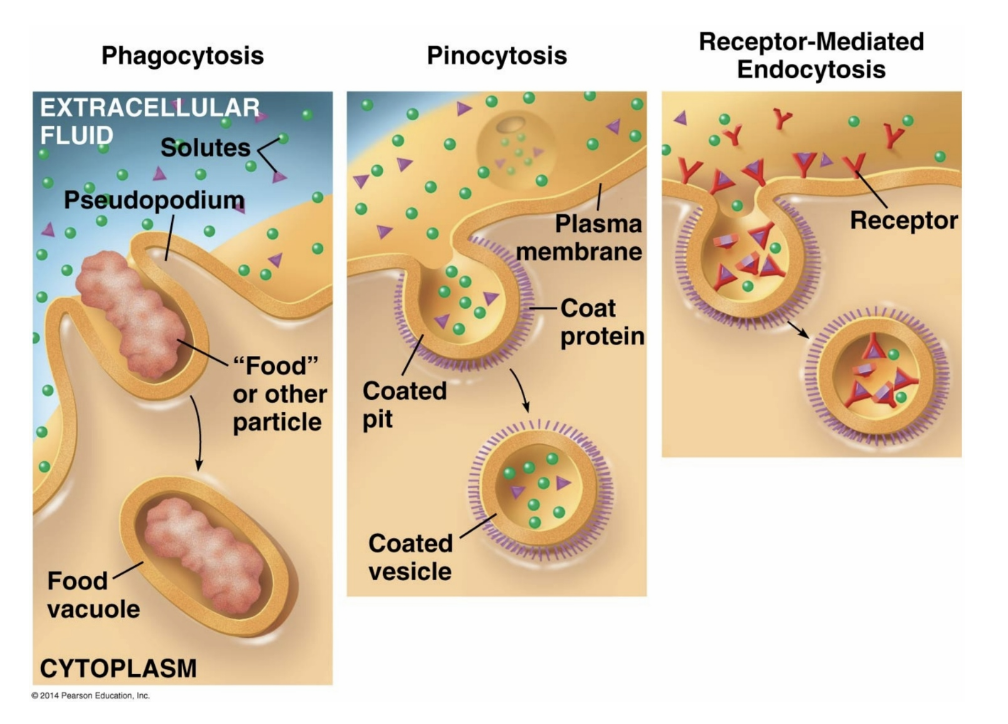
The answer doesn’t have to do with proteins at all. In cases like the ones mentioned in the paragraph above, the phospholipid bilayer of the cell membrane folds around the particle(s) and detaches from the cell membrane, heading into the cell. Because the membrane is fluid, it can be restored quickly to avoid permanent damage. This method of literally engulfing external matter is called endocytosis. There are three main cases in which this happens:
- In the case of a large food particle: this is called phagocytosis.
- In the case of many small particles: this is called pinocytosis.
-
In the case of signaling molecules binding to receptors that need to be transported into the cell: this is called receptor-mediated endocytosis.
- This one’s a little confusing, check out THIS article from Unit 4 to learn more about receptors and signaling molecules!
All three processes are visualized in the image below:
Similar to endocytosis, exocytosis is used when there are large waste products that need to be excreted from the cell.
That’s all there is to know about cell transport for AP Biology! We know it’s a TON of information, so take your time reading through it. Since these are very visual concepts, we also recommend watching some YouTube videos to supplement your learning. Happy studying :)