
Introduction
Welcome to AP Biology Topics 2.9 and 2.10: Cell Compartmentalization & Endosymbiotic Theory. In this lesson, we will be focusing on the evolutionary aspect of cells!
Prokaryotes vs. Eukaryotes
Prokaryotes (unicellular organisms) do not possess organelles, meaning that all major processes occur in the cytosol. They are limited in their ability to create specialized environments, resulting in them being smaller compared to eukaryotes because of surface area-to-volume constraints. Eukaryotes have organelles (membrane-bound compartments) that create specialized environments for different processes, such as mitochondria for cellular respiration, chloroplasts for photosynthesis, nucleus for storing DNA, etc. This is known as compartmentalization.
The Endosymbiotic Theory
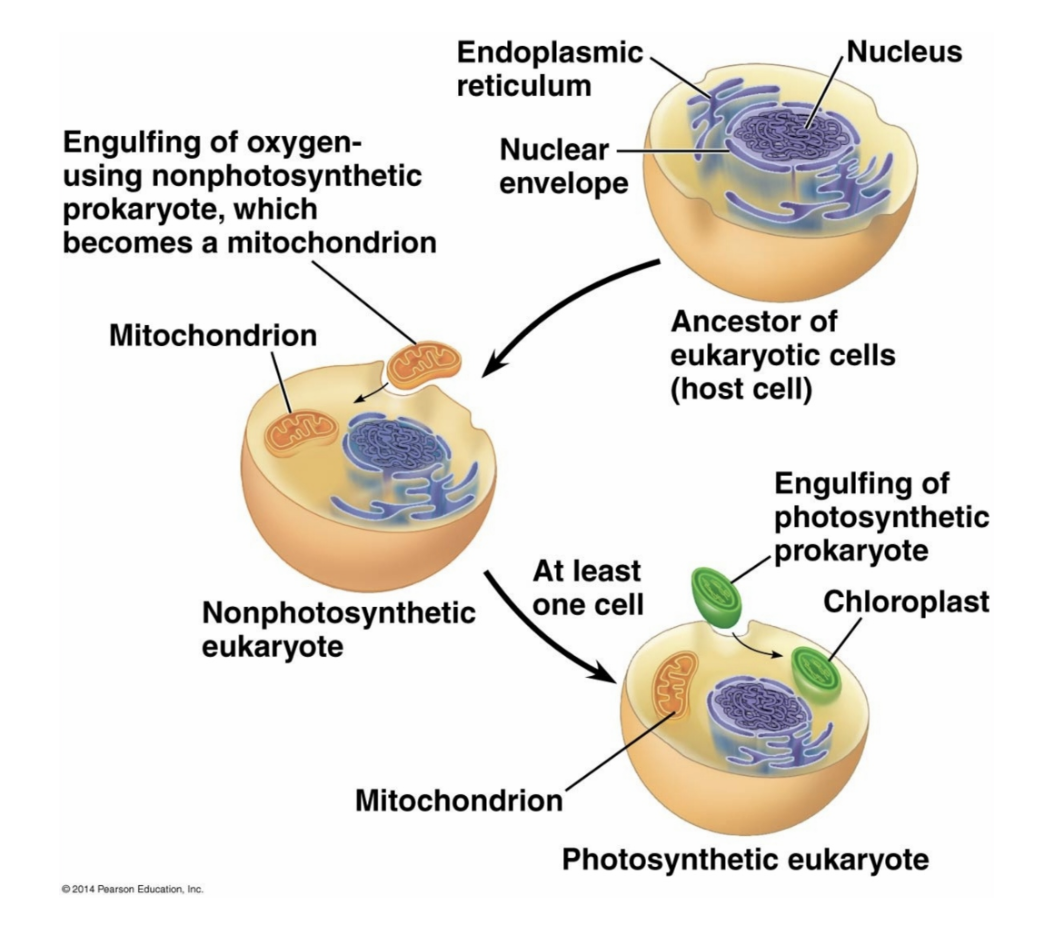
The endosymbiotic theory claims that eukaryotic cells emerged through a series of endosymbiont events. An endosymbiont is an organism that lives in the body or cells of another organism in a mutually beneficial relationship. According to this theory, certain organelles in eukaryotic cells used to be free prokaryotic organisms that were engulfed by other cells.
The theory suggests that:
- A eukaryotic cell first formed when an ancestral prokaryotic cell developed internal membranes.
- The early eukaryotic cell engulfed an aerobic bacterium, but instead of digesting it, the host cell formed a symbiotic relationship with it, evolving into organelles (e.g. mitochondria). You can learn more about symbiotic relationships in THIS Unit 8 article.
- Some eukaryotes engulfed photosynthetic bacteria, which evolved into chloroplasts.
Below is a picture that illustrates this concept:
Multiple characteristics of mitochondria and chloroplasts support the endosymbiotic theory:
- Both organelles are surrounded by double membranes, supporting the theory of engulfment.
- Both organelles are similar in size to bacteria (1-5 μm).
- Similar to prokaryotic cells, both organelles contain ribosomes and their own genetic material, duplicate on their own independent of the cell cycle (which you can learn more about in THIS article), and have the ability to synthesize ATP on their own.
- The DNA of both organelles is circular and double-stranded DNA, which corresponds with the DNA found in bacteria.