Introduction:
Welcome to Topic 3.4! You’re halfway done with Unit 3 and, after you finish Unit 3, you’re almost halfway through AP Bio! No longer will you have to learn about cycles and energy, which is definitely a plus.
However, that’s talking about the future. In the present here and now, we’re still in uncharted territory—photosynthesis.
The basic gist of photosynthesis is:
However, AP Biology goes way more in-depth than this. In this article we’ll be covering the basics of photosynthesis and its two parts:
- The Light Reactions
- The Calvin Cycle
Although both parts are technically independent of one another, they both have the same end goal: creating glucose for plants!
What is Photosynthesis?
Photosynthesis is the series of reactions that use carbon dioxide, water, and light energy to create carbohydrates (in the form of sugars) and oxygen. These carbohydrates can be used for various things in the cell or could be stored for future use.
Light is the primary energy source of life on earth. Organisms are fueled by the producers (autotrophs) that capture light energy from the sun and synthesize sugars to be used in organisms or to be stored. Organisms that consume producers and their compounds for energy are called heterotrophs.
Before photosynthesis came to be, there was very little oxygen in the atmosphere. Since then, photosynthesis has become the main source of oxygen for most organisms on the planet. Prokaryotic (cyanobacterial) organisms were the first to use photosynthesis and were responsible for the production of an oxygenated atmosphere. Since photosynthesis evolved in prokaryotic organisms, it eventually became the basis for eukaryotic photosynthesis as well.
Photosynthesis starts with a specific pigment:any substance that absorbs light. Each pigment absorbs light of different wavelengths. These wavelengths’ frequencies each correspond to a different amount of energy.
A graph plotting a pigment’s light absorption as a function of wavelength is called an absorption spectrum.
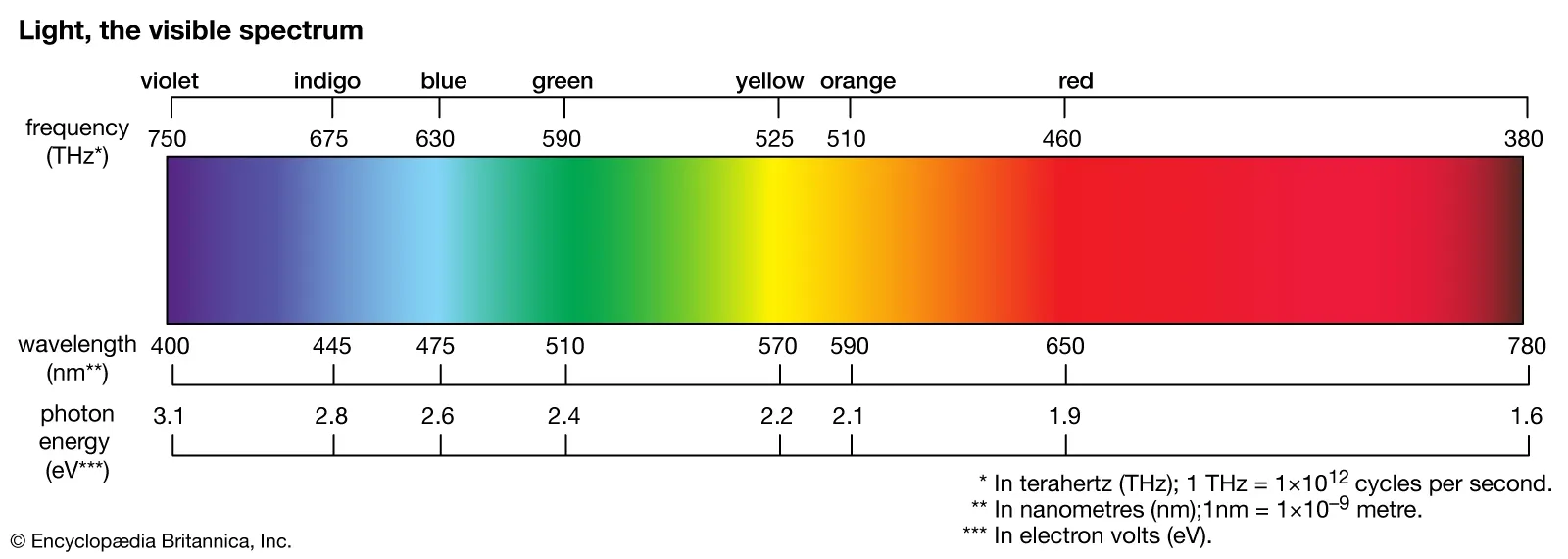
Chlorophyll is the pigment used to absorb light from the sun in photosynthesis. It absorbs violet-blue and red light while reflecting green light.
***COMMON CONFUSION POINT FOR STUDENTS: Chlorophyll does NOT absorb/use green light, it reflects green light away.
Chloroplasts
Chloroplasts contain chlorophyll and are where photosynthesis occurs in plant cells. Chloroplasts have several different parts that help with photosynthesis.
Chloroplasts have outer and inner membranes that surround the stroma. The stroma is the dense fluid-filled area below all the other structures within the membrane-enclosed chloroplast. Suspended within the stroma are thylakoids: sac-like compartments that contain chlorophyll. Thylakoids are arranged in stacks called grana (singular: granum) that help enhance the light absorption of chlorophyll.
The light-dependent reactions of photosynthesis take place in the grana while the second half, the Calvin Cycle, takes place in the stroma.
The Photosynthesis Reaction
The overall equation for photosynthesis is:
The overall chemical change of photosynthesis is the opposite of cellular respiration. For photosynthesis, carbon dioxide is taken in from the atmosphere and water is absorbed from the ground using a plant’s roots.
There are two phases to this reaction and both occur in the chloroplast:
- Light-Dependent Reactions
- Light-Independent Reactions The Calvin Cycle
The Light Dependent Reactions
The equation for the light dependent reactions is:
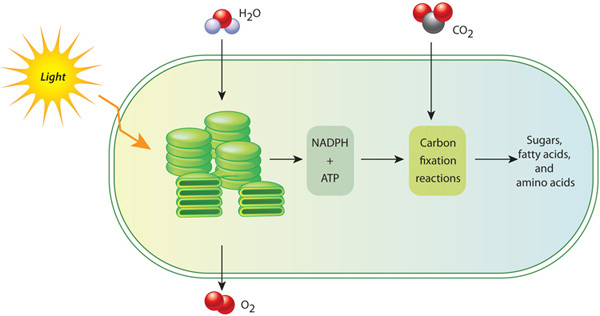
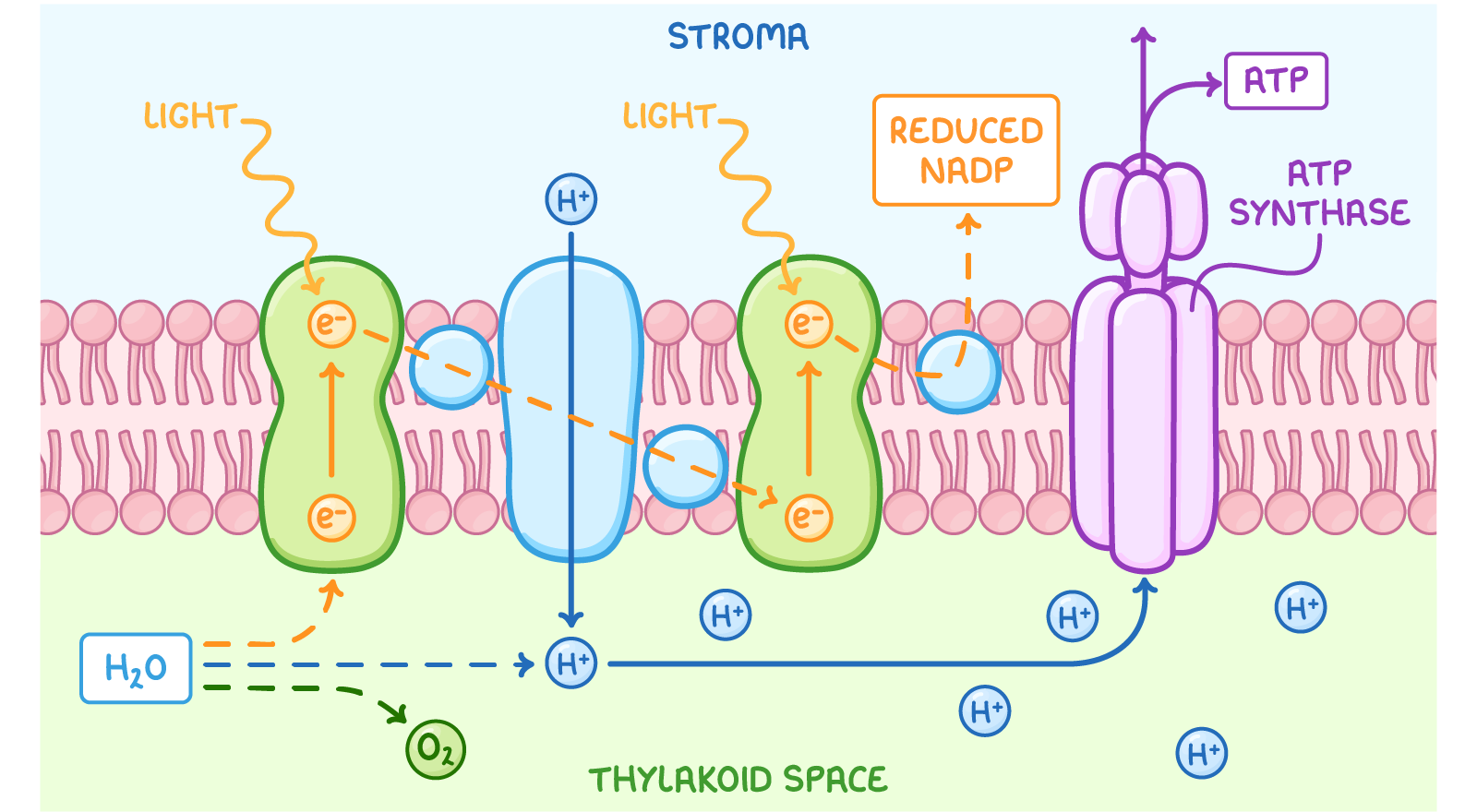
The light-dependent reactions occur in the thylakoid membranes, where light energy is converted into chemical energy in the form of ATP and NADPH.
The net products of the light reactions are NADPH (which stores electrons), ATP, and oxygen ().
Here is a brief summary of the events that occur in light reactions:
- Light Absorption: Sunlight is absorbed by chlorophyll and other pigments in the photosystems, exciting electrons to a higher energy level.
- Water Splitting: To replace the lost electrons, water molecules are split in a process called photolysis, which releases electrons and protons ions), and oxygen gas () as a byproduct.
- Electron Transport: The high-energy electrons move through the electron transport chain, releasing energy as they pass between photosystems and protein complexes.
- Proton Gradient & ATP Synthesis: The energy released from the electron transport chain is used to pump protons into the thylakoid membrane, creating a high concentration of protons. This proton gradient then powers ATP synthase to produce ATP.
- NADPH Formation: After traveling through the electron transport chain, the low-energy electrons are re-energized by light in photosystem 1 and are used to reduce to NADPH.
NADPH and ATP then proceed to the stroma, where they are used to power the light-independent reactions, aka the Calvin Cycle.
Now that we have a good overview of what light-dependent reactions entail, we can explore them at a deeper level.
Photosystems & the Electron Transport Chain
Earlier in the article, we talked about photons of light and how them and their energy gets absorbed by pigments.
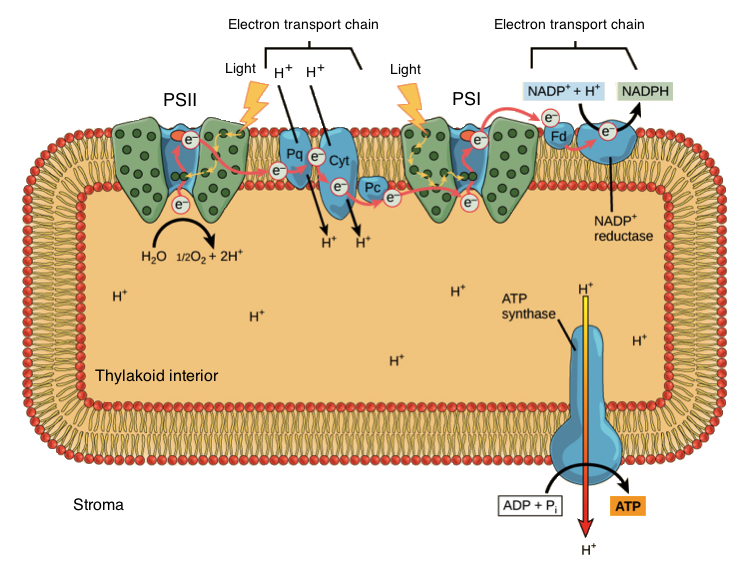
In photosynthesis, these photons are absorbed by groups of pigment molecules present in the thylakoid membrane of chloroplasts. These groups are called photosystems and consist of two parts: a light-harvesting complex and a reaction center.
The light-harvesting complex is made up of many chlorophyll and carotenoid molecules (accessory pigments) that reflect different shades of green and yellow/orange. This arrangement allows the complex to gather light effectively.
When chlorophyll absorbs light energy in the form of photons, one of the molecules’ electrons is raised to an orbital of higher potential energy. The chlorophyll becomes “excited”. (Here’s AN ARTICLE from AP Chem that explains orbitals in further detail, if you’re interested)
The energy is then transferred to the reaction center of the photosystem. The reaction center consists of two chlorophyll a molecules that donate electrons to the primary electron acceptor.
Since electrons need to be constantly used in the reaction center portion of the light-dependent reactions, the splitting of water is used to provide the replacement electrons.
The thylakoid membranes contain two photosystems that are used in photosynthesis - photosystem I (PS I) and photosystem II (PS II). Photosystem I is sometimes referred to as P700 while PS II is sometimes referred to as P680.
Since we now have a better understanding of photosystems, we can go through the major steps of light reactions with more emphasis on the specific parts and molecules involved. The key to the light reactions is a flow of electrons through the photosystems in the thylakoid membrane.
- PS II absorbs light energy, exciting an electron in the P680 reaction center of two chlorophyll a molecules to a higher energy state.
- This electron is transferred to the primary electron acceptor. The chlorophyll is oxidized and now requires an electron.
- An enzyme splits a water molecule into two hydrogen () ions, two electrons, and an oxygen atom.
- The electrons are supplied to the P680 chlorophyll a molecules. The oxygen atom immediately combines with another oxygen atom, forming the molecule that will be waste released into the atmosphere. The remaining ions are released into the thylakoid space.
- The original excited electron form PSII passes from the primary electron acceptors of PS II to PS I through an electron transport chain. The energy from the transfer of electrons down the ETC is used to pump ions into the thylakoid space, creating a proton gradient.
- The proton gradients created by the accumulation of ions in the thylakoid space are used in chemiosmosis to phosphorylate ADP to ATP with the help of ATP synthase. This ATP is sent to the Calvin Cycle.
- Meanwhile, the light energy given to PS II has also activated PS I, resulting in the donation of an electron to its primary electron acceptor. The electrons donated by PS I are replaced by the electrons from PS II.
- The primary electron acceptor of PS I transfers the excited electrons to another ETC.
- These excited electrons are transmitted to , reducing it to NADPH. This further removes from the stroma, increasing the proton gradient. Like the ATP created earlier, this NADPH is essential for the Calvin Cycle.
The main goal of the light dependent reactions is to set up for the Calvin Cycle which turns the energy produced from this part into glucose for energy storage.
Calvin Cycle
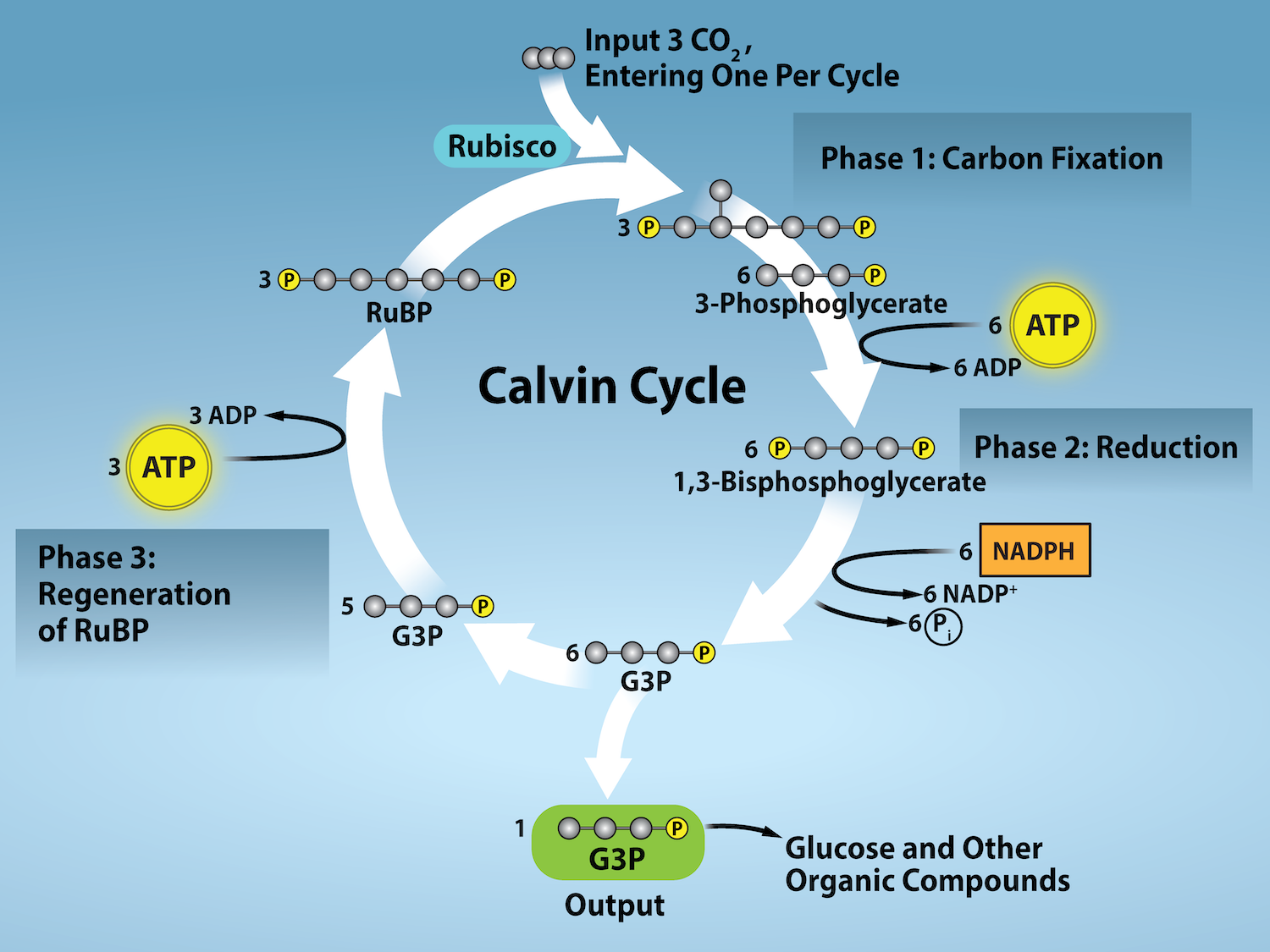
The Calvin Cycle is the light-independent phase of photosynthesis. It occurs in the stroma of chloroplasts, where from the atmosphere and the ATP and NADPH generated in the light-dependent reactions are used to produce glucose and other sugars.
The goal of the Calvin Cycle is to utilize energy from sunlight to synthesize energy-rich molecules for long-term storage in the chloroplasts. It incorporates carbon from carbon dioxide in the atmosphere and ultimately produces G3P (a building block for glucose).
However, in order to net one molecule of the three-carbon sugar G3P, the cycle must go through three rotations and “fix” three molecules of .
To produce the six-carbon sugar glucose (), the Calvin Cycle must go through six rotations and “fix” six molecules of .
The Calvin Cycle involves three main phases:
- Carbon fixation
- Reduction
- Regeneration
Carbon Fixation
In carbon fixation, the enzyme rubisco captures from the air. This is attached to a five-carbon ribulose-1.5-biphosphate. We call this molecule RuBP. The resulting unstable six-carbon molecule immediately splits into two three-carbon compounds called 3-phosphoglycerate (3PGA).
Reduction
ATP provides the energy to convert the 3PGA by phosphorylating the molecule into 1-3-biphosphoglycerate. Next, the six NADPH molecules from the light reactions reduce these molecules into six glyceraldehyde 3-phosphate (G3P) molecules.
Only two G3P molecules continue one to combine to form glucose, the final product of photosynthesis. One G3P molecule leaves the cycle to be directly used by the plant cell.
Regeneration
The remaining G3P molecules are rearranged to generate 3 RuBP molecules, allowing the cycle to begin again.
Below is a picture that provides a visual representation of the Calvin Cycle: