Introduction:
Welcome to the last article in AP Biology Unit 3! This section covers the various cycles that fuel cellular processes in cells.
The major cellular process we’ll be covering here is Cellular Respiration!
There are 3 major different phases to cellular respiration. These being glycolysis, the Krebs (Citric Acid) Cycle, and Oxidative Phosphorylation (Electron Transport Chain, and ATP Synthase aka Chemiosmosis).
Context: Reaction Coupling & ATP
Before we can get into the specific cycles that create energy, we have to take a few steps back and look at some context as to why these cycles are needed.
Almost everything an organism does requires energy. As we learned in TOPIC 3.3, this energy comes in the form of the phosphate bonds found in ATP. Energy is released when these bonds are broken.
Cells can perform endergonic reactions by “coupling” them with exergonic reactions. The energy made from exergonic reactions (such as ATP hydrolysis, the process where water breaks down ATP into ADP + Pi) is used to power endergonic reactions.
Cellular respiration is the main process for creating energy within cells in the form of ATP .
Cellular Respiration
Cellular respiration is an example of a catabolic pathway (a process that breaks down molecules).
There’s two major types of catabolic pathways:
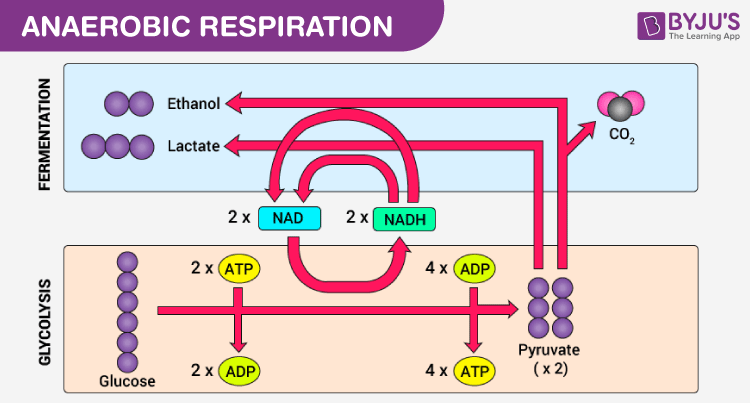
- Fermentation (anaerobic respiration) is the partial degradation of sugars that occurs without the use of oxygen.
- Aerobic respiration is the most prevalent and efficient form of the catabolic pathway in which energy from biological macromolecules, along with oxygen, is used to produce ATP. Aerobic respiration is referred to as cellular respiration. It occurs in the mitochondria.
The chemical reaction equation for cellular respiration is:
The measurable end product of the reaction is and its amount indicates the rate of cellular respiration occurring inside an organism. (this concept will be tested as an application question on the AP exam)
Before going into cellular respiration, we need to understand REDOX Reactions.
REDOX stands for Reduction–Oxidation. It involves the transfer of electrons between species. One species loses an electron, while the other gains an electron.
Oxidation is the loss of electrons, and can be memorized by the acronym (OIL–Oxidation Is Loss). When you lose electrons, you’re losing energy.
Reduction is the gain of electrons (RIG—Reduction is Gain). The gain of electrons means that the species gains energy.
Living systems use REDOX for energy transfer in metabolism. Molecules that are great at accepting and releasing electrons are called electron carriers. A good example of this is NADH, which plays a major role in cellular respiration.
There are three major stages of cellular respiration. The first being glycolysis.
Stage 1 - Glycolysis
Glycolysis occurs in the cytosol in a series of enzyme assisted steps. Unlike other parts of cellular respiration, this doesn’t happen in the mitochondria and doesn’t need oxygen in order to occur—meaning that it's anaerobic.
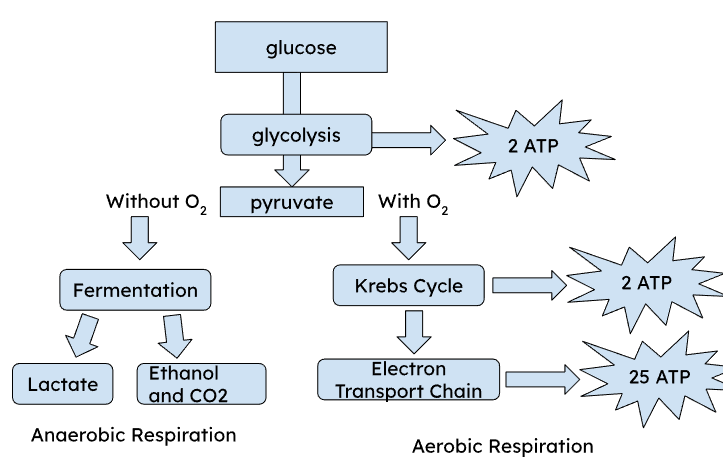
In glycolysis, the degradation of six-carbon glucose begins as it is broken down into two three-carbon pyruvate molecules. During this process, 2 ADP + Pi and 2 get turned into 2 ATP and 2 NADH.
By the end of glycolysis, there will be a net gain of 2 ATP due to the investment phase of glycolysis which starts the catabolic pathway. 2 ATP (the activation energy of the reaction) is invested in order to destabilize the glucose and put glycolysis into action.
The resulting phase is the payback phase of glycolysis where the 2 NADH, 4 ATP (2 net), and 2 pyruvates are left to oxidize further in the catabolic pathway of cellular respiration.
The primary purpose of glycolysis is to break down glucose into pyruvate, which is necessary for the next step in cellular respiration whilst also providing a small amount of ATP.
Following glycolysis, cellular respiration can branch off into two paths: aerobic and anaerobic respiration.
Aerobic respiration uses oxygen in order to create energy while anaerobic respiration does not use oxygen and creates lactic acid or ethanol + $\displaystyle\text{CO}_2$.
We’ll go more in-depth on anaerobic respiration (fermentation) later. We’ll mainly focus on aerobic respiration and its next step: the Krebs Cycle.
Stage 2 - The Krebs (Citric Acid Cycle)
The Krebs Cycle, or the citric acid cycle, is a series of eight enzymatic reactions in the mitochondrial matrix that oxidizes acetyl-CoA to produce ATP, NADH, and for energy production in aerobic respiration.
The main input for the Krebs Cycle is the two pyruvate molecules that were produced in the previous step, glycolysis.
Before entering the cycle, each pyruvate molecule from glycolysis enters the mitochondria and undergoes a “transition step”, forming acetyl-CoA, releasing , and producing NADH.
The purpose of the cycle is to harvest high-energy electrons by reducing and ATP into NADH and , which will carry electrons to the electron transport chain in the next step of cellular respiration. ATPis also produced during this cycle, while is released as waste.
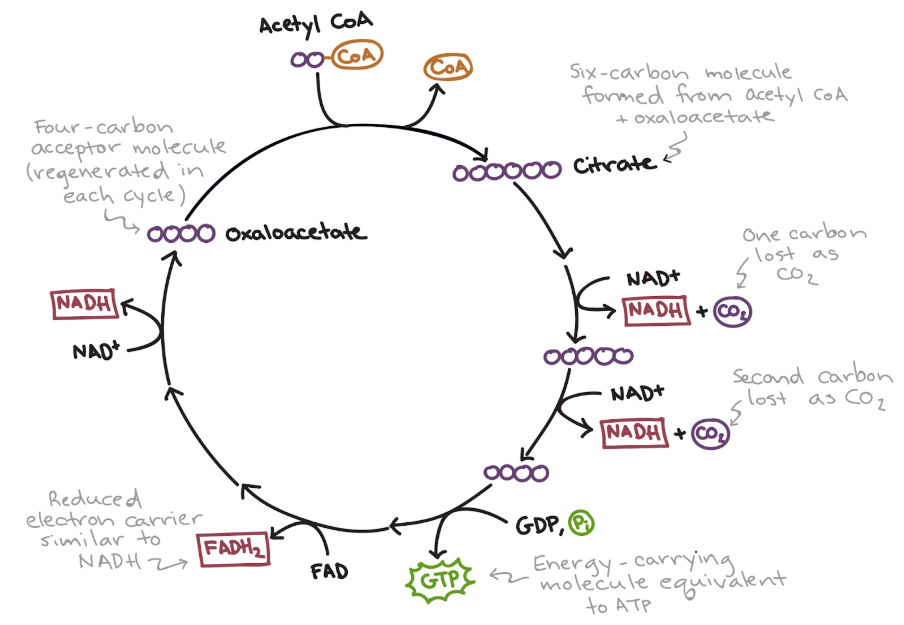
Luckily for you, you don’t need to memorize all that happens specifically in the cycle but instead need to focus on the outputs.
Each turn of the cycle produces:
- 3 NADH
- 1
- 1 ATP
- 2
Since glucose creates two pyruvates in glycolysis, two acetyl-CoA will spin through.
This means that the net output of the whole step is:
- 6 NADH
- 2
- 2 ATP
- 4
The electron carriers ( and ) are the key outputs, as they fuel the next step: oxidative phosphorylation, which is where most in cellular respiration is made.
Stage 3 - Oxidative Phosphorylation
Oxidative phosphorylation is the final and energy-producing stage of cellular respiration, where the electron transport chain (ETC) and chemiosmosis work together to convert the energy stored in and into .
Electrons are passed down the ETC, releasing energy to pump protons across the mitochondrial membrane to create a proton gradient.
This gradient then powers , an enzyme that uses the flowing protons to synthesize large amounts of .
The overall inputs are:
- (
- Oxygen
The overall outputs are:
- 34
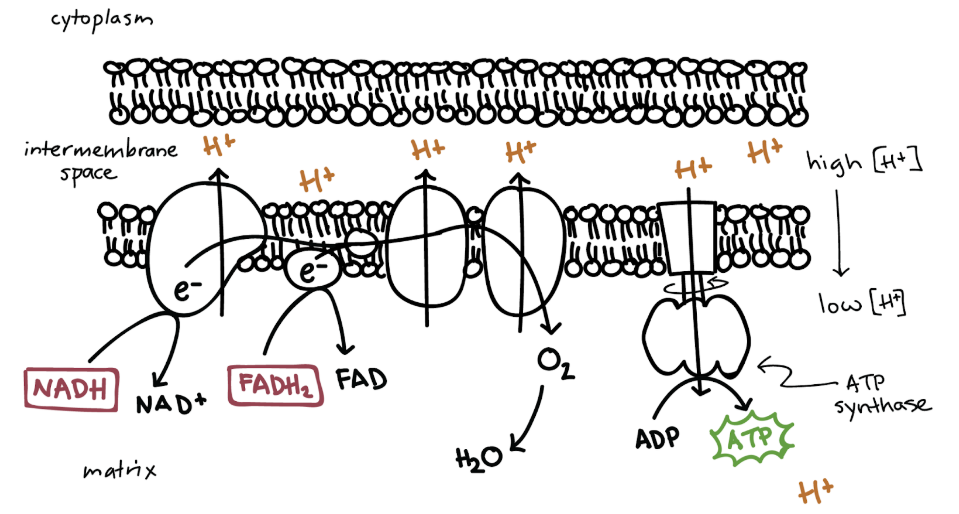
The primary purpose for this stage is to use the energy from the electrons to pump hydrogen ions into the inner membrane. This build-up then causes ions to rush out through ATP synthase, which creates the energy needed to form lots of ATP.
Electron Transport Chain
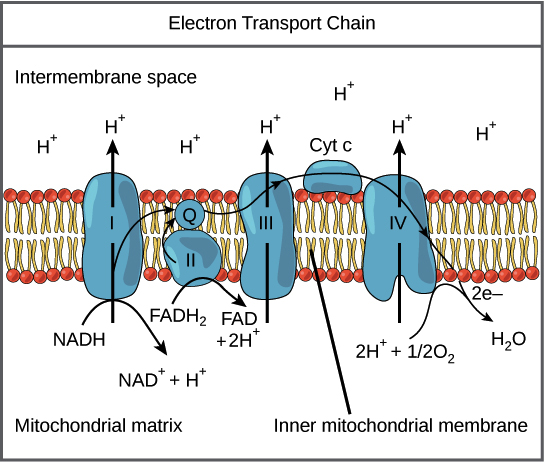
The electron transport chain is the first part of oxidative phosphorylation.
Here, electrons are delivered from NADH and (our electron carrier from Krebs) to the electron transport proteins. The flow of these electrons powers a proton pump which moves electrons from the inside of the membrane to the outside, creating a proton ( ion) gradient across the inner membrane.
Oxygen at the end serves as the final electron acceptor. When it accepts the electrons, it can bond with protons in order to make water.
Chemiosmosis
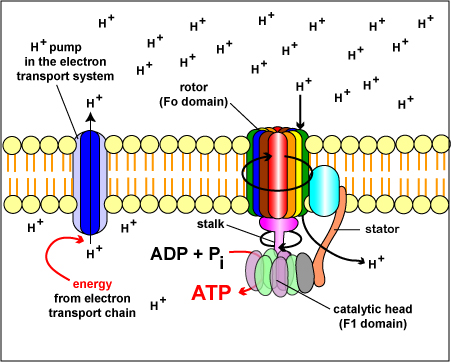
Chemiosmosis is the second part of oxidative phosphorylation.
Protons flow through the channel protein portion of the ATP Synthase enzyme back into the mitochondrial matrix.
This flow provides free energy to build ATPmolecules by having a rotor protein portion of the enzyme bind ADP and Pi.
This is the most efficient way to make ATP and is responsible for most of the ATP molecules made per glucose.
Anaerobic Cellular Respiration
Anaerobic respiration is used for almost all life, including plants! Its primary purpose is to recycle so that glycolysis can continue.
Inputs: pyruvate, NADH
Outputs:
- , Lactate (Lactic Acid)
- For us: , , Ethyl Alcohol