Introduction
Welcome to Unit 4 of AP Biology, which is known as Cell Communication and Cell Cycle! Once you finish this unit, you will be halfway through AP Biology! Topic 4.1 in AP Biology is Cell Communication! In this topic, we will discuss what Cell Communication is and the Forms of Cellular Communication. By the end of this article, you should be able to name and describe the four types of cell signaling.
An Overview of Cell Communication
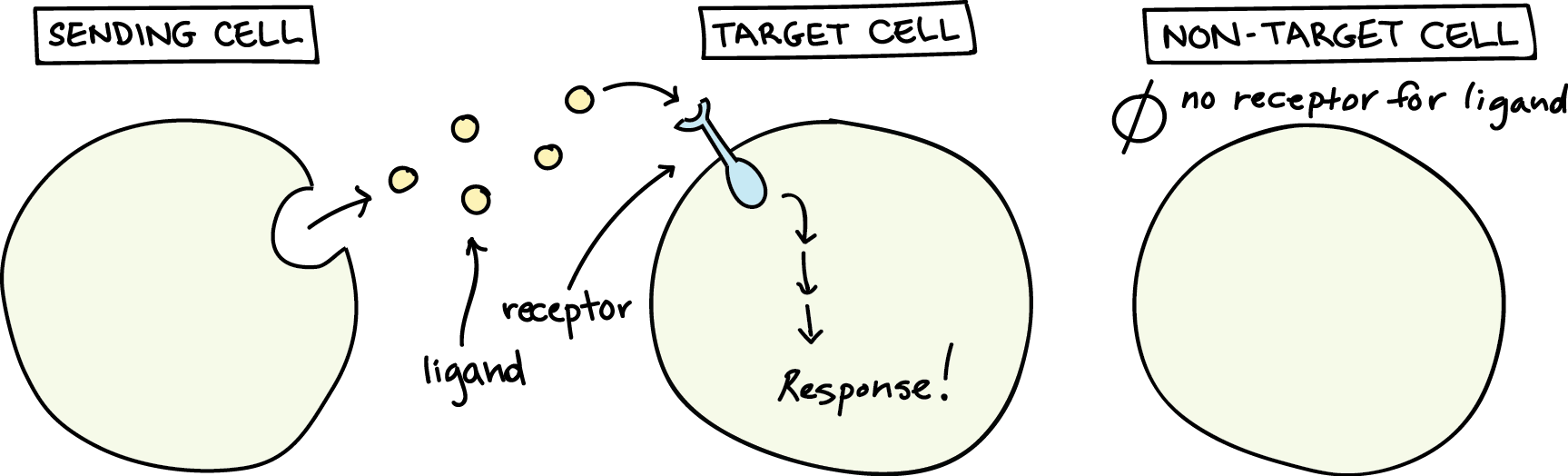
Cell communication is really similar to a group project. In a group project, everyone has a role they have to play. A pivotal skill that a group needs is effective communication. If a single member doesn’t communicate with their group, it can cause complications and potentially may ruin the project. This also happens with cells. Cells communicate with one another and this communication is critical for the survival and function of cells. Cells communicate with each other via ligands. These are sent from the sending cell to the target cell. This can be visualized with the image below:
Short-Distance Communication
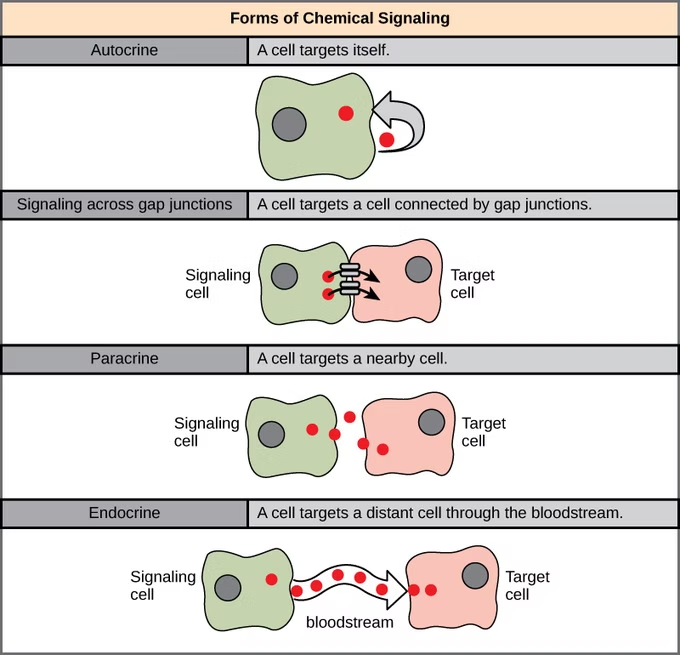
From the name, you can probably guess that this branch of cell communication occurs between cells that are close together (gasp). All the types of this branch of cell communication have similar steps. However, the entire process can vary depending on the distance between the sending and target cell. The table below effectively summarizes some types of signaling, their definition, and an analogy to remember them.
| <b>Type of Signaling</b> | <b>Definition</b> | <b>Analogy</b> |
| <b>Autocrine</b> | When a cell signals itself by secreting the ligand and binding to the receptors on the same cell. | Talking to yourself to remember your role in a group project. |
| <b>Juxtacrine</b> | Direct-contact cell communication through cell junctions (connecting cells via protein complexes); Signaling substances and other material dissolved in the cytoplasm can pass freely between adjacent cells. | Talking to one of the members in your group to discuss what they want to do in the project. |
| <b>Paracrine</b> | Cell communication occurs between cells that are close together without direct contact. | Asking someone in your group to tell someone else in your group what you want to do because you can’t get their attention. |
Long-Distance Communication
Long-Distance Communication is the other branch of cell communication. This branch of cell communication usually occurs between cells that are distant from each other. Think of it as sending a text message to your group about how you want to do the project. Both plants and animals send hormones during long-distance cell communication. Just like short-distance communication, the methods at which long-distance communication varies between plants and animals. Plants release hormones that travel in the plant's vascular tissues, or through the air to reach target cells. A plant’s vascular tissues consist of the xylem and phloem, both of which carry water and minerals up the plant. On the other hand, animals use endocrine signaling by releasing hormones into the circulatory system to reach the target cells. This is often done via the bloodstream of the animal.
Cell Communication: Summary
Practice Questions
Image Source for Question 2:
https://www.nature.com/articles/s41392-024-01888-z
Image Source for Question 3:
https://www.researchgate.net/figure/The-Notch-signaling-pathway-Notch-pathway-activation-occurs-when-Notch-ligand-Delta_fig2_378918909