
Introduction
Welcome to AP Biology Topics 4.2 and 4.3: Signal Transduction Pathways. Topics 4.2 and 4.3 builds on the basic knowledge of cell communication from topic 4.1. In this article, we’ll review the steps and responses in cell communication and signal transduction pathways. By the end of 4.2 and 4.3, you should be able to explain the three steps of cell communication: reception, signal transduction, and response, alongside naming the types of responses and how mutations and chemicals can affect signal transduction pathways.
Signal Transduction Overview
We learned in topic 4.1 that cell communication is critical for survival. Cells communicate by sending ligands (e.g. hormones that travel through the bloodstream) to target cells, which trigger a response.
Think of the ligands, aka chemical messengers, as a piece of mail you send to a friend. Your mail doesn’t magically teleport to the destination, but instead, requires a series of transportation through mail companies. Similar to mail, chemical messengers don’t magically turn into a response. They require signal transduction pathways.
Signal Transduction: Reception
Before diving in, what even is a signal transduction pathway? A signal transduction pathway is a series of events that connect an extracellular signal to an intracellular signal to elicit a cellular response.
A letter cannot be received if it’s not sent in the first place, in the same way that a cellular response can’t occur without a signal transduction pathway, which can’t occur without reception.
Reception is the detection and reception of a ligand by a receptor in the target cell. Using the mail analogy, reception is like when your letter first enters the post office.
The binding between the ligand and the receptor is highly specific, meaning that binding can only occur if the ligand is precisely fitted for the receptor, like a key that’s only usable in one lock (similar to how an enzyme can only catalyze one very specific reaction).
Because not all ligands are the same, not all receptors are the same either. We’ll cover two types of receptors: plasma membrane receptors and intracellular receptors.
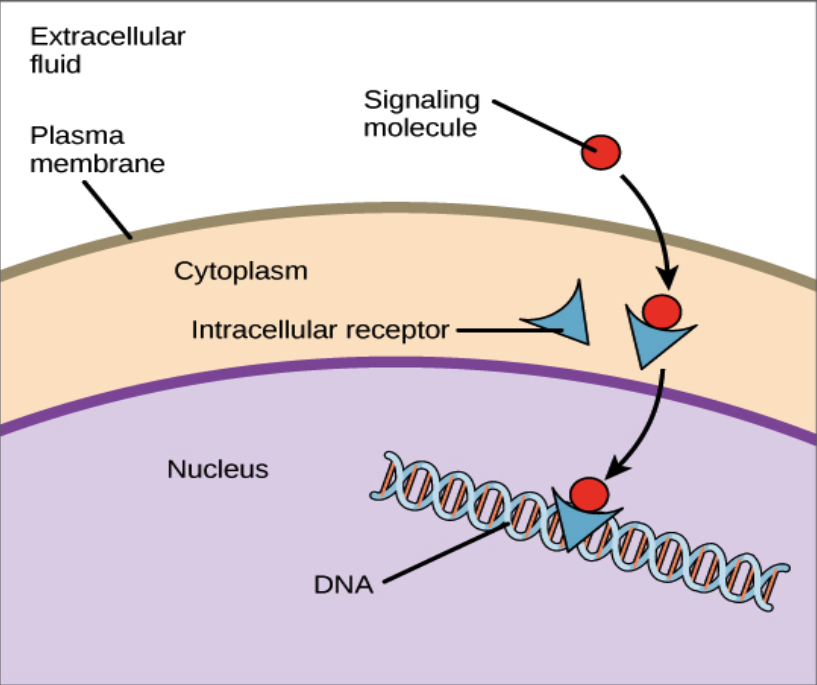
Image Source: Khan Academy | Ligands & Receptors
As the name suggests, intracellular receptors are found inside the cell, either in the cytoplasm or nucleus, as seen in the image. The ligand bonding to its intracellular receptor must be able to pass through the membrane to bind to the receptor, so these ligands are typically small, nonpolar molecules.
On the other hand, plasma membrane receptors are more common than intracellular receptors. As the name suggests, plasma membrane receptors are embedded in the plasma membrane. Because ligands that bind to plasma membrane receptors don’t have to diffuse through the membrane, they’re typically polar, water-soluble, or large molecules.
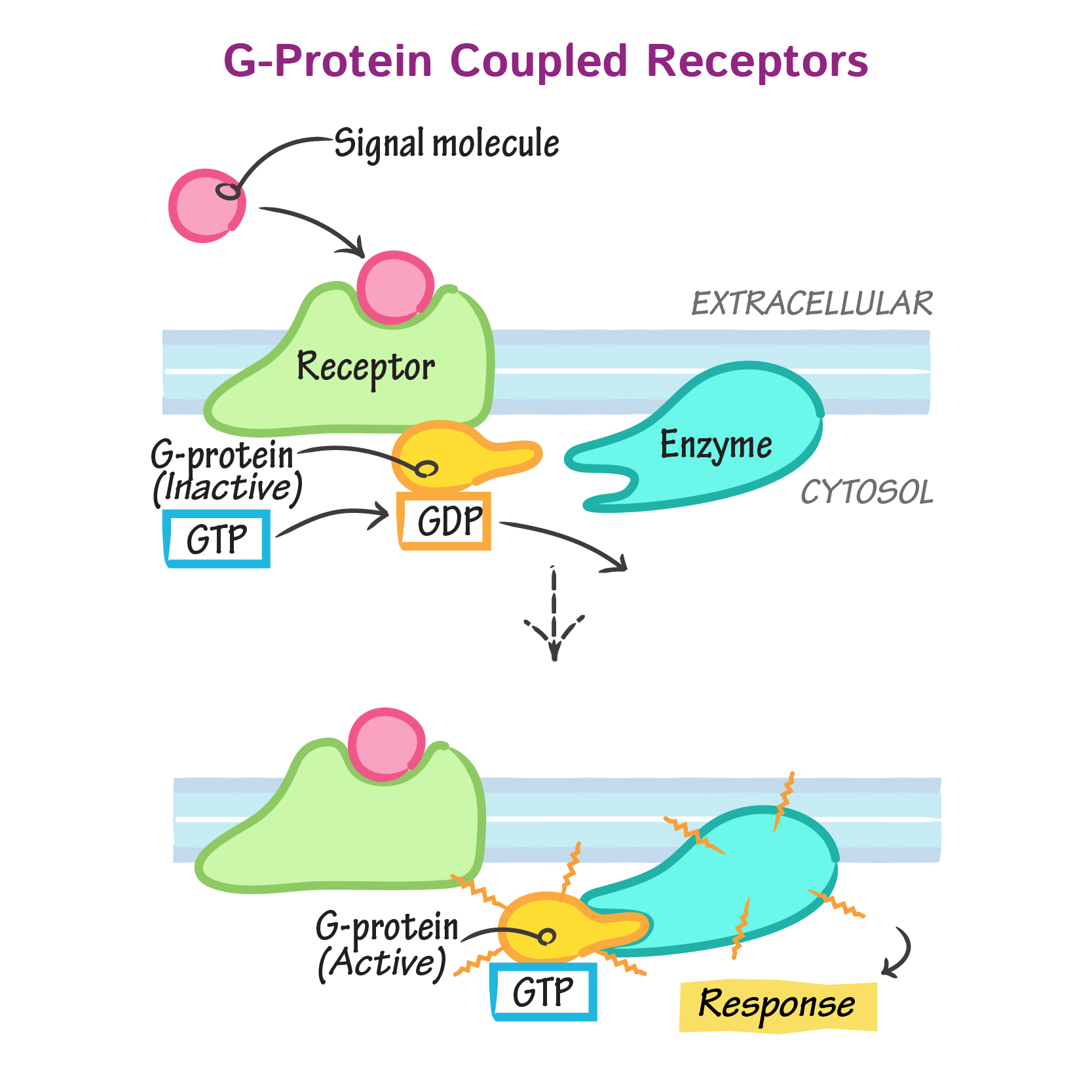
Image Source: ditki | G-Protein Coupled Receptor
Plasma membrane receptors come in many forms, one being G-Protein-Coupled Receptors. G-Protein-Coupled Receptors (GPCRs), as seen in the image, are linked to and interact with guanine nucleotide-binding proteins, and when activated, they replace GDP and proceed to the next enzyme, initiating the beginning of the signal transduction pathway.
Ligand-gated ion channels are another form of plasma membrane receptors. Ligand-gated ion channels are integral proteins that are like a gate. When the ligand binds to the ligand-binding site, it’s like a key opening a gate, allowing ions to flow in. When the ligand isn’t bonded, the gate remains closed so that nothing can pass through.
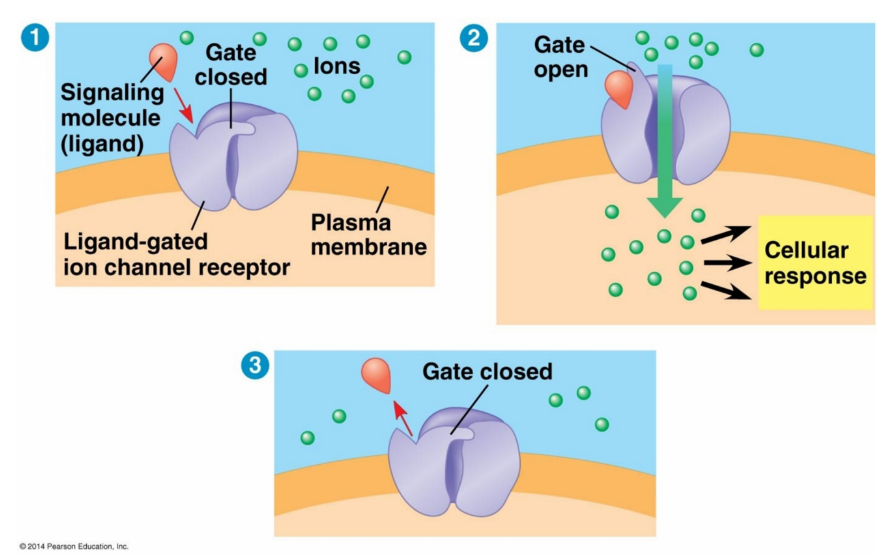
Image Source: 2014 Pearson Education Inc.
Components of Signal Transduction Pathways
As we discussed in Unit 3, receptor proteins are enzyme-linked proteins, meaning that it serves as a receptor and enzyme, so that when the receptor binds to its extracellular active site, the enzyme is activated and the receptors intracellular region changes its shape, triggering an intracellular response.
The intracellular response initiates the signal transduction pathway, ultimately linking an extracellular signal to an intracellular response as seen in the image, similar to pushing over the first domino to begin the chain reaction.
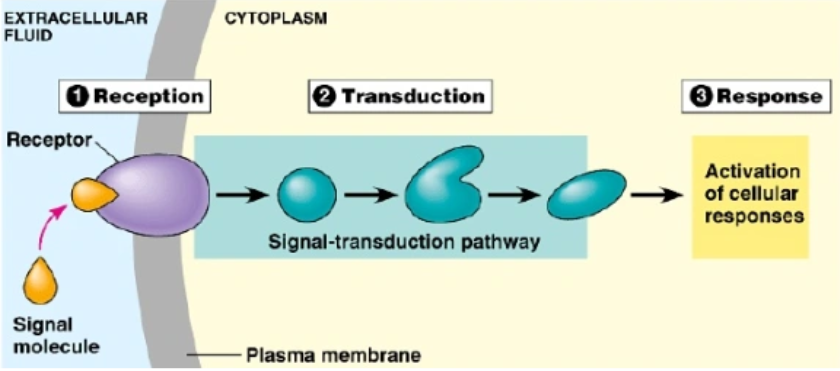
Image Source: Winnacunnet Biology | Three Stages of Cell Signaling
Cyclic AMP is a component of some signal transduction pathways. Cyclic AMP (cAMP) is a second messenger, and when present, activates when the ligand binds to the receptor and relays the signal, like using an amplifier to make a guitar louder. cAMP amplifies the signal by attaching to and activating a kinase. But what’s a kinase? -- A protein kinase is an enzyme responsible for activating proteins, like a light switch.
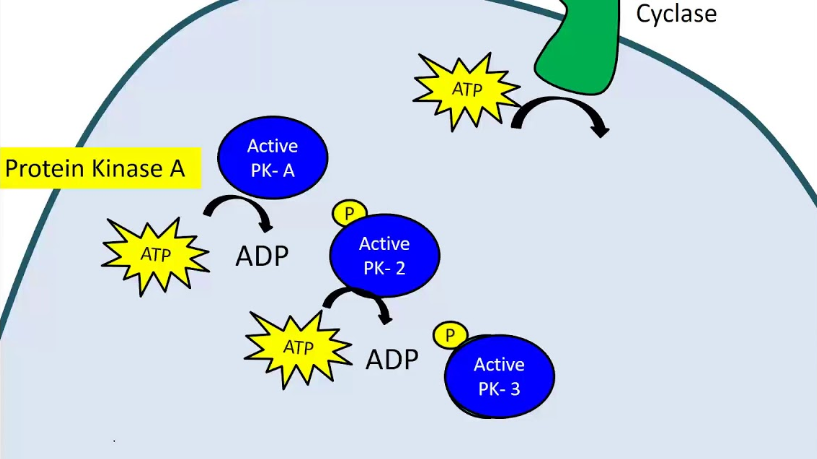
Image Source: Phosphorylation Cascade (Newer Version)
Protein kinases function by removing a phosphate group from ATP (which is converted to ADP) and attaching it to another protein to activate it. This process is called phosphorylation, and the phosphorylated kinase phosphorylates the next kinase until it reaches an end. This is called a phosphorylation cascade, like a waterfall of phosphorylation.
Protein kinases function by removing a phosphate group from ATP (which is converted to ADP) and attaching it to another protein to activate it. This process is called phosphorylation, and the phosphorylated kinase phosphorylates the next kinase until it reaches an end. This is called a phosphorylation cascade, like a waterfall of phosphorylation.
Cell Signaling: Response
The response of the final molecule in the signaling pathway converts the signal to a response that will alter a cellular process.
Now jumping back to the analogy from 4.1, think of the response as the mail finally reaching its destination and being opened by the receiver. Cell responses could include cell growth, secretion of molecules, or changes in gene expression. These changes in gene expression could alter the cell's phenotype or lead to apoptosis, programmed cell death.
Signal Transduction Pathway: Mutations
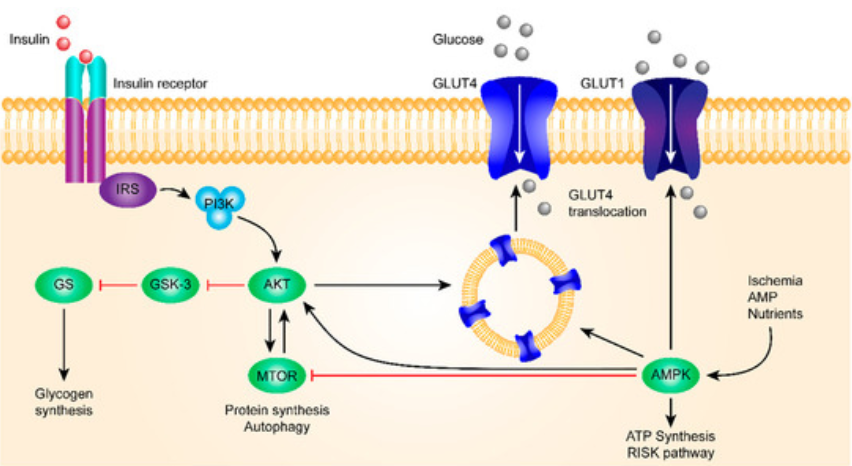
Image Source: MDPI | Metabolomics of Type 1 and Type 2 Diabetes
Diabetes is a condition where the body doesn’t create enough insulin on its own. Because insulin helps to regulate blood sugar levels, diabetics can suffer from high blood sugar if unmedicated, causing a plethora of issues. Diabetics therefore have to manually take insulin to regulate their blood sugar, as seen in the signal transduction pathway diagram, allowing glucose to enter the cell to be broken down, and the blood sugar to return to normal.
But not everything goes perfectly–what if the genes that code for the intracellular domain of the transmembrane protein had a mutation that prevented it from properly functioning? How would that impact blood glucose levels?--This would prevent glucose from entering the cell so that it can’t be broken down, therefore altering the signal transduction pathway and preventing it from properly functioning.
In short, mutations along the pathway affect all downstream components and can result in loss of function or cell death.
Signal Transduction Pathway: Chemical Interference
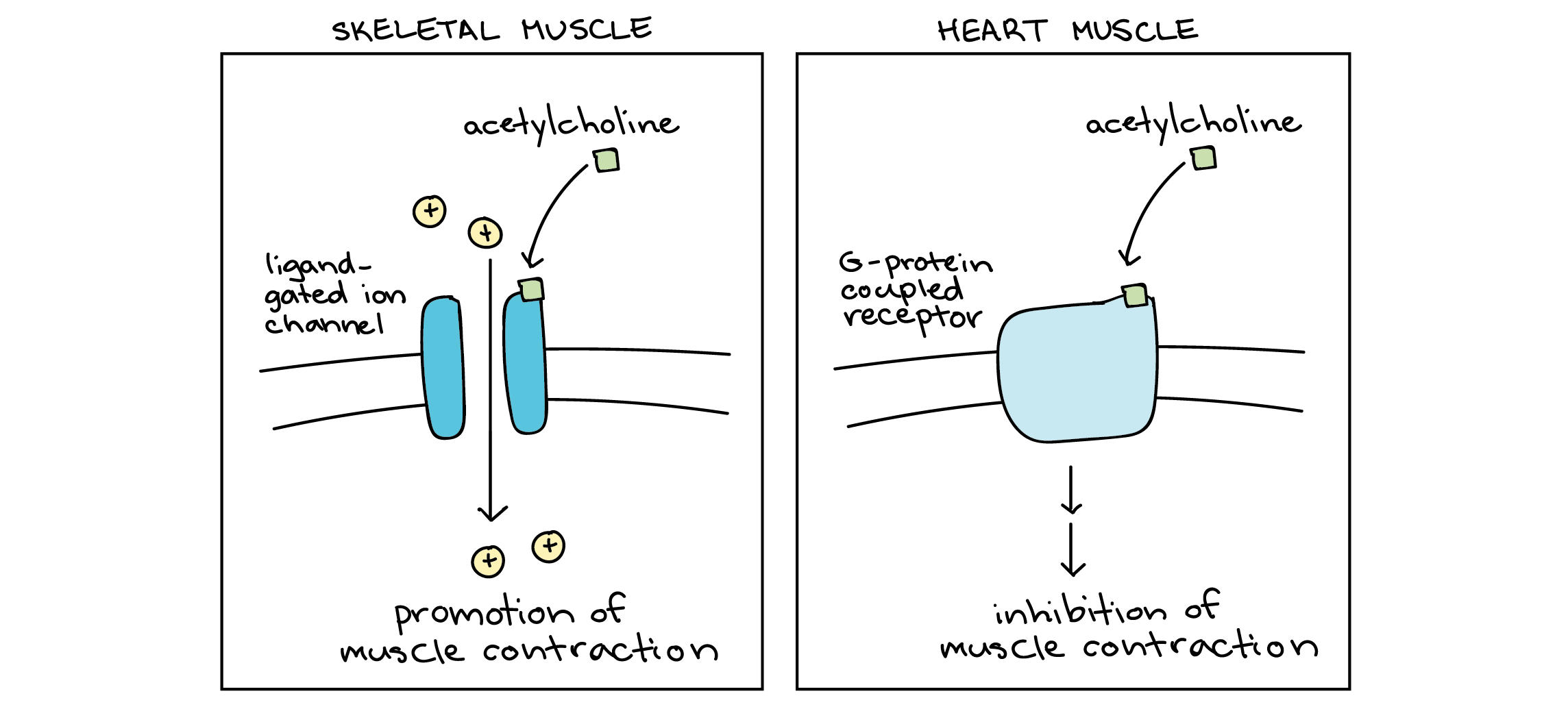
Image Source: Khan Academy | Signal Relay Pathways
As discussed in Unit 3, non-competitive and competitive inhibitor enzymes prevent a ligand from binding to its active site. This same concept can apply to signal transduction pathways.
Chemicals can interfere with a signal transduction pathway's function, like how losing mail during transit can prevent it from reaching its destination. As shown in the photo to the right, acetylcholine serves as an activator in the skeletal muscle, but also as an inhibitor in the heart muscle, preventing enzymes in the heart muscle from functioning.
Conclusion
A signal doesn’t magically elicit a response. For that reason, signal transduction pathways are the cellular process of converting an extracellular signal receptor into an intracellular signal that’ll result in a cellular response. However, mutations can interfere with this pathway and alter or entirely prevent an intracellular response from occurring.