
Introduction
Welcome to AP Biology Topic 4.4: Feedback, which covers how organisms use feedback loops to maintain homeostasis and set points. The previous topics were the process of cell signals getting to a certain location. This topic, however, covers the response end of the process.
Feedback Overview
Our bodies, like any other organism, need to be able to monitor their internal conditions at all times and maintain a specific temperature or pH level. These are set points, or values that the body must maintain to function correctly and live. You’ve likely had a fever and didn’t feel as energetic as usual. This is because your body's temperature was higher than its set point, which is , and is working to maintain homeostasis, or stable internal conditions.
But how are these levels kept stable? After all, human beings go through and live in a variety of conditions.
Feedback Loops
Our answer to this question is feedback loops. Feedback loops occur when a receptor (sensory organ) detects a stimulus (a variable that will cause a response) that is sent to the effector (muscle or gland that responds) to create a response. These responses can either decrease or increase the effect of the stimulus. These are known as negative and positive feedback loops.
Negative Feedback Loops
Negative feedback loops are more common and reduce the effect of the stimulus. If a system is disrupted, negative feedback mechanisms move the system back to its target set point. Circling back to the body temperature example, your body utilizes negative feedback loops to regulate its temperature. In the summer, sweating is an example of temperature regulation. Your temperature receptors in your skin detect the stimulus of heat, leading the effector, the sweat glands, to respond by producing sweat to cool your body. In the winter, your body uses similar mechanisms to stay warm. When your temperature receptors detect the cold, the effector, your muscles, shiver as a response to keep warm.
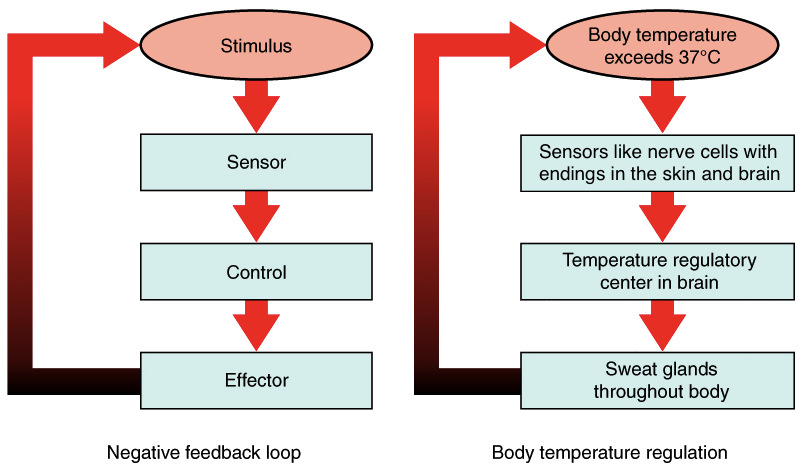
Image Source: Khan Academy | Homeostasis
Positive Feedback Loops
Unlike negative feedback loops, positive feedback loops increase the effect of a stimulus. This response moves the variable initiating the response farther away from the initial set point. An example of positive feedback loops is the microphone and speaker feedback. The stimulus, the mic picking up noise from a speaker, which is then detected and sent back to the speaker (the effector), where it’s further amplified, and as a response, the sound continues to become louder and louder without intervention.
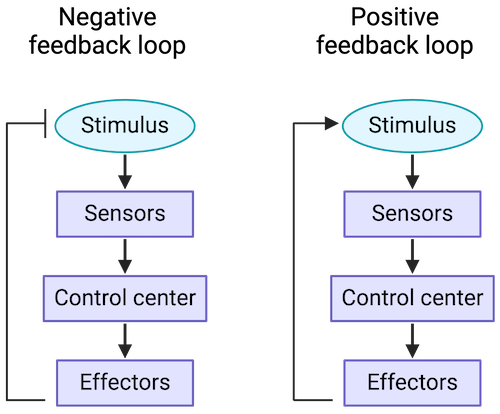
Image Source: Khan Academy | Homeostasis and Feedback Loops
Conclusion
Biological systems require maintaining homeostasis, which is a set level of stable conditions for the body. Homeostasis depends on set points, values that the body must remain at to perform as needed. When these levels are altered, either negative or positive feedback loops ensue. Negative feedback loops reduce the effect of the stimulus while positive feedback loops increase the effect of the stimulus.