
Introduction
Welcome to AP Biology topic 4.5: the cell cycle! Up to this point, we’ve focused on cell communication. In 4.5, we’ll dive deeper into the cell cycle and asexual reproduction. By the end of 4.5, you should be able to name, describe, and connect the stages of the cell cycle and its purpose.
Cell Cycle: Overview
The cell cycle is the life of a cell from its formation until it divides. Like how humans reproduce, our eukaryotic cells also need to reproduce for two main reasons: repair and growth.
The cell cycle consists of three main stages: interphase, mitosis, and cytokinesis.
DNA Organization
Cells cannot properly divide unless their DNA goes through numerous changes in organization.
As we learned in the very beginning, Unit 1, DNA in its smallest form is a double helix. DNA associates with and wraps around proteins known as histones to form nucleosomes. Strings of nucleosomes then form chromatin. Chromatin is non-condensed until after DNA replication, where it condenses to form a chromosome.
Take note of the chromosome's structure. It takes the form of an X, joined together from two sister chromatids. The kinetochore is the proteins attached to the centromere (the region on each sister chromatid where they’re most closely attached) that link each sister chromatid to the mitotic spindle.
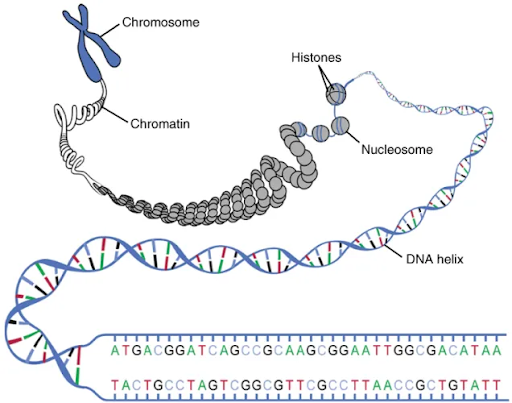
Image Source: DNA Organization and the Cell Cycle | Easy Peasy All-in-One High School
Cell Cycle: Interphase
Interphase is the longest portion of the cell cycle and is divided into three stages: G1, S phase, and G2.
During the G1 phase, the cell grows and carries out normal functions, such as organelle duplication. Think of this as your day-to-day life; running errands, waking up in the morning, showering, etc.
After G1, the cell cycle has two options: G0 phase and S-phase. It enters an undivided G0 phase. Some cells never exit the G0 phase and consequently don’t divide. In the next article, we’ll dive further into these checkpoints.
If the cell exits the G0 phase, it enters the S-phase. The S “Synthesis” phase, DNA, in the form of chromatin, replicates to form two sister chromatids connected by a centromere to prepare the DNA for cell division.
The last step before mitosis is the G2 phase, in which the cell finalizes growth, synthesizes proteins for mitosis, duplicates centrosomes, and produces ATP in larger amounts to prepare for cell division.
As a reminder, not all cells are actively dividing; nondividing cells may remain in one stage of the cycle or exit the cycle.
Cell Cycle: Mitosis and Cytokinesis
Mitosis in eukaryotes is cell division that starts with the parent cell and ends with two identical daughter cells. This means both cells must have the exact same genome. Mitosis is needed for life as it plays a crucial role in growth, tissue repair, and asexual reproduction.
Mitosis occurs after interphase in sequential steps: PMAT (prophase, metaphase, anaphase, telophase), and then cytokinesis.
Image Source for all following images: Mitosis | cK-12
Prophase
- Chromatin condenses, and duplicated chromosomes appear as chromatids
- Nucleoli begin to disappear
- Mitotic spindle begins to form
- Centrosomes move to opposite poles of the cell
Metaphase
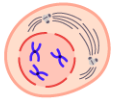
- Spindle fibers align chromosomes at the equator of the cell, lined up at the metaphase plate
- Microtubules are attached to each kinetochore
Anaphase
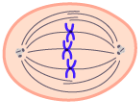
- Paired sister chromatids separate as spindle fibers pull chromatids toward poles
- Cell elongates
Telophase
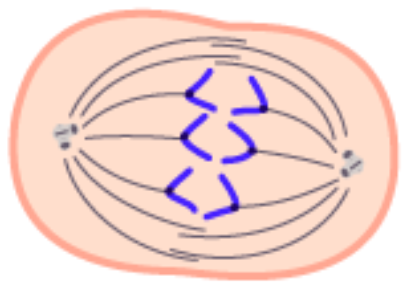
- Mitotic spindle breaks down
- New nuclear envelope develops in each cell
- Chromosomes become less condensed
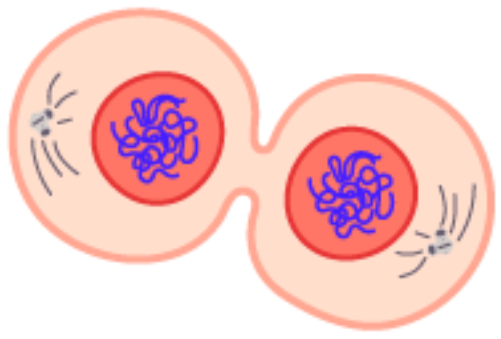
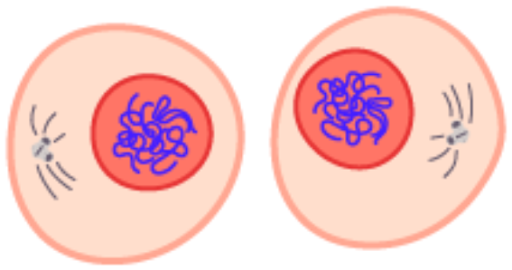
Cytokinesis
- Cytoplasm divides
- In animals, a cleavage furrow forms due to a contractile ring of actin filaments.
- In plants, vesicles produced by the golgi travel to the middle of a cell and form a cell plate.
- Results in two identical daughter cells.
Summary
The cell cycle in eukaryotes is necessary for repair and growth. The cell spends most of its time in interphase, undergoing normal procedures and preparing the cell for mitosis. In mitosis, the cell goes through PMAT, resulting in two identical daughter diploid cells.