
Introduction
Welcome to AP Biology topic 4.6: the regulation cycle! This is a direct continuation of the last topic. In 4.6, we’ll cover the checkpoints and mechanisms that regulate the cell cycle, as well as disruptions to this cycle. All of this moderation of the cell cycle works to keep everything in the organism moving smoothly. By the end of this lesson, you should be able to describe the three main checkpoints of the cycle and be able to describe the purpose of checkpoints and regulators of the cell cycle. Now get ready and buckle up, as it’s time to get regular with the cell cycle!
Cell Cycle Regulation Overview
Like everything else in life–you, me, and the government—the cell cycle isn’t always perfect. Sometimes a step is skipped, or an error is made. To prevent this, cells have checkpoints and internal regulators to prevent errors from affecting the organism.
Checkpoints
As stated above, checkpoints throughout the cell regulate the cycle and provide stop/go signals. The three major checkpoints are the G1 checkpoint, the G2 checkpoint, and the M checkpoint.
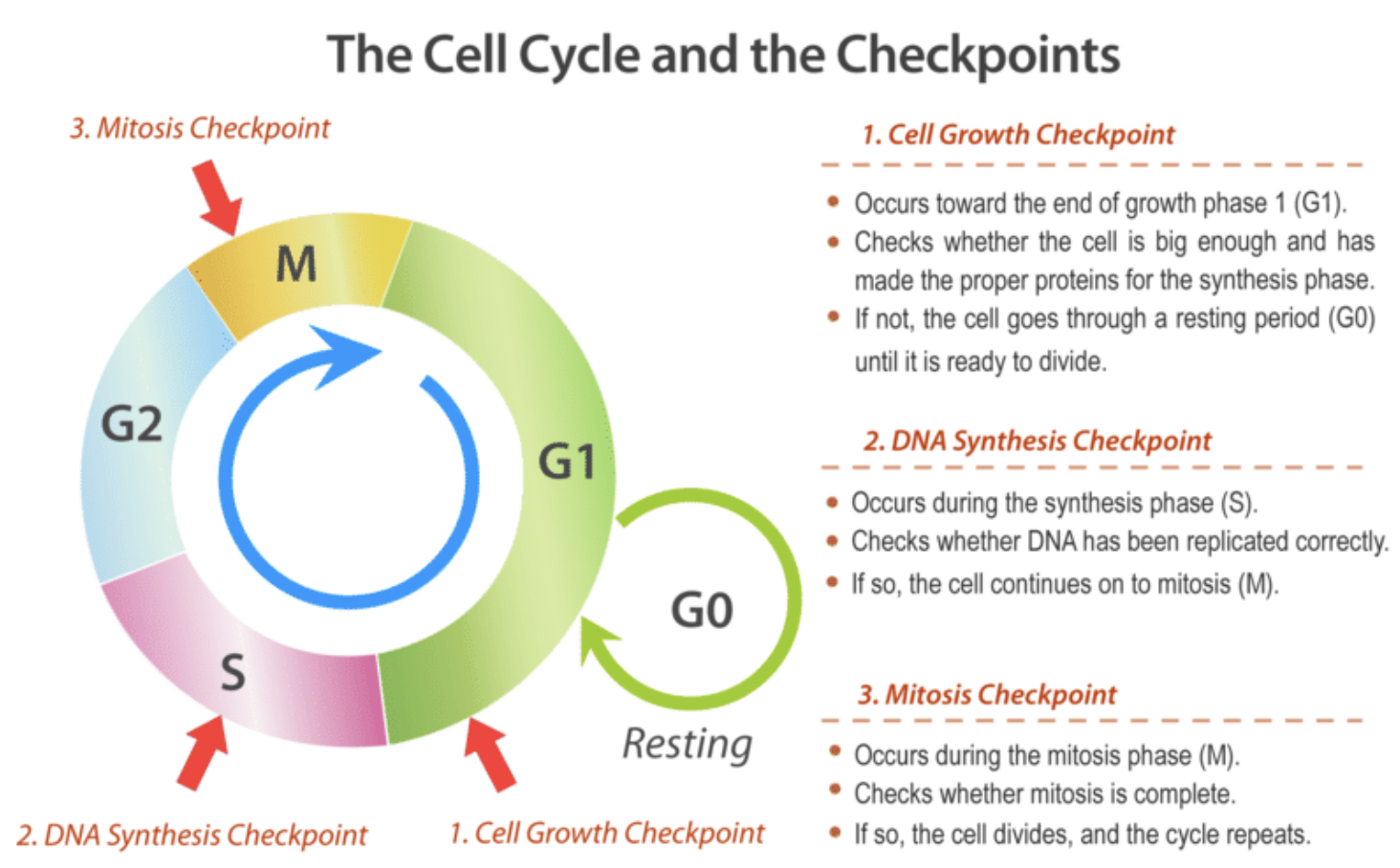
Image Source: 7.2 Cell Cycle and Cell Division | LibreTexts Biology
Internal Regulators
Regulation of the cell cycle also involves an internal control system that consists of proteins known as cyclins and enzymes known as cyclin-dependent kinases (CDKs). Cyclins are synthesized and degraded at specific stages of the cell cycle. At the same time, the concentration of CDKs remains constant through each phase of the cycle and is only active when its specific cyclin is present. Each cyclin-CDK complex has a distinct regulatory effect and operates at various stages of the cell cycle.
[EXCLUSION STATEMENT—Knowledge of specific cyclin-CdK pairs or growth factors is beyond the scope of the AP Exam.]
For more information on Cyclin-CDKs, take a look through this free Khan Academy article.
Cell Cycle Disruptions
Disruptions in the cell cycle can lead to apoptosis or cancer. As stated earlier, if a checkpoint, such as G2, detects irreparable damage, it prevents the cell from continuing with mitosis. Instead, it causes the cell to undergo apoptosis. However, cancer, which is caused by DNA mutations, is entirely an evasion of the cell cycle. Cancerous cells don’t follow checkpoints, divide infinitely when in culture, and are considered to be immortal since they evade apoptosis and continue dividing even with errors. The uncontrollable growth of cancer cells can lead to tumors (a mass of tissue formed by abnormal cells) and become life-threatening.
Conclusion
Cell cycle regulation is immensely important and occurs throughout the cell cycle process. It prevents irreparable damage from being done, allowing organisms to live a full and unafflicted life.