
Introduction
Hello and welcome to Lesson 5.3 & 5.5 of AP Biology Topic 5.3 discusses Mendelian genetics while 5.5 dives deeper into the environmental effects impacting genetics. Our goal is to be able to explain, through the use of Mendel’s laws, the inheritance of genes and traits. We will learn his law of segregation, law of independence, fertilization, probability rules, types of crosses (monohybrid, dihybrid, and test crosses), how we define a genotype, and what a phenotype is.
Gregor Mendel: The Father of Genetics
Mendel’s work laid the foundation for understanding inheritance. He was most famous for his experiment with garden peas that allowed him to determine the mathematical patterns in inheritance. In the past, people thought inheritance was “blending,” but Mendel was able to explain why traits can skip generations and reappear. Mendel made two laws that can help us understand this.
His first law is the Law of Segregation, which states that two alleles for a trait separate during gamete formation, and each gamete receives only one allele from one parent. During meiosis, these separate.
Mendel’s second law is the Law of Independent Assortment, which states that different traits are distributed to gametes independently of one another. This means that the inheritance of one trait does not affect the inheritance of another. However, this only applies to genes that are not linked together, which we discuss in our article on Topic 5.4.
The Experiment Procedure
Mendel chose to observe 7 traits of the Pisum sativum, or garden pea: seed shape, seed color, pod shape, pod color, flower color, flower position, and stem length. The advantages of using this organism are that a) it has a short generation time, meaning quick results, b) a large number of offspring, meaning higher accuracy, c) easy to grow and maintain, meaning practical for experiments, and d) easy to control mating, meaning that humans can easily prevent or facilitate cross-pollination.
Fertilization at the Genetic Level
When two haploid gametes, formed by meiosis (you can check out Articles 5.1 and 5.2 to learn more), merge, a zygote is formed. This zygote is diploid and helps increase genetic variation in populations of organisms with the formation of new allele combinations.
Genes and Alleles
An allele is an alternative version of a gene. For example, a gene for seed color is dominant for a yellow allele (Y) and recessive for a green allele (y). A dominant allele is expressed as long as it is present in a combination. For example, a seed would be yellow if it has either YY or Yy as its gene for seed color. A recessive allele, on the other hand, can only be expressed when both copies are present (yy).
A genotype refers to the genetic makeup or allele combination, e.g., YY, Yy, or yy. The term “homozygous” means having two identical alleles for a gene, where homozygous dominant is YY and homozygous recessive is yy. Heterozygous means having two different alleles for a gene, e.g., Yy.
Parental (P) generation is the original true-breeding parents. The first filial (F1) generation is the offspring of a P cross. The second filial (F2) generation is the offspring of a cross in the first filial (F1) generation. True-breeding organisms are homozygous for a certain trait. One can perform a test cross by crossing the organism with a homozygous recessive organism to determine the genotype of the first organism based on the observed phenotypes.
Phenotypes
A phenotype refers to the observable characteristics expressed in an organism based on a genotype (e.g., black fur or brown fur) inherited from the parental organisms.
Despite this, an organism may express an entirely different phenotype from that same genotype. This is phenotypic plasticity and is caused by environmental conditions. Different environmental conditions can influence how a gene is expressed. For example, there’s seasonal changes that occur in several animals. A common example of phenotypic plasticity are arctic rabbits. These rabbits, depending on the season and environment, can have a different color fur with different textures.
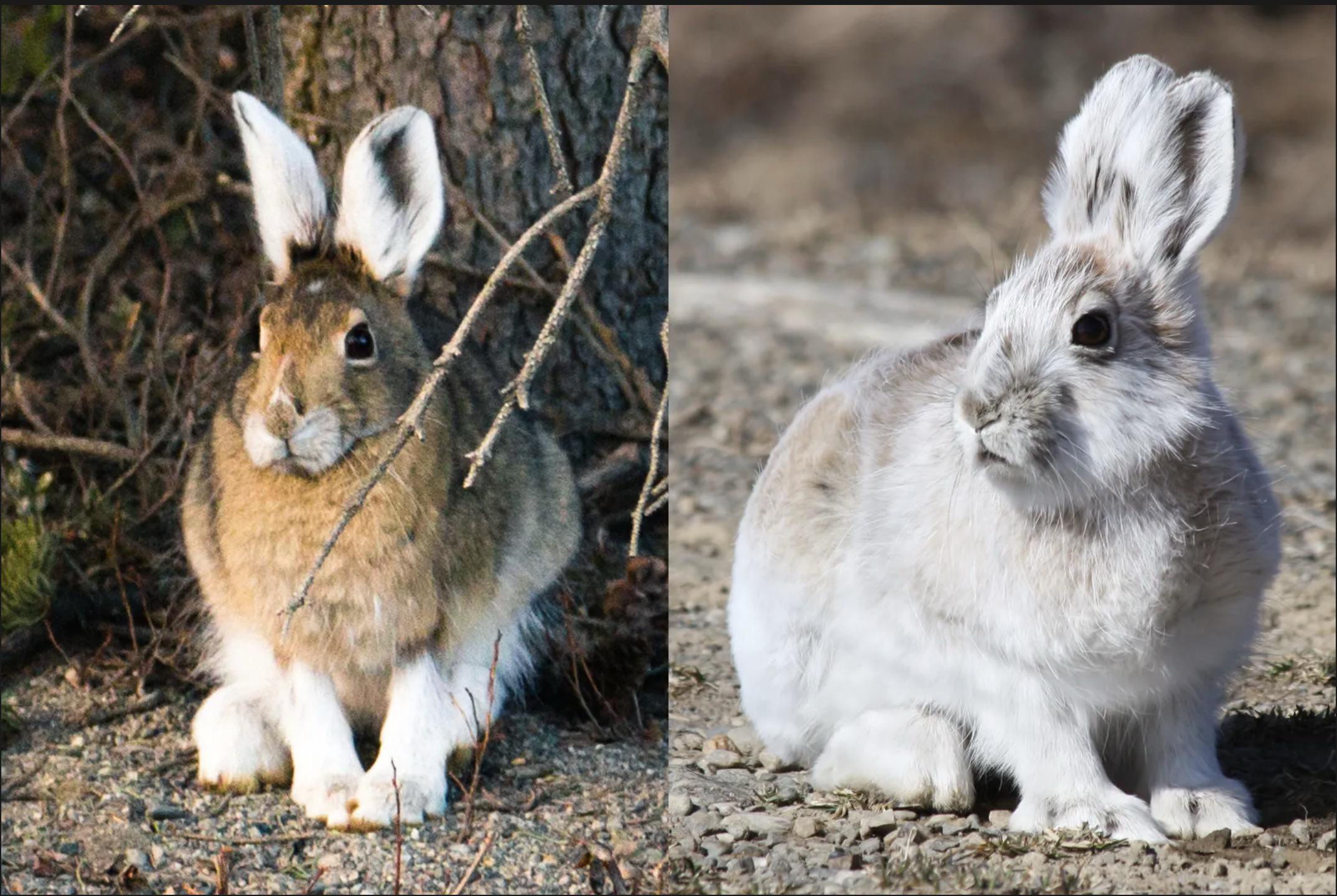
Image Source: Britannica | 7 Animals That Turn White in Winter
Crosses
In AP Biology, monohybrid crosses, dihybrid crosses, and test crosses are very important in mendelian genetics. A punnet square is used to to predict the genotypes and phenotypes of the parents and offspring via probability. There are two relevant laws of probability for mutually exclusive events and independent events in the scope of AP Biology. The first probability rule states “If A and B are mutually exclusive, then: .” The second probability rule states “If A and B are independent, then: .” Memorizing the ratios for these crosses will help save you time during your tests and during the AP Exam. If you find it hard to memorize topics, do not fret, and just use a punnet square. We will define these crosses and list examples (with the punnet squares) below.
Monohybrid Crosses
A monohybrid cross only follows the inheritance of one trait of any genotype. For example, a garden pea can have 2 seed shapes: round () and wrinkled () (see below).
- Round () Round ()
- Genotypic ratio:
- Phenotypic ratio:
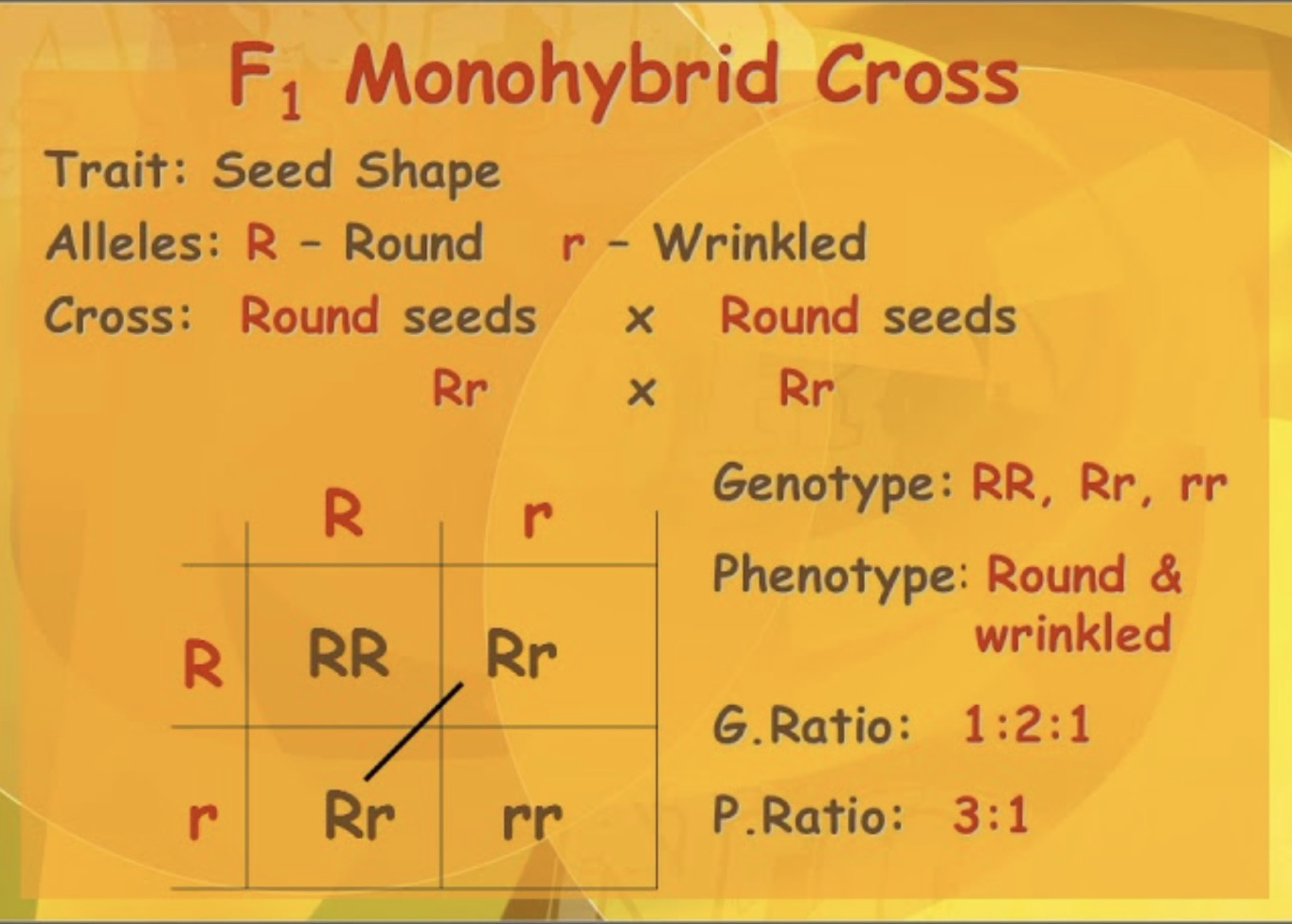
Image Source: Thumbnail from Monohybrid crosses
Dihybrid Crosses
A dihybrid cross follows the inheritance of two traits of any genotype. For example, let’s introduce the color of a garden pea along with the shape of the seed. We categorize this into two different color peas, yellow () and green (). See below for a depiction of the cross. Memorizing the phenotype ratio will probably help you the most.
- Yellow, Round () Yellow, Round ()
- Genotypic ratio:
- Phenotypic ratio: 9 Yellow Round: 3 Green Round: 3 Yellow Wrinkled: 1 Green Wrinkled
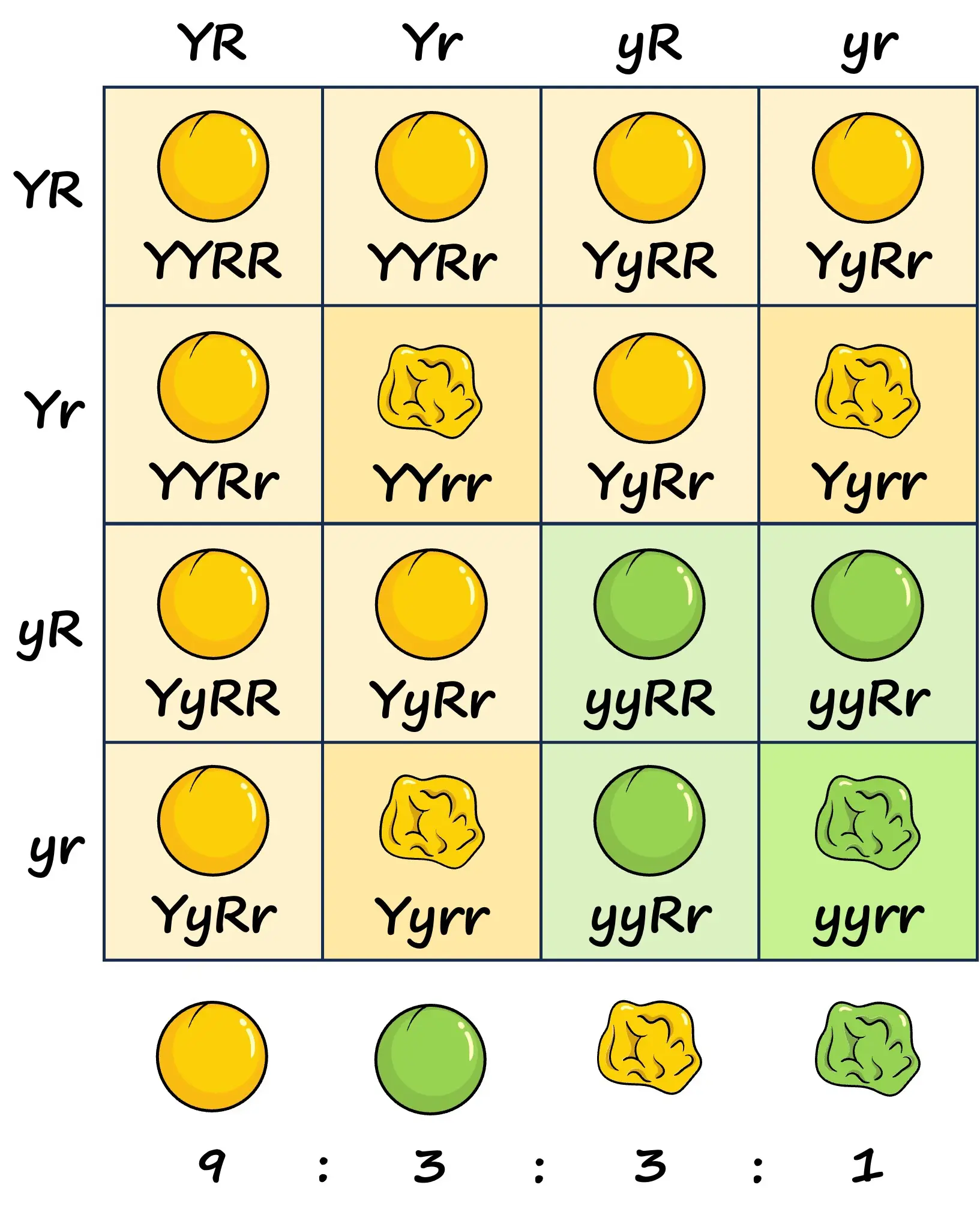
Image Source: BioNinja | Dihybrid Cross
Making a Punnett Square for a dihybrid crosses and crosses with more than 2 alleles will seem difficult and challenging. Fear not however, as there is a strategy you can use to help with any questions like this. For genotypes with 2 alleles or more, instead of doing a dihybrid cross or a trihybrid cross, for example, you can divide each pair of alleles into a monohybrid cross. This is extremely useful when trying to determine the probability of a phenotype or genotype. You can also do the forked line method, which is essentially the same thing but instead of making a Punnett Square, you write down the chances for each genotype. An example is shown below.
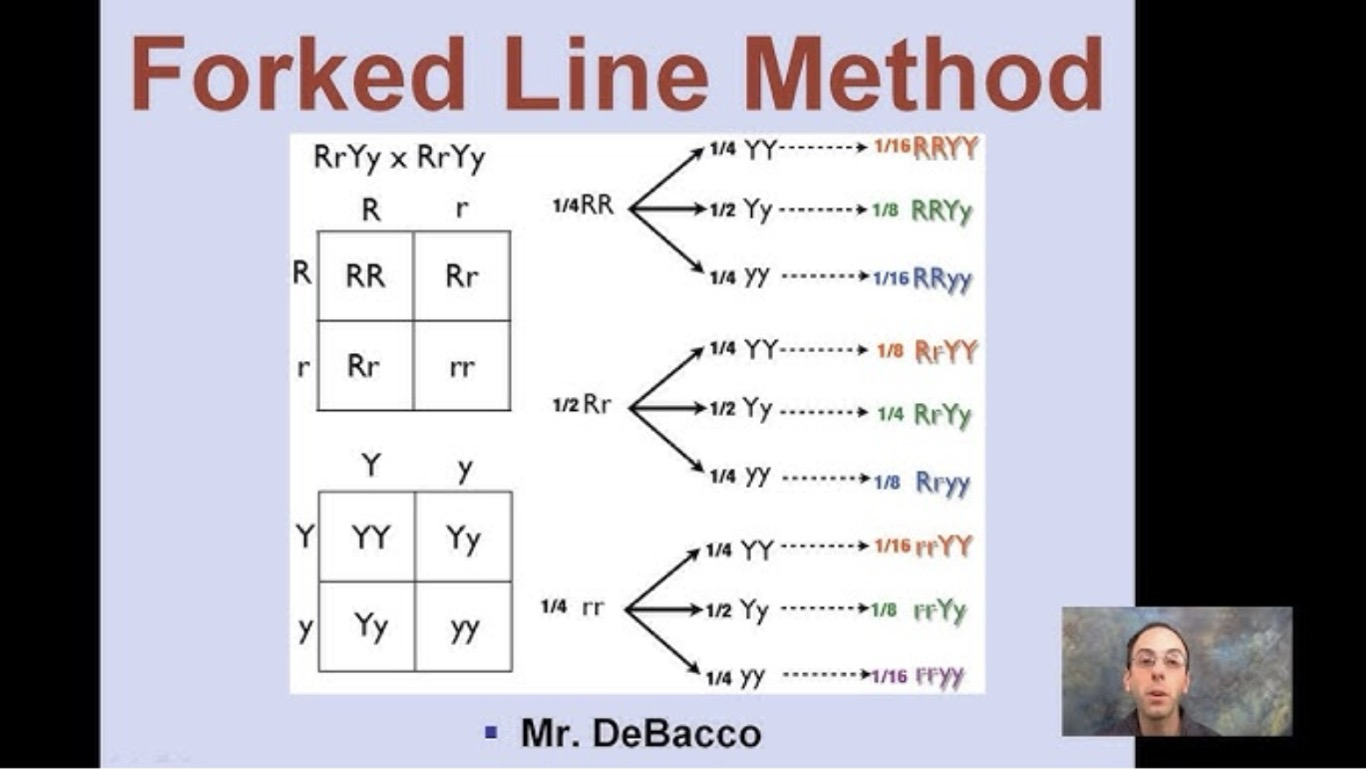
Image Source: Forked Line Method
Test Crosses
A test cross follows the inheritance of a homozygous dominant or heterozygous trait from a genotype with at least one dominant allele (homozygous dominant and heterozygous) with a homozygous recessive genotype). Depending on one of the parental genotypes, we can expect a different genotypic and phenotypic ratio. Continuing with previous examples, let’s use the color of a garden pea along with the shape of the seed. We categorize this into two different color peas, yellow (Y) and green (y)
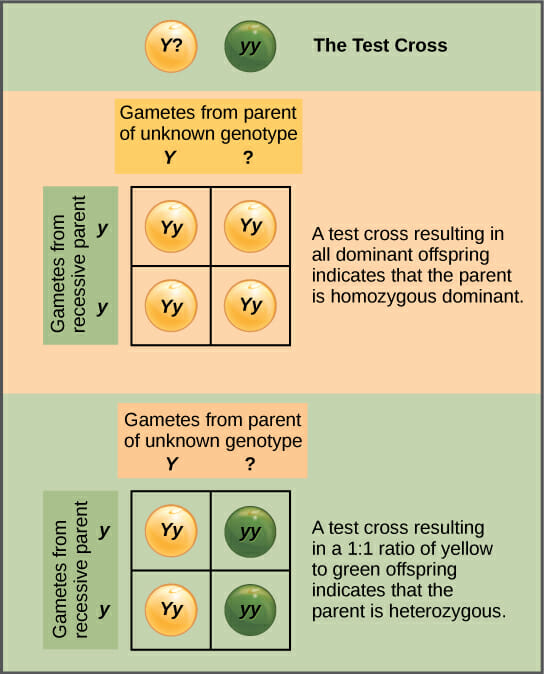
Image Source: Test Cross - Definition and Examples | Biology Dictionary
Thus, if we have a test cross between a homozygous dominant genotype and a homozygous recessive genotype, we can expect
- A genotypic ratio of 1 Yy (100% Yy)
- A phenotypic ratio of 100% yellow
However, if we have a test cross between a heterozygous genotype and a homozygous recessive genotype, we can expect
- A genotypic ratio of 1 Yy: 1 yy
- A phenotypic ratio of 50% yellow and 50% green
Pedigrees: Overview
Pedigrees are partly like a family tree, but instead of mapping a family and its descendants, it maps the traits or genetic diseases passed on throughout a family. We can use pedigrees to determine an inheritance pattern and predict whether an allele is dominant or recessive. We have multiple two general patterns, which are autosomal and sex linked. We have an entire overview for pedigrees that will be essential to understanding them if you encounter a pedigree-related MCQ/FRQ on the exam. (Note as of 06/01/2026: The guide on pedigree-related MCQs/FRQs is currently in progress. It will be made available as soon as it is complete.)
Summary of Vocabulary
-
Mendel’s laws of Inheritance:
- Law of Segregation: Alleles separate during meiosis
- Law of Independence: Different genes, and thus traits, are separated independently
- Genotypes: Genetic Makeup or allele combinations
- Allele: Different versions of the same gene
- Phenotype: Observable characteristics based off genotype
- Phenotypic plasticity: Different phenotype expressed for the same genotype because of the environment
- Punnett squares: Predict genotypes and phenotypes of a parent and its offspring
- Monohybrid Cross: Tracking inheritance of one trait of any genotype
- Dihybrid cross: Tracking inheritance of two traits of any genotype
- Test Cross: Tracking inheritance of a homozygous recessive genotype and a genotype with at least one dominant allele
- Pedigrees: Determinator of inheritance patterns and used to predict whether an allele is dominant or recessive (Note as of 06/01/2026: The guide on pedigree-related MCQs/FRQs is currently in progress. It will be made available as soon as it is complete.)