
Introduction
Hello and welcome to AP Biology Topic 7.10, where we explore deeper into the types of speciation. By the end of this lesson, you should be able to describe ways speciation occurs, explain the pace of speciation, and discuss some types of evolution.
Speciation: Overview
According to the biological species concept, a species is a group of organisms capable of interbreeding and exchanging genetic information to produce viable, fertile offspring.
Speciation is the process by which a new species forms, leading to the diversity of life forms. Speciation occurs when two populations become reproductively isolated from each other, a process that will be covered in more depth later in the article.
Starting off, speciation is a bridge between the concepts of evolution and specifically between microevolution and macroevolution.
Micro and Macroevolution
Microevolution is a change in allele frequencies within a single species or population (natural and sexual selection, genetic drift, gene flow). Pesticide and antibiotic resistance are examples of microevolution. When bacteria are exposed to antibiotics, some bacteria develop resistances to antibiotics. These bacteria are the ones that survive and reproduce, making the larger population stronger as a whole.
Macroevolution is large evolutionary patterns, such as adaptive radiation and mass extinction. An example of macroevolution is the evolution of land mammals into whales that took 10-15 million years. Fossil records show the transition from four-legged land mammals into fully aquatic whales, with them even containing the same pelvic structure of four-legged land mammals today!
But not every species evolves at all times. Stasis is when there’s no evolutionary change over long periods of time.
Speciation: Prezygotic and Postzygotic Barriers
As stated earlier, speciation occurs due to reproductive isolation. The two types of reproductive isolation are prezygotic barriers and postzygotic barriers. Both types maintain isolation and prevent gene flow between the populations
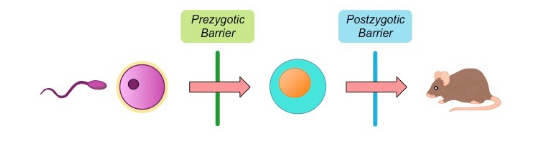
Image Source: Gene Pools and Speciation | BioNinja
Prezygotic barriers (aka mechanisms) prevent mating or hinder fertilization. The five types of prezygotic barriers are habitat isolation, temporal isolation, behavioral isolation, mechanical isolation, and gametic isolation. Take note that all of these are forms of isolation.
Postzygotic barriers (aka mechanisms) prevent a hybrid zygote from developing into a viable, fertile adult. The three types of postzygotic barriers are reduced hybrid viability, reduced hybrid fertility, and hybrid breakdown.
You do not necessarily need to memorize all of these for the AP exam as it’s listed as variable on the AP Biology CED. It may be mentioned, but may not be tested upon as well.
Speciation: Geographic Impact
Another factor that has an impact on speciation is geography. The two modes of speciation based on geography are allopatric and sympatric speciation.
Allopatric speciation occurs when a physical barrier divides a population, or a small population is separated from the main population. In these scenarios, populations are geographically isolated, preventing gene flow. Allopatric speciation is often caused by natural disasters. An example of this is the case of squirrels found on the opposite sides of the Grand Canyon. The two used to be part of the same population, but were divided by the formation of the Grand Canyon. Eventually, the two populations developed different traits due to reproductive isolation caused by the geographic barrier of the canyon, creating two different species.
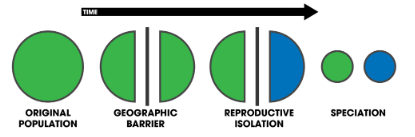
Image Source: Allopatric Speciation (Process diagram) | Wikipedia

On the other hand, sympatric speciation is when a new species evolves while still inhabiting the same geographical region as the ancestral species, occurring without geographic barriers. This is usually due to the exploitation of a new niche through disruptive selection or polyploidy.
As a reminder, disruptive selection is where populations specialize in different resources or niches within the same environment. An example is the apple maggot fly, where subpopulations specialize on either hawthorn or apple trees, leading to divergence.
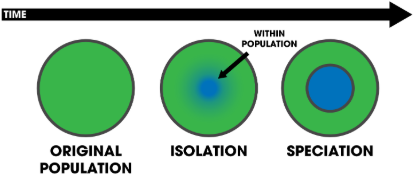
Image Source: Sympatric Speciation | Wikipedia
The key to memorizing the difference between allopatric and sympatric speciation is the presence or lack of presence of a physical geographic barrier.
Pace of Speciation
Evolution and speciation can occur at varying rates due to a range of geological and ecological factors. Gradualism is a process in which evolution occurs slowly over hundreds, thousands, or millions of years. On the other hand, punctuated equilibrium occurs when evolution takes place rapidly after a long period of stasis.
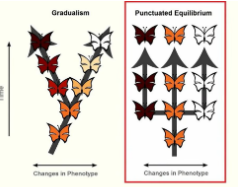
Image Source: Gradualism vs Punctuated Equilibrium: Evolution | ThunderEDUC
Evolution and Speciation
When it comes to evolution, there are various different types.
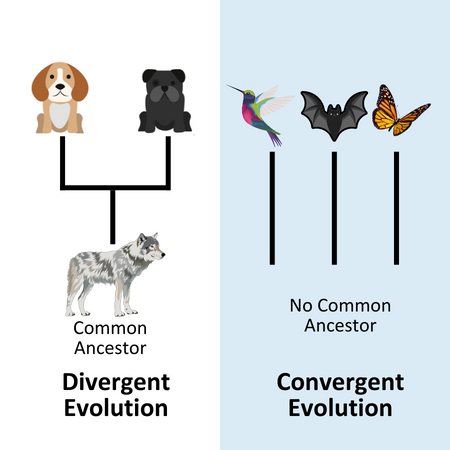
Divergent evolution occurs when groups with a common ancestor evolve and accumulate differences as a result of adapting to their environments, leading to the formation of new species.
Adaptive radiation is a type of divergent evolution that occurs when a new habitat or niche becomes available, allowing a species to diversify rapidly.
Convergent evolution occurs when two different species develop similar traits despite having distinct ancestors, due to similar selective pressures. Revisiting 7.6, these traits are known as analogous traits and typically result from adapting to similar environments.
Speciation Summarized
Speciation is the creation of a new species and it brings the concepts of microevolution and macroevolution. You must also know the prezygotic and postzygotic barriers that result in speciations as well as the different types of speciation, its pace, and types of evolution.