
Introduction
Welcome to AP Biology Topic 8.2: Energy flow through ecosystems. In this article, we’ll discuss the abiotic and biotic factors, energy exchanges, and trophic levels that make up ecosystems.
Ecosystems: Overview
You, a giant anteater, and sand. All three of these have something in common: they all play a role in the ecosystem. The root word eco, meaning habitat, and system, form an ecosystem, composed of all the organisms living in an area and the abiotic factors they interact with.
These organisms, living or dead, are the biotic factors in ecosystems. Humans, plants, and animals are all biotic factors. Things that aren’t living but once were are also considered biotic factors, such as the wood in your pencil and your cotton clothes.
Sand, rocks, and water are all components of the ecosystem too. But how is this possible, since they’re not living and never were? The non-living physical properties of the environment are abiotic factors, and still heavily contribute to ecosystems because of the biotic factors with which it interacts with.
Not all abiotic factors are primarily physical; chemical factors contribute to the ecosystem just as much as physical factors. Sunlight, temperature, and wind, all contribute to and interact with the biotic factors in an ecosystem.
Ecosystems: Energy
Similar to how a car needs fuel to drive, or how you may need coffee in the morning, organisms (including you!) require energy to survive, grow, and reproduce.
In the fitness world, people count their calories each day, relative to how much they burn. Counting the amount of calories is essentially calculating your metabolic rate. An organism's metabolic rate describes the total amount of energy that it uses in a unit of time. With humans, this unit is typically 24 hours.
Humans metabolic rate is heavily influenced by gender, age, height, and weight. Similar to how a larger, highly active adult male in his 30s would burn more calories than a short, moderately active pre-teen girl, and consequently have different caloric intakes, an elephant wouldn’t use the same amount of energy as a hummingbird would relative to mass. This is because metabolism is also relative to mass. A highly-active young person would have a higher metabolic rate than an older, larger person with lower activity because they burn more calories relative to their weight. This is why we consider hummingbirds to have the highest metabolic rate of all warm-blooded creatures, because while they’re relatively small, they exert so much energy into rapidly beating their wings and flying that they burn an immense amount of energy relative to their weight.
Usually, metabolic rate and mass have an inverse relationship, where smaller organisms tend to have higher metabolic rates and vice versa.
Some of this energy is needed to regulate body temperature and stay warm, because your body doesn’t magically stay 98 degrees Fahrenheit in cold weather by itself. Revisiting unit 3, cellular respiration has heat energy as a byproduct, which humans and alike endotherms use to maintain their body temperature. On the other hand, ectotherms such as lizards, snakes, and other reptiles don’t have effective internal body systems to regulate their heat, so they instead regulate their temperature behaviorally by moving into the sun or shade or by aggregating with other individuals.
Think of it like this: If you gain money, it’s either stored or used to buy something, or in other words, grow. If you lose money, your bank account will shrink and eventually become depleted. But instead of money, it’s energy. Organisms that gain energy use it to grow and reproduce, but a net loss of energy will lead to a loss of mass and reproductive output, and eventually, eventual death.
Ecological Levels of Organization
Think of a community as every living thing in a forest—trees, animals, fungi, and more—all interacting with one another. Within that community, a population is defined as a group of organisms of the same species living in the same place at the same time.
For example, in that forest ecosystem, all the deer make up one population, while all the oak trees make up another.
On the other hand, communities are groups of different species that live in the same environment at the same time. In that forest ecosystem, all species living in that area are part of the community, including both deer and oak trees.
These communities and populations live in different biomes, which are areas with unique features that are classified based on the animals and plants that live in them. For example, cacti live in dry biomes such as deserts and polar bears live in colder, wet environments like snowy biomes.
Ecosystems: Trophic Levels
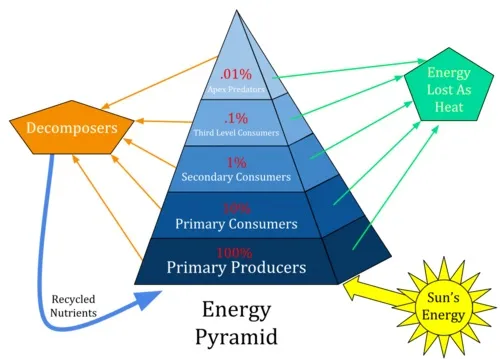
Image Source: Ecological pyramid | Wikipedia
Species are grouped into trophic levels based on how they get their energy. But because energy cannot be recycled in the same way that matter can be, the sun constantly gives energy to ecosystems.
As seen on the diagram, decomposers aren’t on a specific level. Decomposers, as the name suggests, recycle materials from biotic factors such as dead organisms and waste. Decomposers, such as bacteria and fungi, are important in maintaining the health and efficiency of ecosystems as they can improve soil fertility, recycle nutrients, and regulate biogeochemical cycles that we’ll learn about later in 8.2.
At the bottom of the pyramid are primary producers, composed of autotrophs who use the sun to grow and create organic compounds through either photosynthesis or chemosynthesis. While plants make up a significant portion of autotrophs, certain animal organisms, such as algae and cyanobacteria, can use the sun to grow through chemosynthesis.
As stated above, there are two types of autotrophs: photosynthetic and chemosynthetic. Photosynthetic organisms capture energy (using photosynthesis) to help create ATP as discussed in topic 3.4
On the other hand, chemosynthetic organisms capture energy from small inorganic molecules present in their environment, which can occur in the absence of oxygen, unlike photosynthetic organisms that require oxygen to photosynthesize.
Above primary producers are primary consumers, which are herbivores, or animals that get their energy by eating only autotrophic plants, rather than using the sunlight for energy or feeding on other animals. Primary consumers don’t create their own food through energy from the sun, but instead gain their energy from consuming carbon compounds such as carbohydrates, lipids, and proteins that are found in the tissues and cells of plants.
Above primary consumers are secondary consumers, which are carnivores, or animals that eat meat. Specifically, secondary consumers eat herbivores, or sometimes other secondary consumers as well. Secondary consumers don’t create their own food through energy from the sun, but instead gain their energy from consuming carbon compounds such as carbohydrates, lipids, and proteins that are found in the tissues and cells of animals..
By now you may have noticed the pattern: for all trophic levels above primary producers, the organisms on that trophic level gain their energy by consuming organisms from the same trophic level or the one below it.
At the top of the pyramid are tertiary consumers, or as labeled in the image, apex predators who are carnivores that eat other carnivores or sometimes herbivores. Once again, tertiary consumers don’t create their own food through energy from the sun, but instead gain their energy from consuming carbon compounds such as carbohydrates, lipids, and proteins that are found in the tissues and cells of animals.
However, energy can’t be directly reused or recycled. Notice that only about 10% of the available energy actually gets transferred to the next trophic level upon predation. This is because the remaining 90% of energy is used for biological processes such as growth and maintaining homeostasis. This is known as the 10% rule. The primary producers start with 100% of the energy, as seen in the image, and as it moves up a trophic level, it decreases into one tenth of the original percent.
Because these levels are interconnected, the population of one impacts another. For example, if an area experiences less sunlight than usual for an extended period of time, plant growth will decrease, limiting the food supply for primary consumers, reducing the population, and creating a chain reaction.
Ecosystems: Biogeochemical Cycles
Unlike energy, matter is cycled through ecosystems since it’s found in limited amounts. These cycles are biogeochemical cycles, or in other words, matter and nutrient cycles that contain both biotic and abiotic factors. These biogeochemical cycles are interdependent and ultimately demonstrate the principle of conservation of matter.
Carbon Cycle
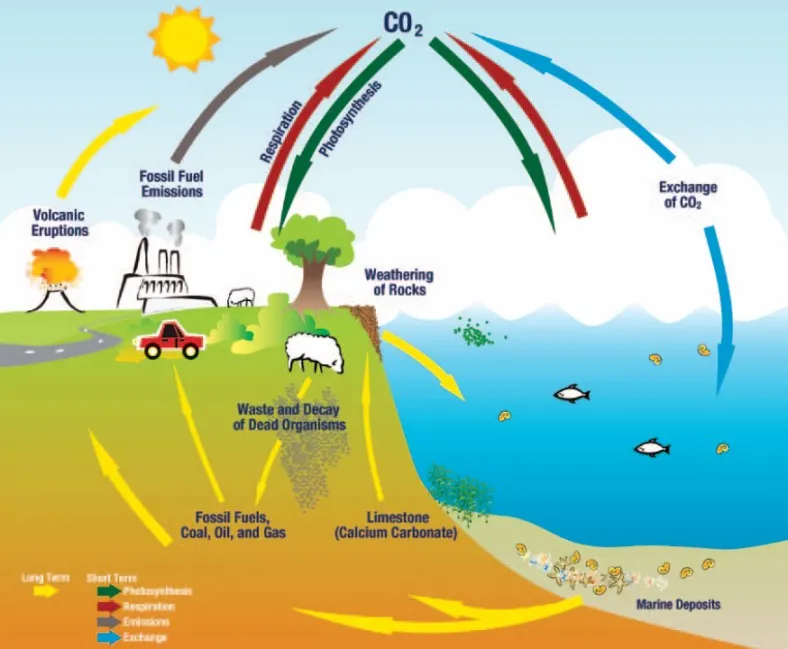
The carbon cycle is essential for life and is required in the formation of organic compounds. The carbon cycle recycles carbon (as the name suggests), balancing the CO2 in our atmosphere, regulating Earth’s temperature, and is one of the key elements to life we learned about in unit 1.
The main components of the carbon cycle are photosynthesis, cellular respiration, decomposition, and combustion.
Photosynthesis: Also known as Carbon Fixation, where it can be split into three main steps. The first step is carbon absorption, which can be described as the “intake step.” In this step, plants take in CO2 from the air/aquatic environments through stomata. The second step is conversion to biomass, which can be described as a conversion from CO2 to carbon. In this second step, plants use the sun’s energy to break down CO2 back into organic carbon molecules to be again used as a building block for new molecules. Finally, the last step is the carbon entering the food chain. When herbivores and other consumers eat these plants, the “fixed” carbons are now absorbed in their stomachs to be again used as a building block. From here, through the biological pyramid described in the previous section, the carbon is passed around.
Cellular Respiration: This does the opposite of Photosynthesis & Carbon Fixation. In Cellular Respiration, organisms create CO2 as a by-product and release it into the atmosphere, keeping CO2 levels constant.
Decomposition: Decomposers also use respiration to break down dead organisms, and release carbon back into the environment after (also known as releasing biomass back into the atmosphere).
Combustion: This is more commonly caused by human involvement. When humans burn hydrocarbons (fuels) like coal, oil, and wood, carbon dioxide is released in mass to the environment, increasing CO2 levels drastically.
Water Cycle
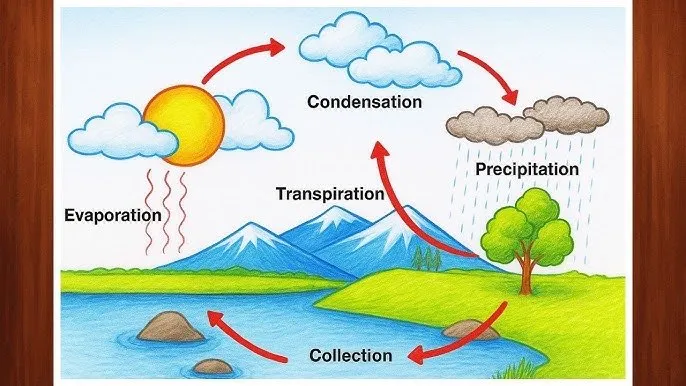
Water is essential for all life and influences the rate of ecosystem processes. Like the carbon cycle, the water cycle helps to regulate the Earth’s temperature. In addition, it regulates climate patterns and cycles our plants' limited quantity of drinkable water while being used to keep humans and agriculture alive.
The main components of the water cycle are evaporation, condensation, precipitation, and transpiration.
Evaporation: This is where heat (from us, the sun, chemicals) heats up liquid water, and creates water vapor (moisture in the air).
Condensation: This is where water vapor condenses into liquid. This may be in the form of clouds in the sky, or the water on the outside of your cold glass of water on a summer day!
Precipitation: After condensation, the water in the air condenses further, and eventually becomes heavy enough to call as precipitation. It might fall as rain, sleet, or even snow!
Transpiration: This is the process where plants absorb water from the soil through their roots and release it as water vapor into the atmosphere through the stomata.
Nitrogen Cycle
Nitrogen is important for the formation of amino acids, proteins, and nucleic acids, as it’s also one of the key elements to life. In addition, the nitrogen cycle enables the recycling of nutrients and improves the quality of agriculture.
Main components: fixation, assimilation, ammonification, nitrification, denitrification
In the nitrogen cycle all of the steps are done by microorganisms, primarily in the soil. Most of the nitrogen can be found in the atmosphere. The most important is nitrogen fixation, where microorganisms fixate nitrogen () into ammonia (), which later ionizes into (), by using the hydrogen found in the soil.
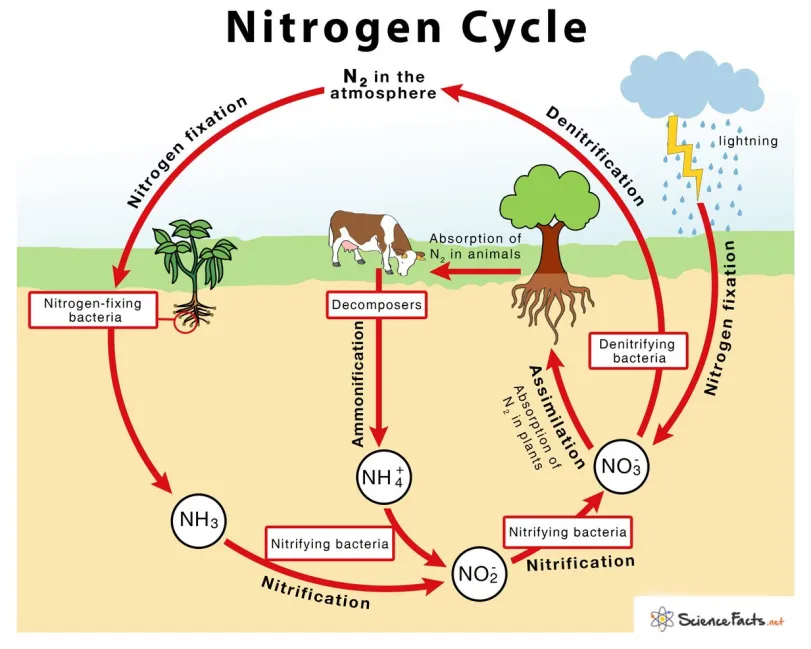
Image Source: Nitrogen Cycle | ScienceFacts.net
Phosphorus cycle
Phosphorus is important for the formation of nucleic acids, phospholipids, and ATP (energy) while also being one of the key elements to life. The phosphorous cycle improves agricultural quality by cycling nutrients and aiding in plant growth.
The phosphorus cycle involves weathering rocks releasing phosphate into soil and groundwater. Producers take in phosphate, which is incorporated into biological molecules; consumers eat producers, transferring phosphate to animals. Phosphorus returns to the soil via decomposition of biomass, or excretion. Phosphate can also be incorporated back into the environment via decomposition of decaying organic matter
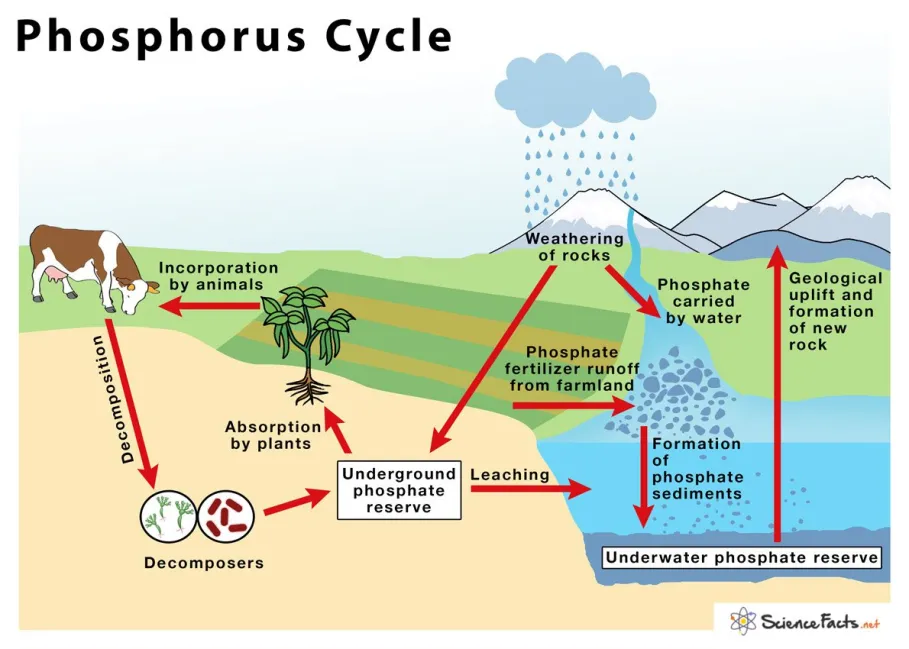
Image Source: ScienceFacts.net | Phosphorus Cycle
Summary
Ecosystems are complex environments that have numerous abiotic and biotic factors with complex interactions. Ecosystems run off energy, of which one's metabolic rate can vary from organism to organism, and this energy is obtained through different ways as we’ve learned through endotherms and ectotherms. These organisms are grouped into trophic levels depending on how they obtain energy, with ectotherms at the bottom and endotherms, specifically tertiary consumers, on the top.