
Introduction
Hello and welcome to Topic 8.3 of AP Biology! In this section, we’ll be covering population ecology, the study of how and why populations change over time. In 8.3, we’ll learn how factors like birth rates, death rates, and environmental conditions influence population size, as well as how scientists model population growth using different equations. Without further ado, let’s get into it!
Populations: Overview
Think of a community as every living thing in a forest—trees, animals, fungi, and more—all interacting with one another. Within that community, a population is just one species living in that area.
For example, in that forest ecosystem, all the deer make up one population, while all the oak trees make up another.
A population is defined as a group of organisms of the same species living in the same place at the same time. When people talk about the population of a country, they’re usually referring to humans only—the same idea here.
Population: Ecology
Now imagine a fire spreading through a forest. Some factors make it spread faster, like dry wood or wind. Others only slow it down, like water or a lack of fuel/oxygen. Populations work in a similar way.
Population ecology is the study of the factors that influence population size and how it changes over time.
Some key factors include:
- Birth rate (how many individuals are born)
- Death rate (how many individuals die)
-
Migration (2 types)
- Immigration (individuals entering a population)
- Emigration (individuals leaving a population)
For example, if a highly contagious disease spreads through a population, the death rate may increase. If deaths outnumber births, the population size will decrease, and vice versa (ignoring migration).
Population: Growth
Scientists measure how populations change using something called the per capita rate of population change. This tells us how fast a population is growing or shrinking per individual.
The standard typical equation is:
- = change in population size over time
- = birth rate
- = death rate
If births are greater than deaths, the population increases.
If deaths are greater than births, the population decreases.
This model assumes that there is no movement in or out of the population as immigration and emigration as if you remember they’re both factors that can also affect growth in a population.
Exponential Growth
Under ideal conditions with plenty of food, space, and no predators—populations can grow extremely fast. This is called exponential growth.
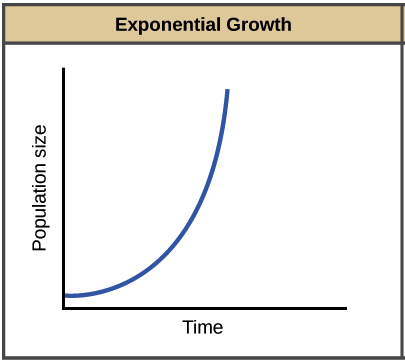
Image Source: Khan Academy | Exponential & Logistic Growth
The exponential growth equation is:
- = maximum per capita growth rate
- = population size
This is calculated through the exponential growth formula, where stands for change in population size, stands for change in time, and stands for max per. capita growth rate of population, and is the population size.
In exponential growth, the larger the population gets, the faster it grows. This creates a J-shaped curve when graphed. However, this type of growth doesn’t last forever. Eventually, resources become limited.
Carrying Capacity & Limited Factors
Carrying capacity is the maximum number of individuals an environment can support long-term. This limit is controlled by limiting factors, which can include:
- Food availability
- Water
- Space
- Predators
- Disease
There are two types of limiting factors:
- Density-dependent factors: Stronger when population density is high (disease, competition, predation)
- Density-independent factors: Affects populations regardless of size (natural disasters, weather)
Real-World Connections
Population ecology helps explain real-world situations like why invasive species spread so quickly and how diseases impact populations. Understanding these patterns allow scientists to make predictions and inform conservation efforts.
Conclusion
Population ecology reveals that population changes aren’t random and instead that they follow predictable patterns based on environmental conditions and biological factors. By understanding concepts like growth models, carrying capacity, and limiting factors, we can better explain how populations survive and interact with their environment.