
Introduction
Welcome to AP Biology Topic 8.4: Effect of Density on Populations. In this section, we will review resource availability and environmental factors that influence changes in population size.
Populations and Limits to Growth
Elevators can only hold a set amount of weight and people before they become cramped, uncomfortable, or even fail to function correctly. The amount of weight an elevator can hold is determined by many factors, such as the material's strength and the elevator's size; the stronger the cable and the larger the elevator, the greater the weight limit.
Like elevators, populations have limits too. While elevators' weight limits are set by strength and size, population limits are determined by the availability of resources. The specific size of the population that available resources can support is a population's carrying capacity.
The more resources available to support a population, the greater its carrying capacity. Once a population exceeds its carrying capacity, available resources won’t be enough to support the entire population, and some individuals will starve and die off. Because population density affects the population's fitness, this is known as density-dependent selection.
In 2017, in Arizona, USA, a wildfire wiped out a significant portion of the rare Arizona squirrels' population. Unlike density-dependent selection factors, this population shift was caused by a natural disaster, unaffected by the population's density, making this density-independent selection. Density-independent selection factors limiting a population’s growth are entirely due to chance, such as a fire, flood, or other natural disaster. These events are sometimes called bottleneck events.
Logistic Growth
In real ecosystems, populations don’t grow infinitely. Instead, they level off due to limited resources. This is called logistic growth.
The logistic growth equation is:
- = change in population size over time
- = maximum per capita growth rate
- = population size
- = carrying capacity
As the population approaches carrying capacity: resources become scarce, growth slows down, and the population stabilises. This creates an S-shaped (sigmoid) curve.
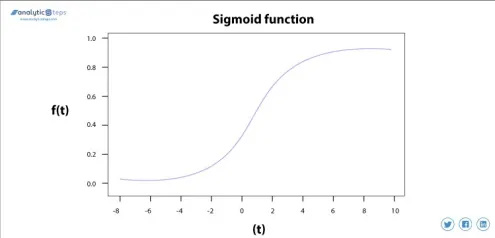
Image Source: Introduction to Logistic Regression - Sigmoid Function, Code Explanation | analyticSteps
Modeling Carrying Capacity: Logistic Growth Model
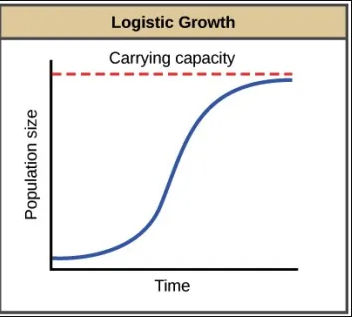
Image Source: Exponential & logistic growth | Khan Academy
The logistic growth model is important when discussing the effects of density on populations.
Logistic growth occurs in populations whose growth is affected by its density. These populations undergo density-dependent selection. We use the logistic growth model to show how populations grow when resources are limited, and it helps model carrying capacity and its relationship with population size.
Using the logistics growth model, we can see that population size will increase exponentially before flattening. The flattening of the curve at the top is due to density-dependent factors, such as food availability, limiting the population size.
Summary
Population dynamics are complex and impacted by several density-dependent and density-independent factors. We use the logistical growth model to visualize and determine carrying capacity.