
Introduction
Welcome to another article about limits, and today we will be learning about our first theorem, the squeeze theorem! This theorem is very useful for us to know whenever we are taking the limit of certain functions, as sometimes there really is no way to solve it with our current knowledge unless we use the squeeze theorem.
Squeeze Theorem
The whole idea of the squeeze theorem is that you’re using functions to sort of “squeeze” the function to a point where there is no other possible value. For the squeeze theorem to work on a function, we need two functions to sort of squeeze in on that one function. For example, let’s say we want to find . Using the squeeze theorem, it might look something like this:
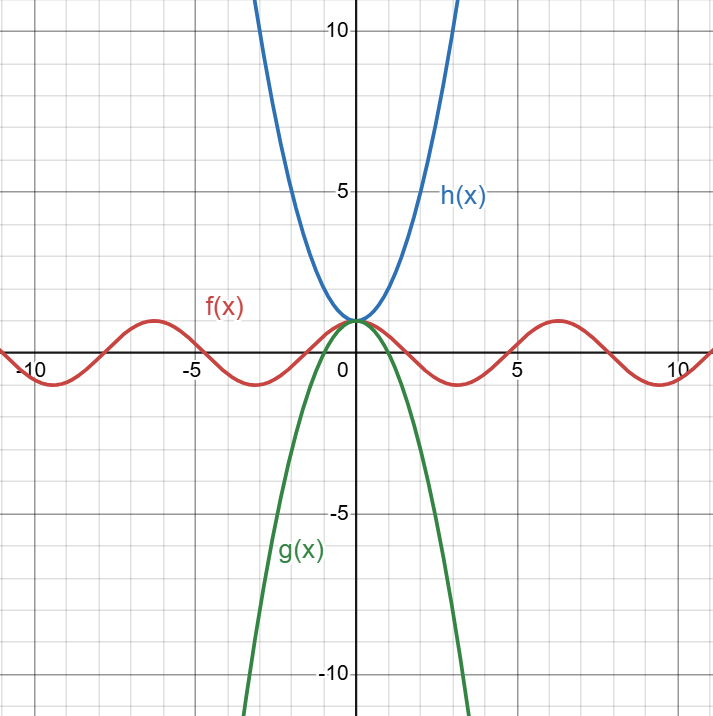
Notice that both functions from the top and bottom squeeze the middle function until there is only one value that the middle function could possibly be, which is . Also, notice that the top function is ALWAYS above or equal to the middle function, and the bottom function is ALWAYS above or equal to the middle function. If we say that is the bottom function, is the top function, and is the middle function, we can say that this must be a condition:
Notice that we aren’t stating this over an interval. This means that this statement must hold up for any value of . If it doesn’t, then it can cause some potential unwanted confusion.
To find the limit, we will have to use the fact that the functions squeeze the middle function into one value. We can say that the limits of and at are going to equal each other according to the graph. This must mean that whatever the limits of and at are, the limit of must be in between the two functions.
Guess what? and are so squished together that there is only one value which could possibly be. So whatever and are, that value is going to equal .
We can now combine our conditions and say the following:
If and then .
This is a very general statement, but it explains it nicely. Let’s try to apply it with the graph at the top.
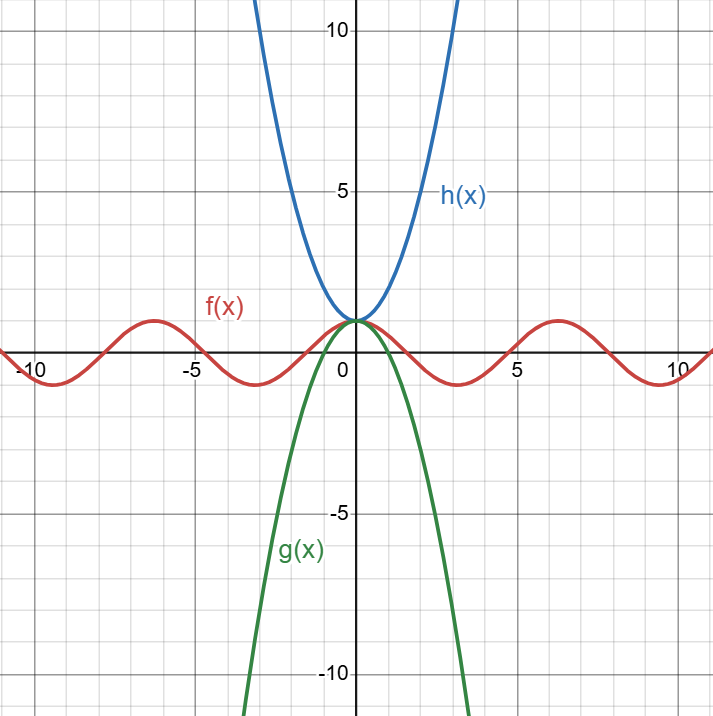
We want to solve for the limit of at . In the theorem, we can say that as is simply a placeholder for the -coordinate we want to evaluate the limit at. simply describes the value of and . If we look at the graph, the value of seems to be , so .
We have now met both conditions, so we can also say that , or in other words, .
Sometimes, we will need to look at graphs, and other times, we will look at actual functions and expressions.
Example 1:
Using the graph below, use the squeeze theorem to calculate
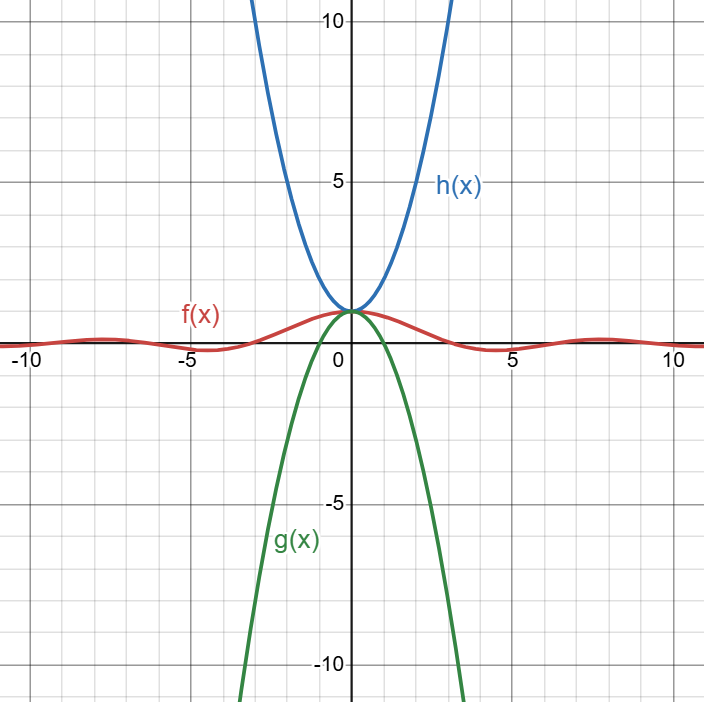
We can use the squeeze theorem and simply list the values:
If and then .
Visually, we can see that everywhere, so this condition is met. , because that is the -coordinate we are evaluating the limit for. As we can see from the graph, both and approach the same value, which is , so this condition is also met. As such, .
Finally, we can say that , or that .
Fun fact is actually , so .
Example 2:
Calculate .
This has nothing to do with the squeeze theorem unless you want to go through some geometry. To solve this, we can use some strategies we learned previously. We can multiply the fraction’s numerator and denominator by its trigonometric conjugate, .
The limit now becomes . Through trigonometric identities, . We can substitute this in to get the following:
We can split this limit into the following:
was the expression we used in Example 1, and its limit at is equal to . The second limit can now be directly evaluated through just substituting the number in.